
Monthly Archives: December 2017

Change and Reputation

Reputation1

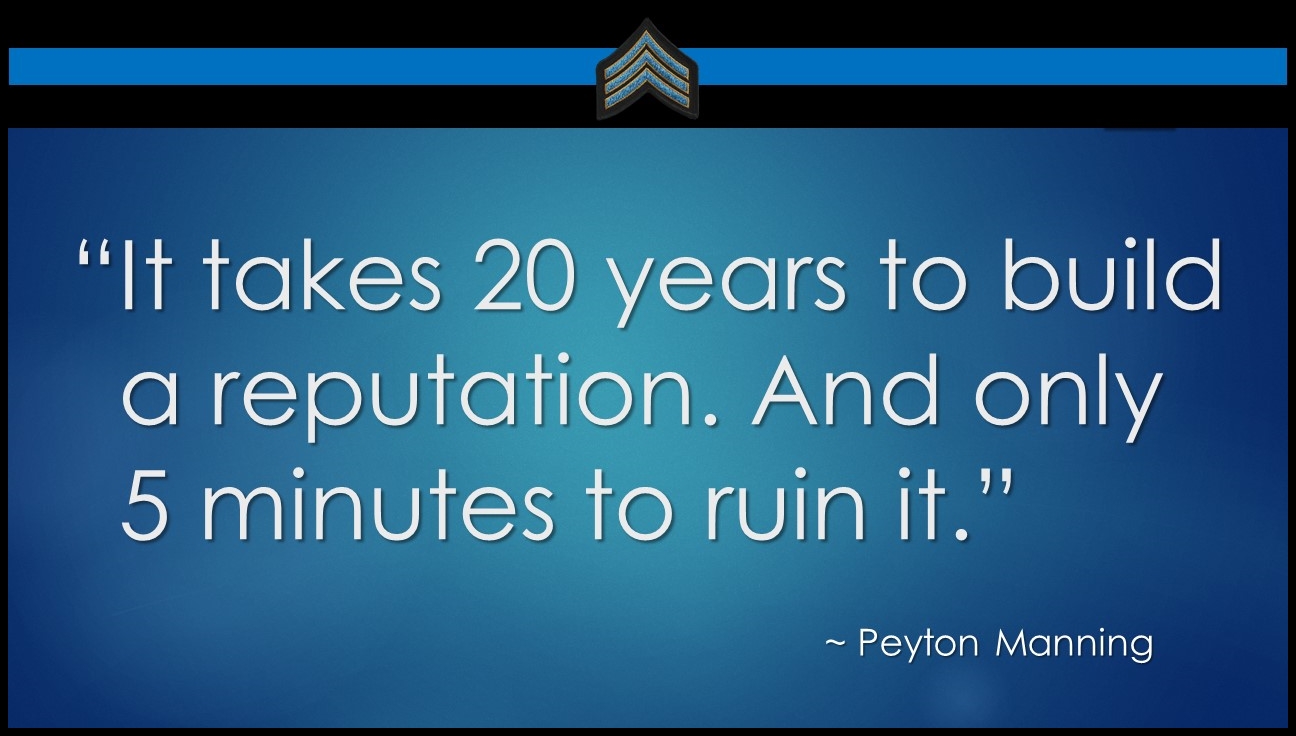
As a police sergeant, I have 2 primary goals regarding the officers on my squad: 1. Keep them safe. 2. Assist them in being successful at reaching their goals. To assist them in being successful with their goals, I find it is necessary to help give them perspective on the “big picture.” In law enforcement, it is easy to get caught up on short-sighted issues that demoralize a squad like staffing, compensation, negative public perceptions, etc. With that being said, I wrote this and read it in one of my recent briefings.

Change and your reputation go hand in hand in any organization, but in a mid-sized police department it is even truer – there is nowhere to hide within a 400 person department. We all know the phenomenal street cop whose career was or is being derailed by their poor reputation/attitude. More times than not, their poor reputation/attitude is related to their inability to deal with change effectively.

Change is inevitable. The only thing that stays constant is that circumstances and situations are always changing. How you deal with change comes down to your own personal responsibility and accountability – What do you expect of yourself? This defines not only your ability to deal with change, but also develops your reputation within the organization. Are you a whiny victim of change or are you someone who can deal and work within the system that is present?

The sooner it is accepted that the system is what it is and will always be slow to respond, the easier it becomes to deal with organizational lapses. Organizations, like people, are inherently flawed – no organization is perfect because they are run by human beings who are made up of attitudes, egos, and emotions. To move beyond the lapses, though, you have to take the long view and not be focused on just the short-term. So, the question becomes, how can you react to change to get the best outcome and solidify a reputation as a positive, forward thinker?

First, when change is approaching, ask this question of yourself, “What can I do?” This is the most direct and proactive response you can have. Sometimes you’ll have the ability to affect change before it is upon you and sometimes you won’t. The key is to remember that working within yourself is the only thing you actually have true control over. By taking initiative and working from the front, you can often help direct change in a more palatable direction.

Reputation2

But, what if there is nothing you can do to directly affect the change that is coming? I answer that question with a quote from Maya Angelou, “If you don’t like something, change it. If you can’t change it, change your attitude.”

If you can’t effect the situation directly, then whining, complaining, or having beat office bitch sessions will do nothing but hurt YOUR reputation. The perceived “problem” will rarely be blamed because it is so ambiguous and comes from “they” levels. You know who “they” are, right? I implore you not to see change as something that is out to get you – it is vital to your career success to be a person who can identify the positives and opportunities that come with change.

There are 3 things you are always in control of when it comes to change – your actions, your attitude, and your effort. The common denominator to all 3 of those is YOU – you are in control and no one can take that away unless you let them. It is all about being proactive, not reactive.

Here are 5 steps to help deal with change in a positive, forward-thinking manner. These steps are adapted from the book Who Moved My Cheese? by Spencer Johnson.

Change Awareness

  1. Accept that change happens.
  2. Anticipate change.
  3. Affect change, if possible.
  4. Adapt to change quickly by adjusting your perspective.
  5. Enjoy change by being in personal control of your response to it.

Ultimately to succeed, not just within an organization, but in life, it is about survival of the fittest – your ability to adapt and overcome to change. Just like responding to a call, the situation is always going to be fluid. How you respond is your choice and builds your reputation either for better or for worse!

The mission at Thin Blue Line of Leadership is to share positive leadership tactics with the field of law enforcement. Positive leadership and creating a positive squad culture are on-going commitments that must be nurtured and developed over time by anyone in a law enforcement leadership position. By discussing topics like this, law enforcement leaders are tending to the welfare of the “whole” officer, not just the one in uniform.

Share your thoughts or comments with us below or on our Facebook page. Continue saving the world one call at a time and as always, LEAD ON!


Don’t Get Captured

“Work hard, have fun, be safe, and don’t get captured.” I end every patrol briefing with those four simple requests. The first three are pretty straightforward. It was the last one that generated snickers from my patrol officers, but that was fine by me; I knew they had heard it. Each briefing for a month and a half ended in the same way, but the snickers slowly faded. I assume they probably thought I was nuts to continue making the same dumb joke every shift. Then, I shared the meaning . . .

A few years ago, I was sitting in my living room watching one of the best television shows ever made, HBO’s The Wire. Jimmy McNulty, played by Dominic West, and the group of characters that had come together to run a wiretap had been disbanded and reassigned back to their old assignments. The scene opens with a Baltimore Police Department lieutenant giving a patrol briefing. At the very end of the briefing, he closes by saying, “Don’t get captured.”

As a patrol officer at the time, I thought that was a pretty funny way to end a briefing. The simplistic meaning I came up with was that it was a comedic way for the writers to get across the danger that exists on a daily basis working patrol in Baltimore. For some inexplicable reason, this phrase stuck with me. I decided, years before promoting, that I would end every briefing I lead with “don’t get captured,” but for very different reasons than the simplistic one I thought of the first time I heard it.

Don’t get captured truly has a much deeper meaning. Think about it, what does it really mean to be captured? Here are my two reasons for ending each briefing this way:

First, to be captured means you or someone leading you has created a situation that is beyond your control; too far behind enemy lines, surrounded. In law enforcement, it is very easy to metaphorically get too far behind those lines. It could be walking into a domestic violence call without backup, trying to break up a fight without recognizing the encircling crowd, or getting pulled into a foot pursuit without knowing what is around the corner. These are all situations that good patrol officers need to learn to recognize and respond to appropriately so they don’t get behind those lines. The same sentiment holds true for law enforcement supervisors that are running emergency traffic and leading officers during the most volatile moments policing has to offer.

Second, to be captured also means that you gave up and stopped fighting. As officers, we all accept the reality that we may have to physically defend ourselves and survive long enough for backup to arrive. If we give up, quit, and stop fighting; then the consequences could be life threatening. Babe Ruth said, “It’s hard to beat a person who never gives up.” Could there be any truer statement than that for the patrol officer that is in a fight for their life?

So, why do I end every patrol briefing by saying, “don’t get captured?” I do this because it serves as a subtle reminder to the men and women I’m leading to always be cautious of what they are heading into and to never give up. Backup is coming . . . just keep fighting.

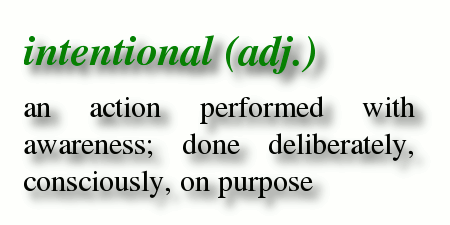
Thank you for reading our blog. The mission at Thin Blue Line of Leadership is to share positive leadership tactics with the field of law enforcement. Positive leadership and creating a positive squad culture are on-going commitments that must be nurtured and developed over time by anyone in a law enforcement leadership position. Development of a positive culture must be intentional; otherwise, who knows what will develop in its place.

Share your thoughts or comments with us below or on our Facebook page. Continue saving the world one call at a time and as always, LEAD ON!
Confusion of Sacrifice

Finding a balance between home and work can be a daunting and difficult task for any profession, but when it comes to being a police officer it takes very purposeful effort to make it work. There is no need to recite statistics on law enforcement officers and divorce rates, we all know where those stand. The fact is that to be as safe and effective as possible on patrol, things at home must be good. A distracted officer is a liability not only to himself, but also his fellow officers. As a law enforcement leader, it is imperative that the topic of striking a healthy balance between home life and patrol life be discussed.

To discuss this topic further, the root of the issue must be unearthed. As a law enforcement supervisor that has been married for nearly 20 years, I believe that the issue begins with a confusion of sacrifice. Every shift, we go out on patrol and put everything on the line for people that we don’t even know. We run towards the sound of shots, we get in the middle of fights, and we work shifts that “normal” people have never considered. That is the sacrifice we chose to make when we took on this job.

The confusion of sacrifice sets in is when we get home and are too tired, too emotionally unavailable, or have too many excuses for the things that need to be done at home and in our marriages to keep them functioning like well-oiled machines. Where’s the guy that ran towards the sound of shots, got in the middle of the fight, or worked a fifth 12 hour shift in a row? Where is the hero that went out and saved the world one call at a time? It is easy to understand how a significant other can become confused by the amount we are willing to sacrifice for work, but then not reciprocate that same level of sacrifice at home.

So, here are three things this can be done to help alleviate this confusion of sacrifice…

  1. Sacrifice a little sleep.

After working the last day of the week, nothing sounds better than a good sleep, but this is one thing that can easily be altered to demonstrate a little sacrifice for the home front. While working these crazy law enforcement shifts, our significant others and children are home living life without our presence. On that first day off, commit to just getting the minimum amount of sleep needed to get onto their schedule. Maximizing the amount of home time is vital to showing purposeful sacrifice at home.

  1. Plan one-on-one time with your significant other.

The amount of time available on a weekend depends on each department’s particular schedule, but during that off time, plan something that can be done one-on-one with your significant other. This does not have to be anything elaborate or expensive; just something that is purposely planned to allow time to talk, discuss the upcoming week, or simply enjoy each other’s company. While an actual date is phenomenal, it can be as simple as a walk around the neighborhood, a game of cards, or uninterrupted time sitting on the front porch. If there are young children and getting a babysitter is a hurdle, get the kids into bed, make or pick up a late dinner, and have an in-home date. Whether big or small, the main point is to do something purposefully each weekend.

  1. Share why being a police officer is important.

One of the biggest misunderstandings about being a police officer is the lack of understanding as to why – Why would anyone want to be a cop? To alleviate confusion of sacrifice in a relationship, it is vital that communication with your significant other is open regarding why working as a police officer is important to you. Share what is enjoyable about the job, the funny things that occur during a shift, something cool that another officer did, or that you were involved in. The more a significant other understands the “why” behind the badge, the less confusion of sacrifice there will be.

The mission at Thin Blue Line of Leadership is to share positive leadership tactics with the field of law enforcement. Positive leadership and creating a positive squad culture are on-going commitments that must be nurtured and developed over time by anyone in a law enforcement leadership position. By discussing topics like this, law enforcement leaders are tending to the welfare of the “whole” officer, not just the one in uniform.

Share your thoughts or comments with us below or on our Facebook page. Continue saving the world one call at a time and as always, LEAD ON!

Intentional Culture

The mission at Thin Blue Line of Leadership is to share positive leadership tactics with the field of law enforcement. Positive leadership and creating a positive squad culture are on-going commitments that must be nurtured and developed over time by anyone in a law enforcement leadership position. Development of a positive culture must be intentional; otherwise, who knows what will develop in its place.

For demonstrative purposes, I am going to discuss culture as it relates to the position of a sergeant with his/her squad, but these concepts are applicable at any level within an organization. When speaking of culture, I am specifically defining it as the prevailing actions and attitudes that a group demonstrates on a consistent basis. Actions and attitudes are the building blocks of culture and both must be guided in a desired direction.

Here are 4 ways to develop an intentional culture . . .

  1. Cultural development begins the minute you assume a leadership position. The minute you walk into your first briefing, you are already beginning to develop the culture of the squad. Were you early, late, or right on time? Officers are watching every step you take and are trying to decipher what you like, what you don’t like, what you expect of them, and what they can get away with. You must know within yourself what direction you want to go or a power vacuum will form. The squad is seeking direction and leadership, either you give it to them or someone else will. There is not a minute to waste.
  2. Your style will teach your officers the culture. To be intentional about your squad’s culture, you must feed them examples of how you picture the culture. This cannot be done from the office. It requires being out on the road with them and demonstrating your style in action so they aren’t having to guess. Contact, communication, and connection between you and your officers is key. While in briefings, encourage your officers to ask “why” so they can better understand your decision-making process. The more they understand, the more the culture will begin to reflect the style you desire.
  3. What you reward will be repeated. You must reward desired actions and attitudes consistently. When you know within yourself the direction you want your squad to go, you will be able to easily recognize behaviors that deserve rewarding. This needs to be done even more blatantly if the desired behavior is a significant change from how things were prior to your being there. Positive reinforcement is a very powerful tool for a leader, but you must be careful in what you reward because that behavior will be repeated. When giving compliments, specifically define what was good. Instead of just saying something like, “Nice job;” specifically define the action or attitude that you observed. For example, “Nice job, I like the way you kept your cool back there when that guy was yelling at us. You didn’t lose your temper and maintained officer safety without lowering yourself to that level.”
  4. What you ignore, you condone. When taking over a leadership role, such as a sergeant starting with a new squad, there are always going to be things you see that you don’t necessarily agree with and differ from your desired culture. It is incumbent of you to not ignore them. Ultimately, what you don’t address will be assumed to be acceptable. On the flip-side, you must also be careful not to just bark orders about how you want things done or you’ll very quickly take on the persona of a micromanager. To make your redirections acceptable, you must define why it is important to you and why it should be important to that officer.

Before your can have any effect on the culture of a squad, you have to know what the culture is that you would like to have. If you cannot picture in your head what the perfect squad culture would look like, then how can you lead other people in that direction? Take the time to write out your thoughts and think about what has or has not worked in your previous assignments. What qualities made up the best squad/unit you have been a part of? This is your squad’s culture, be intentional about it!

What do you do at you department to be intentional about culture?

Share your thoughts or comments with us below or on our Facebook page. Continue saving the world one call at a time and as always, LEAD ON!