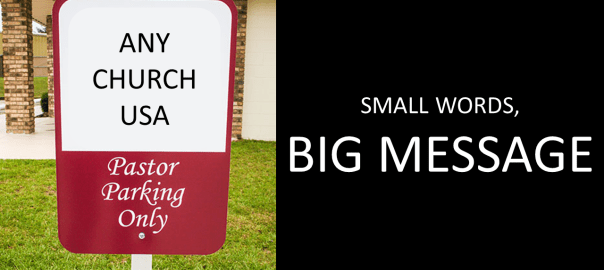
Yesterday morning, I went out for my typical run before the blazing Arizona sun made it unbearable. After a year or so of consistent running, I have finally gotten to the point that I can actually think while I’m running hard. So, when I veered off my regular route to break routine, I ran by a church that I normally would never see and noticed a sign similar to the one pictured above. That sign definitely got me thinking throughout the rest of my run and even into the next morning which is why I am writing this.
The sign is placed directly in front of the main doors of the sanctuary. It is at the head of the closest parking stall in a rather large parking lot. This parking spot was even closer to the church entrance than 5 handicapped stalls and the sign that said “Pastor’s Wife Parking…
Who are you as a leader? How do you know if the decisions you are making are meeting your personal expectations? Do you take the time to weigh your actions, attitudes, and effort against a personal mission and set of core values? Have you taken the time to define your own mission and core values? How do you know if you are staying on path?
The other day, I was instructing a class on Leadership Accountability to a group of 20 officers, sergeants, and civilian staff that are currently in my department’s leadership development program. On the whiteboard, I put up the following quote to generate discussion…
We began discussing the importance of a leader controlling their actions, attitude, and effort when looking for solutions to challenging leadership dilemmas. Then one of the officers asked the following question, “I get that the leader must adjust their sails to control what…
A little over a week ago, an affluent shopping mall in the City where I work was overrun by looters and rioters using the peaceful George Floyd Protests as a smoke screen for their lawless activities. I was off that night, but was called in the next evening to supervise a Rapid Response Squad to handle additional threats that were being posted over social media for other parts of the City.
I spoke that night with some of the newer officers, mostly with less than two years on, about what they had experienced. As they spoke, their eyes would open wide and they all said they had never seen or expected to be in the middle of anything like that – even as a police officers. There was fear behind those eyes and at the same time a twinge of anger for having been made to feel that fear. It was in that moment that I became truly worried about how things would play out if another similar incident took place and these officers had to respond. Are they professional? YES. Are they well trained? YES. Is fear an incredibly destructive force to professionalism and training? YES!
The next day I was home for a few hours before needing to return to work as the police department was being mobilized in a way that I had never seen before. While working on some things in my home office, I opened a drawer and found a plastic bag full of almost 200 smile buttons that one of my daughters had given to me. They were leftover from a school project she had done a little over a year ago and she had given them to me assuming I would find a use for them someday. I immediately took them out and put them in my duffel bag to take to work. I did not know how they would be used, but in these unprecedented times I knew that they may be useful because as human beings a legitimate smile goes a long way and when I saw these in the drawer, they made me smile.
As part of my duties with the Training Unit, I have been studying Mirror Neurons and their affect on communication. These are the neurons in our brains that are responsible for helping with empathy, understanding context, imitation learning, and more. They also are the same neurons that fire off positive feelings when we observe someone do something nice for another person. Yes, just watching another person buy someone a coffee or pick up some items they dropped on the floor gives third party observers a little jolt of positive feelings. This is the internal mechanism that tries to connect us as human beings and positively support our further existence through helping one another. Mirror Neurons are also the reason when some looks at you and gives you a genuine smile you cannot help but to smile back – they are connection builders.
Fast forward a week to present day. The department has been mobilized and some officers are going on working straight 10 days with at least another four to go. Tension is high, nerves are fraying, and we are in a state of constant concern that the looters and rioters will return based upon continuing social media posts threatening to do so.
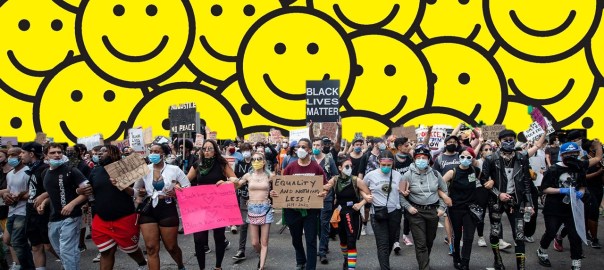
Then we get word of a planned protest for Sunday in our City with an expected turnout of approximately 1500 people. When the Ops Plan came out, I scrolled through to see what my assignment would be. I found that myself and my fellow Training Unit supervisor were assigned to be parking lot security for the three main parking lots being provided for the arriving protesters. It was in this moment that I immediately knew how we could use the smile buttons that I was still carrying around with me.
My uniform shirt.
As myself and my fellow sergeant arrived at the all supervisors meeting, we both attached yellow smile buttons to the pockets of our uniform shirts. While at the meeting there were a couple of eye rolls and snickers, but there were also more than a few smiles with comments back that they liked the buttons. Some even asked for their own. The tension in the meeting was thick and it was clear that assisting this protest to go off peacefully was the goal of the day.
While driving from the meeting to our designated parking lot security spot, we started discussing our role for the day. We came to the conclusion that to be “standoff-ish tactical security” was not the way we wanted our first interactions with the arriving protesters to be. For lack of a better term, we decided to become the “Wal-Mart Greeters” of the protest. Our role was going to be to say “Hi” to everyone we see, explain why we were there, and offer them a smile button as a sign of peace and solidarity with the message they were there to share. The Message . . . Bad cops make the job of every good cop that much more dangerous and give the entire profession a black eye. We wanted them to know that we agreed.
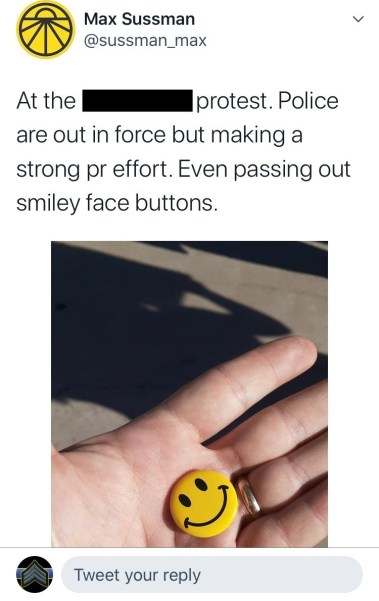
We began approaching arriving protesters as they were filtering from their vehicles to the staging area to await the start of the march. Everyone was greeted with the biggest smiles we could give them (without looking too awkward, I hope) and then we would ask if they would like a smile button as a sign of solidarity and hope for a peaceful protest. Unlike the tweet below states, this was not a PR effort on behalf of the department, it was just two cops trying to build connections.
Tweet from a protester.
The responses were overwhelmingly positive. It was amazing how a smile button could break the tension of the moment and tear down the barriers to allow positive communication to happen. People gave us handshakes, returned smiles, thanked us for being there, asked questions, and immediately put on the buttons. Multiple people explained to us that they support our specific police department, but were there to support the bigger message across the nation and we shared our agreement. The immediate connections that occurred in those brief encounters were undeniable. This was quite honestly one of the coolest moments of my entire policing career and I will never forget it.
The protest march lasted for nearly two and a half hours and could not have run any smoother. As they were leaving the area, my partner and I got about our duties of traffic control and assisting pedestrians across the street, it was awesome to see people still wearing the smile buttons. Even the ones that did not have a button had a real smile on because they felt like they had been able to voice their concerns about law enforcement and been heard. We made sure to smile back and ask how the march was activating those amazing little mirror neurons and building even more connections.
It is not going to be huge sweeping changes or reforms to the law enforcement profession that are going to make the difference. It is going to be continuous small acts of positivity and discussion that officers do every day to build positive connections that will make the difference.
I challenge other officers to break through the fear that may come from these challenging and changing times and find ways to build positive connections. Get a smile button, put it on your uniform, and then have a few extra in your pocket to share with someone to start a discussion. Even if they do not stop to talk, I guarantee they will at least smile at the attempt. Smile buttons can be found here….AMAZON LINK.
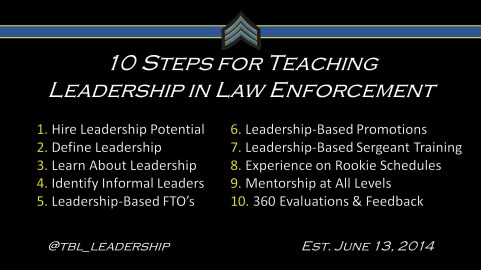
This is Part 2 of 10 Steps for Teaching Leadership in Law Enforcement. To read Part 1, click here.
Leadership-Based Promotional Processes
When it comes to promoting higher in rank, every department seems to have their own unique process; usually some combination of written tests, assessment centers, oral boards, etc. Most of these evaluation tools focus more on the managerial qualities of rank rather than leadership qualities. In order to promote the continual learning of leadership, promotional processes must be based upon leadership demonstrated in the past, present, and most likely into the future. That is what a leadership-based promotional process must be based upon; the prediction of continued leadership into the future. I will not attempt to give a generic process that a law enforcement agency should duplicate, but I will try to make a few points that any agency could focus their process upon in their…
“The rank of office is not what makes someone a leader. Leadership is the choice to serve others with or without any formal rank. There are people with authority who are not leaders and there are people at the bottom rungs of an organization who most certainly are leaders. It’s okay for leaders to enjoy all the perks afforded them. However, they must be willing to give up those perks when it matters.”
~ Excerpt from Leaders Eat Last by Simon Sinek
A couple of weeks ago, I received a direct message on Twitter that asked the following: “I was in the military and have been a police officer for 10 years. I would love to hear how you teach leadership. I’m not trying to be a doubter, but I work for some non-leading people who don’t know or understand leadership or how to lead.”
As a law enforcement supervisor, have you ever tried to explain to someone what good policing is? Sometimes putting things into words can be an extremely difficult task. If you are like me, the first hundred times you try to answer this question you find yourself jetting off into all these tangents about handling calls, traffic enforcement, conducting thorough investigations, making big busts, taking down the “really bad guys,” and somewhere in there working with the community. By the time you get done it feels like you just named off a bunch of different tasks and never really answered the question – What is good policing?
One night, I was driving in for my overnight shift listening to the “EntreLeadership” podcast and they were interviewing a gentleman named Mick Ebeling. What really struck me was when Mr. Ebeling began talking about transactional and relational marketing as it relates to his…
Whether you are a brand new law enforcement leader or one that has been around awhile, you must recognize the importance of developing a squad culture. If a squad culture is not developed intentionally, then the leader will be putting him or herself at the mercy of whatever fills that culture vacuum. So, the question becomes, how do you intentionally develop a squad culture?
Before getting into the nuts and bolts of developing a squad culture, there are two things that must be understood. The first thing to understand before developing a squad culture is the definition of culture. The culture of a group can be defined as the conglomeration of a group’s actions and attitudes over time; it’s atmosphere. The second thing to understand in developing a squad culture is that it doesn’t happen in a day, it has to happen every day. It must be taught, explained, reinforced, and…
Why does the general public like the fire department better than the police department? The simple answer is this, the fire department is better at creating positive “wow” moments – saving lives, putting out fires, and of course getting cats out of trees. Sure, as law enforcement, we have our positive moments too, but we also have the disadvantage of having to hold people accountable for their unlawful actions by making traffic stops, writing tickets, placing people under arrest, and occasionally using force.
It would seem that law enforcement is stuck between the proverbial rock and a hard place. Therefore, it becomes imperative of law enforcement leaders to support, recognize, reward, and promote their officers when they have the opportunity to take initiative and create positive “wow” moments for those they serve.
I would like to share a story that occurred a couple of weeks ago which represents the concept of creating…
Jim Collins starts his book, “Good to Great,” with this simple quote: “Good is the enemy of great.” That quote struck me like a lightning bolt because, all too often, law enforcement gets stuck in the rut of thinking that good is a fine place to be. How often have you heard the phrase, “Good enough for government work” thrown around the department? We, as first-line supervisors, preach to our officers about avoiding complacency, but if we allow our squads to just be good then aren’t we exemplifying complacency in our leadership?
Whenever I read a book of this type, I am always thinking about how I can apply it in my role as a sergeant of eight officers that are within my span of influence. So, I decided that I would write this blog to share my thoughts on the major concepts described in “Good to Great” and how…
The mission at Thin Blue Line of Leadership is to simply inspire law enforcement leaders to be better than they were yesterday. Sharing positive leadership tactics and creating a positive law enforcement culture are on-going commitments that must be nurtured and developed over time by anyone in a law enforcement leadership position.
The ideas below are simple, but not easy. They take both effort and time. These are all things that are within your control by making the most of your actions, your attitude, and your effort as a leader. Current research is showing that it is not about the big grandiose gestures, but the consistent small actions that those you are leading come to trust about you.
Here are 10 Law Enforcement Leadership Commandments . . .
Emphasize good culture over rules. Good culture within the organization or squad will take care of the rules. Be intentional about what…



 The next day I was home for a few hours before needing to return to work as the police department was being mobilized in a way that I had never seen before. While working on some things in my home office, I opened a drawer and found a plastic bag full of almost 200 smile buttons that one of my daughters had given to me. They were leftover from a school project she had done a little over a year ago and she had given them to me assuming I would find a use for them someday. I immediately took them out and put them in my duffel bag to take to work. I did not know how they would be used, but in these unprecedented times I knew that they may be useful because as human beings a legitimate smile goes a long way and when I saw these in the drawer, they made me smile.



 Thin Blue Line of Leadership