Category Archives: Leadership

The Mission, Vision, Core Values Project

The Mission, Vision, and Core Values of my police department have been out-of-date, full of clichés, and completely unused for years. In their 20+ years of existence, they have become posters on the wall that we walk by every day, but serve no purpose other than to go on the department webpage and in the annual report.

So, I decided to submit the following project suggestion through my chain of command up to the Chief of Police. AND GUESS WHAT . . . He agreed, loved it, and has approved it to move forward as soon as possible.

I am currently in the process of carrying out the below plan, so I thought I would share it with all of those that read the Thin Blue Line of Leadership Blog. Enjoy and let me know if you have any thoughts or questions.

MISSION, VISION, CORE VALUES PROJECT

PURPOSE: The purpose of this project is to create a new mission, vision, and set of core values for the XXXXXXX Police Department by utilizing a collaborative process involving the entire organization. The goal is to create discussion, build buy-in, and generate acceptance of our new mission, vision, and set of core values.

PROCESS: To accomplish this project, it will be spread out over a four-month period. Each unit, both sworn and professional staff, will view an introductory video on the definition, purpose, and value of a good mission, vision, and set of core values. Each month following, they will receive a more specific video to discuss, within their group, the given topic and submit their unit’s suggestion for what our department’s mission, vision, or set of core values should be. The Training Section will receive each unit’s submission and filter them down. Those will then be presented to Chief XXXXXXX for approval. The ones that obtain the Chief’s approval will be put out to vote by units to the entire department.

MONTH #1 – INTRODUCTION TO THE MISSION, VISION, AND CORE VALUES PROJECT

  • Define mission, vision, and core values and why they are important to an organization.
  • Where we learned/failed with our current mission, vision, and core values.
  • Discuss Peel’s 9 Law Enforcement Principles and their application to current policing.
  • Discuss the following questions to start the conversations within the units.
    • What is policing?
    • What is good policing?
    • Why do we police?
    • How do we police?
    • Who do we serve?
    • How could we serve them better?

MONTH #2 – CORE VALUES

  • Define core values and why they are important to an organization.
    • Identifies the fundamental beliefs of the organization.
    • These beliefs dictate how we treat those we serve, those we work with, and how we solve problems.
    • Core values require a commitment to living and working them.
  • Examples of corporate and law enforcement core values.
  • What should our core values be? (3 to 4 only)
    • Unit discussion and core value development.
    • Submit core value suggestions to Training Section.
    • Training section filters.
    • Chief approves of finalists.
    • Units vote to choose our core values.

MONTH #3 – MISSION STATEMENT

  • Define a mission statement and why it is important to an organization.
  • A mission statement defines…
    • What we do – our purpose?
    • What problem are we trying to solve for the greater good?
    • What we get out of doing what we do properly – the value?
    • How we do it? (This ties back into our core values.)
  • Examples of corporate and law enforcement mission statements.
  • What should our mission statement be?
    • Unit discussion and mission statement development.
    • Submit mission statement suggestions to Training Section.
    • Training section filters.
    • Chief approves of finalists.
    • Units vote to choose our mission statement.

MONTH #4 – VISION STATEMENT

  • Define a vision statement and why it is important to an organization.
  • A vision statement defines…
    • Why we do what we do? Why do we police?
    • What is the result of a future where we are meeting our core values?
    • What is the result of a future where we are meeting our mission statement?
  • Examples of corporate and law enforcement vision statements.
  • What should our vision statement be?
    • Unit discussion and mission statement development.
    • Submit mission statement suggestions to Training Section.
    • Training section filters.
    • Chief approves of finalists.
    • Units vote to choose our vision statement.

ROLLOUT OUR DEPARTMENT’S NEW MISSION, VISION, AND CORE VALUES.

Once this project is completed, I will be creating and instructing training to our Field Training Officers, Sergeants, and other supervisors on how to best utilize our new mission, vision, and core values and get the most out of them.

The mission at Thin Blue Line of Leadership is to inspire law enforcement leaders to be better than they were yesterday. Positive leadership and creating a positive squad culture are on-going commitments that must be nurtured and developed over time. By discussing topics like this, law enforcement leaders are tending to the welfare of the “whole” officer, not just the one in uniform.

Share your thoughts or comments with us below or on our Facebook page. Continue saving the world one call at a time and as always, LEAD ON!

Nextgen Field Training – The Phases

There are two foundational principles of the Nextgen Field Training Model that are addressed by the way in which the phases are established:

  • Create a field training model with a clear distinction between training and evaluation.
  • Build both training and evaluation phases in a manner consistent with the crawl-walk-run experiential learning format.

PHASES OF THE NEXTGEN FIELD TRAINING MODEL:

  • Phase 1 – Foundational Training                                
  • Phase 2 – Exposure Training                                                       
  • Phase 3 – Cleanup Training                                                          
  • Phase 4 – Evaluation (Previous FTO)                                       
  • Phase 5 – Evaluation (Independent FTO)               
  • Solo Phase – Evaluation (Assigned Supervisor)                   

KEY CONCEPTS OF TRAINING PHASES 1, 2, and 3:

  • Primary goal is for FTOs to train the OIT as a TEAM in preparation for the evaluation phases and solo capability.
  • No scoring on Observation Reports (OR). This establishes the concept that learner effort and being willing to jump in, try something, and risk making mistakes is more valuable than learner correctness.
  • Phases 1, 2, and 3 are set up in the crawl, walk, run experiential learning format.
    • As exposure to tasks increases, the role of the OIT transitions.
      •  Learning -> Trying -> Doing.
    • As exposure to tasks increases, the role of the FTO transitions.
      • FTO -> Coach -> Mentor.
    • As the OIT transitions through the learning phases, the reliance upon the FTO should lessen and the OIT will be expected to utilize other resources available to them to answer questions in preparation for the Evaluation Phases.
  • Proficiency Training Tasks are not assigned to specific training phases in order to stimulate interleaving, effortful retrieval, and spacing in OIT learning.
    • The Phase 1 Trainer is the Foundational Trainer. The goal of the Phase 1 FTO is to establish the OIT’s foundational knowledge/skills and then begin increasing their exposure to patrol experiences.
    • The Phase 2 Trainer is the Exposure Trainer. The goal of the Phase 2 FTO is to expose the OIT to as many patrol experiences as possible. Repeated exposure, especially to infrequent CFS, is encouraged and beneficial to the OIT’s learning. Take the experiential learning opportunities as they present themselves.
    • The Phase 3 Trainer is the Cleanup Trainer. The Phase 3 FTO focuses on getting exposure to CFS that Phase 1 and 2 were unable to get and/or provide additional repeated exposures.
    • All Proficiency Tasks must be signed off before the OIT can move to Evaluation Phase 4.
  • Phase 3 may be eliminated for lateral or waiver officers to accelerate their field training, but they will still be expected to demonstrate proficiency on all Proficiency Tasks during evaluation.

KEY CONCEPTS OF EVALUATION PHASES 4 and 5:

  • Primary goal is to EVALUATE the OIT’s ability to perform at a solo capable level.
  • Since this is an Evaluation Phase, observation reports are scored in comparison to the Standard Evaluation Guidelines definition of a solo capable officer.
  • All Proficiency Tasks are signed off and show OIT has had training and experience in these areas.
  • Scoring observation reports only in the Evaluation Phases helps to remove scoring inconsistencies since the FTOs are only scoring officers that have received ALL of the pre-requisite training and should be solo capable.
  • OIT is acting as a solo capable officer with the FTO there primarily as an evaluator. FTO evaluators will still provide training on infrequent tasks the OIT comes across during these phases. Scoring will reflect this appropriately.
  • Phase 4 Evaluator will be the same FTO, when available, the OIT had while on Phase 1. If the Phase 1 FTO is unavailable, then Phase 2 FTO will be the next choice for Phase 4.
    • This provides a bridge into the evaluation process for the OIT. (Crawl)
    • The OIT starts their evaluation process with a familiar FTO, squad, and district.
  • Phase 5 Evaluator will be an independent FTO that has not worked directly with the OIT.
    • This is to build the OIT’s self-reliance to assist in their success when they are solo.
    • The independent evaluator also limits potential biases in the OIT’s success or failure.
  • At the end of Phase 4 or 5, if an evaluator feels the OIT has not had enough exposures to be able to comfortably decide on the OIT moving forward, they may request an extension. This does not negatively impact the OIT and provides additional time for the OIT to demonstrate solo capability.
  • At the end of Phase 4 and 5, if an evaluator feels the OIT is not solo capable, they can initiate a Performance Training Plan to work on those specific issue(s).
    • If a Performance Training Plan is initiated, that Evaluation Phase will not count and the OIT will still need to pass 2 Evaluation Phases before moving on to the Solo Phase.
    • OITs will only be given one Performance Training Plan after they reach the Evaluation Phase.
  • Interpretation of Evaluation Phase Results
    • Both Evaluators Pass OIT. -> OIT moves to Solo Phase on assigned patrol squad.
    • Evaluator’s Disagree on Passing OIT. -> OIT receives a Performance Training Plan to address Evaluator’s specific concerns and then must pass another Evaluation Phase.
    • Both Evaluators Fail OIT. -> OIT is removed from the program.

KEY CONCEPTS OF SOLO PHASE:

  • Primary goal is to EVALUATE the OIT’s ability to perform at a solo capable level while operating on their assigned patrol squad under the supervision of their assigned sergeant.
  • To get to the Solo Phase, the OIT must have been passed by 2 Field Training Evaluators.
  • If the OIT is successful in the Solo Phase, they will be fully released from the Field Training Program by their assigned sergeant and will be considered a solo capable officer. The patrol sergeant receiving the new officer has final approval for releasing the OIT.
  • If the supervisor has significant and specific documented concerns about the OIT’s ability to perform at a solo capable level, a Performance Training Plan will be initiated. An FTO will work with the OIT on their assigned squad to complete the PTP. The OIT will then repeat a Solo Phase Evaluation with their assigned sergeant.

The mission at Thin Blue Line of Leadership is to inspire law enforcement supervisors to be the best leaders they can be by providing positive leadership tactics and ideas. Positive leadership and creating a positive squad culture are on-going commitments that must be nurtured and developed over time. Thin Blue Line of Leadership is here to help.

Please do not hesitate to contact us if you have ideas to share or suggestions for improvement. Your thoughts or comments on this blog are always appreciated either below or on our Facebook page. You can also follow us on Twitter at @tbl_leadership.

Continue saving the world one call at a time and as always, LEAD ON!

Sergeant School Discussion Panel Key Points

One of the responsibilities of my current position is to coordinate, organize, and instruct portions of our department’s Sergeant-In-Training (SIT) School. This school is designed to introduce prospective sergeants to the basic expectations, tasks, and responsibilities of the sergeant position before they head out for a five-week sergeant field training experience.

One of the most highly regarded portions of the school are the discussion panels that we have at the end of each day. Each discussion panel is a two-hour Q & A session with a specific group to get their thoughts on the position of being a sergeant. This is an opportunity for the prospective sergeants to hear each of the group’s viewpoints at the same time. The groups for this year’s discussion panels included the Chiefs, Patrol Lieutenants, and New Sergeants.

For this Thin Blue Line Leadership blog, I want to share the top 3 keys points that came up during each group’s discussion panel.

THE CHIEFS

  • You raised your hand for this. When putting in to be a sergeant or any leadership position, you are raising your hand volunteering to take on the tasks and responsibilities of that job. No one is forcing you. It will come with both good and bad. Attack the job with the personal accountability of a leader and set the example.
  • The most difficult transition. All of the chiefs agreed that the most difficult transition they went through was from that of officer to sergeant. One day they were working alongside their squad mates as peers and then after a few supervisor classes and riding with a couple of senior sergeants they were blessed off to be sergeants themselves. They now had to see things from a slightly more elevated organizational viewpoint and this can create some challenges, if new sergeants are not prepared for it.
  • You are a part of “they” now. This is a realization that relates to the second bullet point, but is one that prospective sergeants should come into with their eyes wide open. Even in excellent organizations, there is a degree of “us” versus “them,” management versus labor. Promoting to sergeant is the first step into the world of management and meeting the standards set forth by the department’s vision, mission, and values must be at the heart of a new sergeant’s communication and leadership.

PATROL LIEUTENANTS

  • Communication is key to clearly leading up and down the chain of command. In most law enforcement organizations, the lieutenant position is the definition of middle management. They have the unique position of observing the importance of clear communication throughout the chain of command on a daily basis. They rely on sergeants to clearly communication their officer’s needs up while also counting on the sergeants to relay their communication back down to the officers. It is only through this smooth flow of information that the chiefs hear the officers and the officers hear the chiefs.
  • Make decisions. Patrol lieutenants have one primary expectation for those selected to promote to the rank of sergeant – make decisions. Over the years, those that enter the sergeant process have done so with years of experience handling calls, working on specialty units, developing resources, and forming a network of connections. They have made numerous decisions for themselves, but typically not for an entire squad under the scrutiny of everyone listening to the radio. Forget all of those extraneous factors and focus on doing the right thing, at the right time, for the right reasons.
  • Handle issues when they are small. Sergeants have the unique opportunity to develop one-on-one relationships with their officers. If time and effort are put into establishing these relationships, sergeants will know when things are off or when an officer is having an issue. Issues will typically begin in the form of small mistakes; missed deadlines, short temperament, admin problems, mistakes on typical things they do not make mistakes on, etc.  The best thing a sergeant can do is address these problems when they are small by finding the root cause. Find the root cause, help the officer through the issue, and keep it from becoming a larger problem that could affect the rest of their career. If the sergeant has established a rapport with their officers, they will understand that taking care of the small things is how they show they care.

NEW SERGEANTS

  • Humility is a must. Moving from officer to sergeant is a difficult transition for typical “Type A” personalities because no one wants to make mistakes; especially officers and detectives that have had successful careers up until promoting. The fact of the matter is that as a newly promoted sergeant, mistakes will be made. Have the humility to learn from those mistakes and get better every day; officers understand this and are willing to work with a humble sergeant.
  • There is a TON of admin to do for the benefit of your officers. The position of sergeant comes with a ton of new admin responsibilities that differ from those of being a solo officer. Primarily this admin is related to things that take care of the officers – vacation schedules, training requests, court conflicts, reading paper, etc. One of the keys to being a good, if not great sergeant, is handling all of these new admin responsibilities that primarily only benefit the officers without them ever knowing about the amount of time, effort, and energy put into doing what is right by them.
  • Actions show what you really care about. One of the key aspects of learning to be a good sergeant is understanding that a sergeant’s actions demonstrate what they really care about. Where a sergeant commits their time, effort, and energy is what officers will believe the sergeant cares about the most. Therefore, it is vital that sergeants take the time to build relationships, get to know their officers, and find ways to help their officers’ careers.

After going through each of these Discussion Panels, the observation that was consistent between the chiefs, lieutenants, and new sergeants was that being a patrol sergeant was and is by far one of the best assignments available in a police department.

The mission at Thin Blue Line of Leadership is to inspire law enforcement supervisors to be the best leaders they can be by providing positive leadership tactics and ideas. Positive leadership and creating a positive squad culture are on-going commitments that must be nurtured and developed over time. Thin Blue Line of Leadership is here to help.

Please do not hesitate to contact us if you have ideas to share or suggestions for improvement. Your thoughts or comments on this blog are always appreciated either below or on our Facebook page. You can also follow us on Twitter at @tbl_leadership.

Continue saving the world one call at a time and as always, LEAD ON!

Field Training and Emotional Intelligence

Daniel Goleman wrote the book Emotional Intelligence back in 1995. The key concept behind emotional intelligence is that the better you understand and manage your emotions and the emotions of people around you, the greater your chances of success. In other words, make emotions work for and not against you. Whether it is during a call for service, traffic stop, conversation with a trainee, or an interview for a special assignment, your level of emotional intelligence is a key factor in how those situations play out.

The concept of emotional intelligence has a direct correlation to field training. The best field trainers are ones with high emotional intelligence because they not only control and utilize their own emotions effectively, but also those of their trainee and the other people involved in the calls for service they respond to. Emotionally intelligent officers can read people’s emotions and the atmosphere of a room as easily as other people read a book. This is an amazing asset to wield because it assists in their predictions about what will and will not work best in any given situation.

There are 4 domains to work on in order to improve your emotional intelligence and gain this edge for yourself…

1. Develop better self-awareness of your emotions.

Knowing what you feel, why you feel that way, and how those feelings are either helping or hindering you is the first step to developing better emotional intelligence. Take the time to slow down your thinking and explore why you feel the way you do whenever you have a strong emotional response to something. Why are you feeling anxious about a decision? What is causing you embarrassment, jealousy, or anger? Why do you love your significant other?

As you answer these questions, you start to realize that your brain is simply responding as it has been programmed to do for thousands of years. Emotions are an internal self-preservation system regulated by hormones and endorphins. They are meant to help us avoid danger and seek out things that help us survive. The problem is that we are responding to a 21st Century world with a “caveman” response system. Why do you think we get that feeling to punch a computer when it isn’t doing what we want it to? Or swear wildly at a car that just cut us off? When you develop the ability to pinpoint the root causes of your own emotions, then you’ll be ready to focus on improving the next domain.

2. Develop better self-management of your emotions.

Once you improve your ability to identify why you are feeling the way you do, now you begin to be able to better manage your emotional responses to stimuli. The ability to manage your own emotions gives you the following superpower – emotional adaptability. Emotional adaptability is the ability to adjust your emotions from the current state they are in and redirect them in another direction that is better suited for success. For example, simply take a sentence and replace the words “have to” with “get to.” Do you have to pick up the kids from school or do you get to pick up the kids from school? Do you have to be a field trainer or do you get to be a field trainer? Just a simple turn of phrase like this can completely change your emotional response to the situation or circumstances.

Scientific research has proven that when you have an overall positive outlook you have a greater chance of success at whatever you are doing. Want to improve your emotional self-management and adaptability? Here are 3 quick and easy ways to do it…

  • Write notes of appreciation. Whenever you show appreciation for something, not only does it make you feel better by recognizing it, but it also makes the person you are recognizing feel good. That starts a cycle of positive reinforcement. Even something as simple as a Post-It Note that says, “Great job interviewing that DV suspect yesterday” can go a long way towards motivation.
  • Take the time to reflect on things in your life that you are grateful for. Each night before bed or each morning before you start your day, take just 5 minutes to write down 3 things that you are grateful for in your life. I started doing this about 3 years ago and I cannot begin to tell you how much I have benefited from this practice.
  • Take the time to develop a strength. Whatever you are passionate about, be sure to give yourself opportunities to spend time doing what you love to do – hike, mountain bike, collect butterflies, shooting, wood work, fishing – whatever it is make time to do it.

3. Develop better social awareness.

Social awareness is the ability to understand how other people are feeling in the moment. It is empathy, paying attention to others, listening to their words, understanding why they feel the way they do, and finding a common ground. The ability to put yourself in another person’s shoes and understand their perspective, not necessarily agree with it, is what social awareness is all about. How does your OIT feel after a difficult call or after making a mistake? Understanding that can greatly improve your response and how the conversation goes afterwards. If you are reading this right now and thinking, “this is bullshit,” you have just proven that this could be an area for improvement for you.  🙂

This same concept also applies organizationally. Do you have the ability to see how organizational decisions effect the big picture or do you just look at how it affects you? Can you put yourself in the shoes of your sergeant or lieutenant and understand where they are coming from? It is this ability that often defines the great from the merely average leaders within an organization.

4. Develop better relationship management. (The key to being an awesome field trainer!)

The final step to improving your emotional intelligence comes in your ability to influence, mentor, coach, lead, and inspire others. It is about nurturing relationships through the 4 C’s of influence – Contact, Communication, Connection, and Commitment. Contact is the amount of time you have to spend around another person. As you spend time around them, communicate, interact, and learn about them. It is only through communication that you find ways to connect. What do you have in common? Once you build a connection, that is when you get a commitment from them to trust what you have to say and be accepting of your influence. It is this influence that makes an FTO memorable to an OIT. Everybody can remember fondly the FTO that you felt was truly invested in your success and wasn’t just going through the motions.

We, as law enforcement, spend hours and hours shooting, driving, and practicing defensive tactics. But, if you really want to develop a skill that will put you in the upper echelons of successful police officers, it is the skill of emotional intelligence that needs to be developed. When you think about it, policing is about 20% tactics and 80% communication, but we train in the exact opposite of that fact. The best part of this whole thing is that the domains of emotional intelligence are complimentary. Meaning that any improvement in one automatically helps to boost the others.

Stay safe and take care of each other. Thank you, as always, for everything you do to train the new officers of this department. It is greatly appreciated.

The mission at Thin Blue Line of Leadership is to inspire law enforcement supervisors to be the best leaders they can be by providing positive leadership and culture development tactics. Positive leadership and creating a positive squad culture are on-going commitments that must be nurtured and developed over time.

Thin Blue Line of Leadership is here to help. Continue reading our Twitter feed and check out our other blogs for tactics on creating positive culture. Share your thoughts or comments on this blog below or on our Facebook page. You can also follow us on Twitter at @tbl_leadership.

Continue saving the world one call at a time and as always, LEAD ON!

Protests and Smile Buttons

A little over a week ago, an affluent shopping mall in the City where I work was overrun by looters and rioters using the peaceful George Floyd Protests as a smoke screen for their lawless activities. I was off that night, but was called in the next evening to supervise a Rapid Response Squad to handle additional threats that were being posted over social media for other parts of the City.

I spoke that night with some of the newer officers, mostly with less than two years on, about what they had experienced. As they spoke, their eyes would open wide and they all said they had never seen or expected to be in the middle of anything like that – even as a police officers.  There was fear behind those eyes and at the same time a twinge of anger for having been made to feel that fear. It was in that moment that I became truly worried about how things would play out if another similar incident took place and these officers had to respond. Are they professional? YES. Are they well trained? YES. Is fear an incredibly destructive force to professionalism and training? YES!

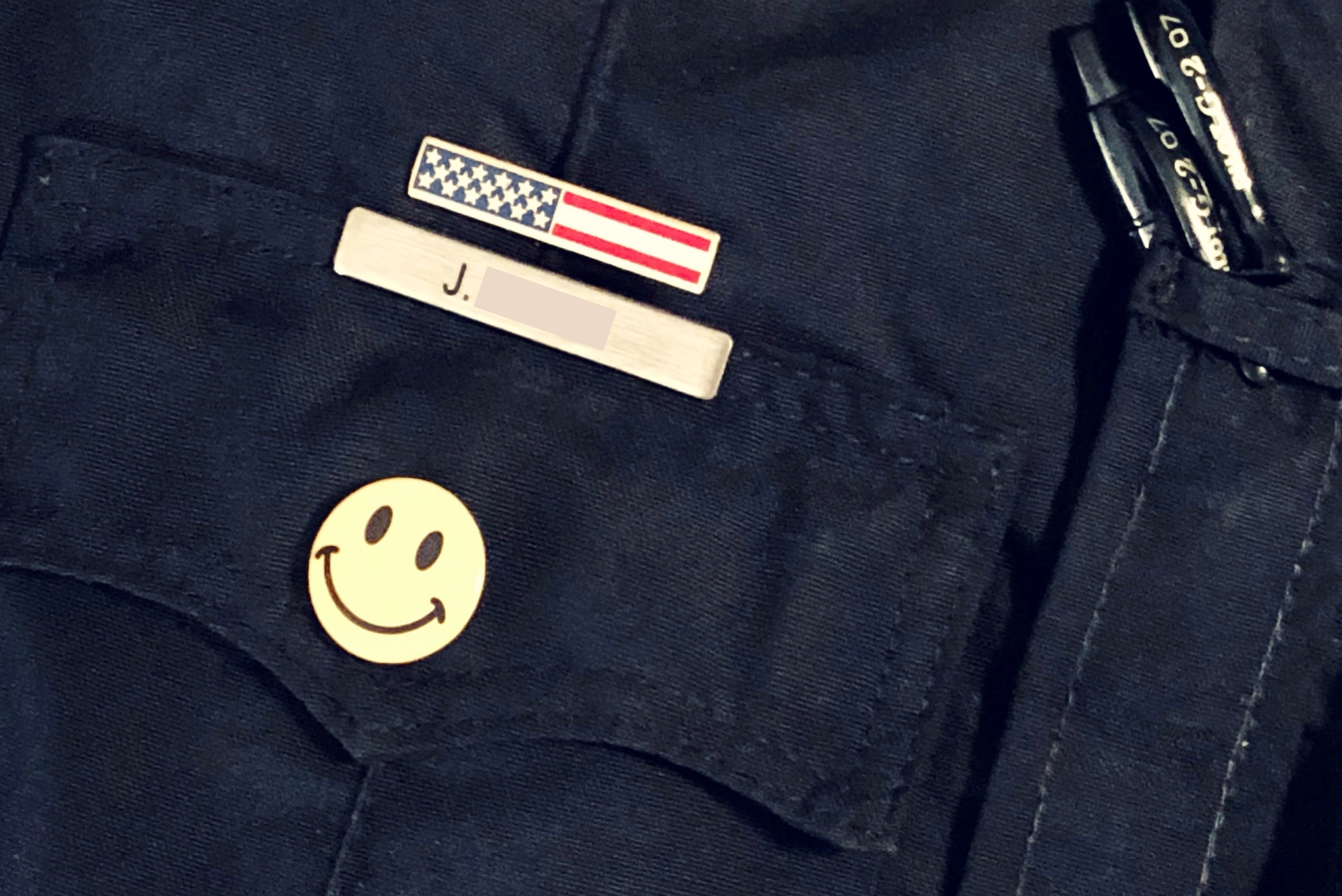
Smile ButtonThe next day I was home for a few hours before needing to return to work as the police department was being mobilized in a way that I had never seen before. While working on some things in my home office, I opened a drawer and found a plastic bag full of almost 200 smile buttons that one of my daughters had given to me. They were leftover from a school project she had done a little over a year ago and she had given them to me assuming I would find a use for them someday. I immediately took them out and put them in my duffel bag to take to work. I did not know how they would be used, but in these unprecedented times I knew that they may be useful because as human beings a legitimate smile goes a long way and when I saw these in the drawer, they made me smile.

As part of my duties with the Training Unit, I have been studying Mirror Neurons and their affect on communication. These are the neurons in our brains that are responsible for helping with empathy, understanding context, imitation learning, and more. They also are the same neurons that fire off positive feelings when we observe someone do something nice for another person. Yes, just watching another person buy someone a coffee or pick up some items they dropped on the floor gives third party observers a little jolt of positive feelings. This is the internal mechanism that tries to connect us as human beings and positively support our further existence through helping one another. Mirror Neurons are also the reason when some looks at you and gives you a genuine smile you cannot help but to smile back – they are connection builders.

Fast forward a week to present day. The department has been mobilized and some officers are going on working straight 10 days with at least another four to go. Tension is high, nerves are fraying, and we are in a state of constant concern that the looters and rioters will return based upon continuing social media posts threatening to do so.

Then we get word of a planned protest for Sunday in our City with an expected turnout of approximately 1500 people. When the Ops Plan came out, I scrolled through to see what my assignment would be. I found that myself and my fellow Training Unit supervisor were assigned to be parking lot security for the three main parking lots being provided for the arriving protesters. It was in this moment that I immediately knew how we could use the smile buttons that I was still carrying around with me.

Uniform Smile
My uniform shirt.

As myself and my fellow sergeant arrived at the all supervisors meeting, we both attached yellow smile buttons to the pockets of our uniform shirts. While at the meeting there were a couple of eye rolls and snickers, but there were also more than a few smiles with comments back that they liked the buttons. Some even asked for their own. The tension in the meeting was thick and it was clear that assisting this protest to go off peacefully was the goal of the day.

While driving from the meeting to our designated parking lot security spot, we started discussing our role for the day. We came to the conclusion that to be “standoff-ish tactical security” was not the way we wanted our first interactions with the arriving protesters to be. For lack of a better term, we decided to become the “Wal-Mart Greeters” of the protest. Our role was going to be to say “Hi” to everyone we see, explain why we were there, and offer them a smile button as a sign of peace and solidarity with the message they were there to share. The Message . . . Bad cops make the job of every good cop that much more dangerous and give the entire profession a black eye. We wanted them to know that we agreed.

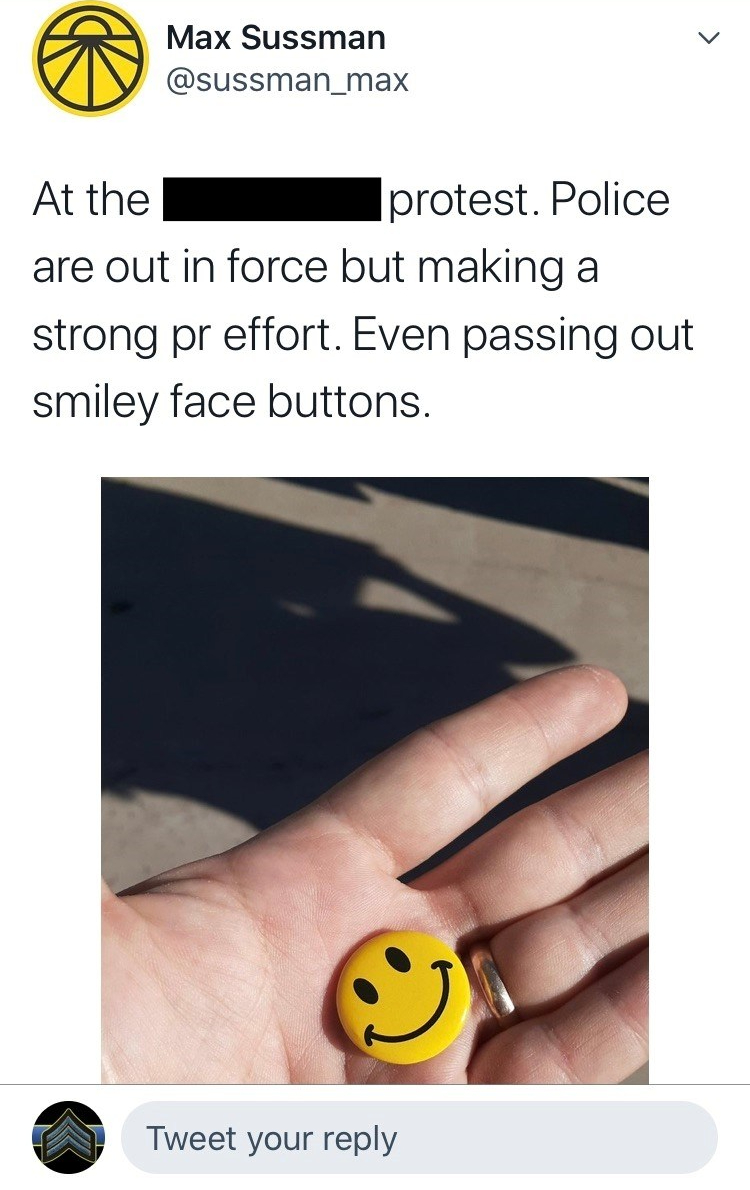
We began approaching arriving protesters as they were filtering from their vehicles to the staging area to await the start of the march. Everyone was greeted with the biggest smiles we could give them (without looking too awkward, I hope) and then we would ask if they would like a smile button as a sign of solidarity and hope for a peaceful protest. Unlike the tweet below states, this was not a PR effort on behalf of the department, it was just two cops trying to build connections.

tweet
Tweet from a protester.

The responses were overwhelmingly positive. It was amazing how a smile button could break the tension of the moment and tear down the barriers to allow positive communication to happen. People gave us handshakes, returned smiles, thanked us for being there, asked questions, and immediately put on the buttons. Multiple people explained to us that they support our specific police department, but were there to support the bigger message across the nation and we shared our agreement. The immediate connections that occurred in those brief encounters were undeniable. This was quite honestly one of the coolest moments of my entire policing career and I will never forget it.

The protest march lasted for nearly two and a half hours and could not have run any smoother. As they were leaving the area, my partner and I got about our duties of traffic control and assisting pedestrians across the street, it was awesome to see people still wearing the smile buttons. Even the ones that did not have a button had a real smile on because they felt like they had been able to voice their concerns about law enforcement and been heard. We made sure to smile back and ask how the march was activating those amazing little mirror neurons and building even more connections.

It is not going to be huge sweeping changes or reforms to the law enforcement profession that are going to make the difference. It is going to be continuous small acts of positivity and discussion that officers do every day to build positive connections that will make the difference.

I challenge other officers to break through the fear that may come from these challenging and changing times and find ways to build positive connections. Get a smile button, put it on your uniform, and then have a few extra in your pocket to share with someone to start a discussion. Even if they do not stop to talk, I guarantee they will at least smile at the attempt. Smile buttons can be found here….AMAZON LINK.

A genuine smile will get us a long way.

Performance vs. Trust in Field Training

What is more important when it comes to being a good field trainer – Performance or Trust?

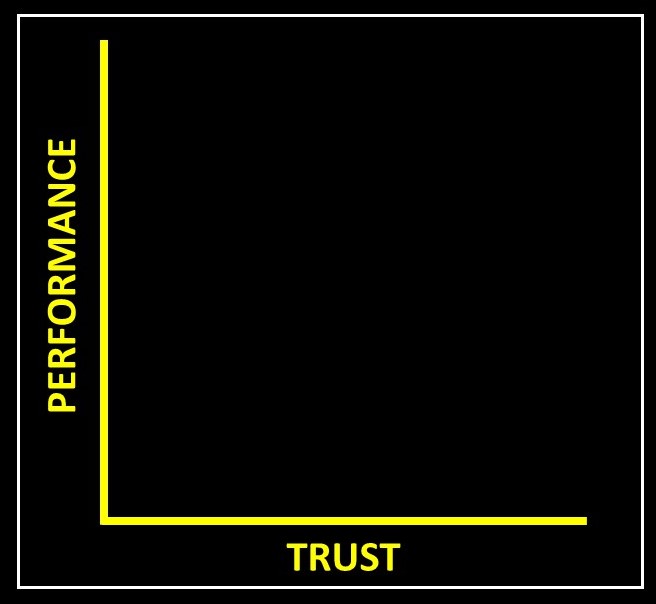
Before you answer that, let’s explore why I’m asking the question. Author and speaker Simon Sinek works regularly with the Navy Seals. During one conversation he asked them how they select who gets to go to the elite Seal Team 6 or promoted since they are all considered to be the best of the best. To answer that question, they drew a graph like the one below. (Simon Sinek Performance vs. Trust Video)

Slide1On the vertical axis they wrote “performance” and on the horizontal axis they wrote “trust.” Performance was defined as their skills and knowledge on the battlefield – shooting, tactics, orienteering, planning, endurance, etc. Trust was defined as how they are off of the battlefield – teamwork, integrity, respect, humble, etc. The Seals explained that they take each candidate and rank them on both of these criteria to see how they compare. Over time, they discovered the following…

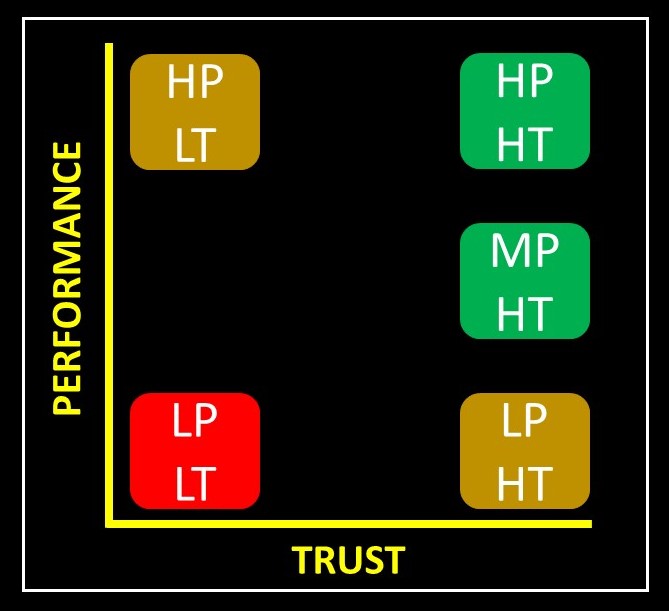
There were two candidates that were obvious. If the person was a Low Performer/Low Trust (LP/LT) they didn’t want them and if the person was a High Performer/High Trust (HP/HT) they absolutely wanted them. But, there were only so many candidates that were that clear and obvious.

Slide2It was the next choice were the Seals discovered they were initially making mistakes in their selection process. Their next choice initially was the High Performer/Low Trust (HP/LT). The person who was a “rock star” in training and on the battlefield, but outside of that they weren’t really liked or trusted. The quote the Seals used was, “I would trust them with my life, but NOT my money or my wife.” This caused many, many issues within the ranks of one of the most elite special forces units in the world.

What was their fix?

After analyzing where the mistakes were occurring, they reorganized the hierarchy of their entire selection process. Instead of taking the High Performer/Low Trust Seals, they prioritized taking the Moderate Performer/High Trust (MP/HP) individuals. They then would equally consider even a Low Performer/High Trust (LP/HT) candidate in comparison to a High Performer/Low Trust one. This was done because after years of various difficulties and failures, the Navy Seals discovered that Performance can be taught, learned, and improved. Trust can only be earned and is a much more valuable commodity when making such decisions of significance.

How does this relate to Field Training?

First, no one that works with you is going to care if you have the most tickets, most arrests, find the most drugs, take the most calls for service, or get the coolest assignment; if they don’t trust you. Do things often that build trust – back up other officers, help with impounds, take paper when you know they are down a lot . . . in other words, help other people out sometimes. That not only will help those around you, but will also make a huge difference when it comes to testing for special assignments or promotion.

Secondly, the same concept applies to the OITs (Officer-in-Training) you are training. It is great if they are a natural cop and are kicking butt through FTO (Field Training Officer), but if they are showing behaviors that make your level of trust in them diminish, then you should be cautious. Would you trust your money and spouse around them? If not, try to articulate why and document it. The FTO Program would rather remove a low trust OIT than have them make it through and be a pain for the next 25 years or until they cause a significant integrity issue of some kind.

Lastly, as a Field Training Officer, you will find that your ability to train and the success of your OITs is directly related to the level of trust you build with them during the short time you have them for training. Here are 3 tips for quickly building trust with OITs…

  1. When you first meet them, introduce yourself and explain that everything you from here on out is for their benefit to make them a successful solo capable officer. If you say it with conviction, they will believe you and you will immediately be establishing a rapport built on trust; even if you have to get on them about something.
  2. Be up front about the expectation for them to make mistakes. Explain that you would rather see them take initiative on a call for service and make a mistake; rather than, hang back waiting watching other officers do the work and not make a mistake. If you are going to be upset and/or frustrated with an OIT, be upset/frustrated at the lack of initiative, not the mistake. Training can fix the mistake. Initiative is built on trust.
  3. Take the time to introduce yourself. Tell them about your family, life outside the PD, struggles you’ve experienced, and successes you’ve had. Then ask them about who they are. What is their family situation, what did they do before coming to SPD, why do they want to be a cop, what has been the hardest for them in FTO so far, how are they adjusting to shift work, etc. You never know where those conversation will go. OITs have to know you care about them before they will ever care about what you have to teach them. TRUST > PERFORMANCE

The mission at Thin Blue Line of Leadership is to inspire law enforcement supervisors to be the best leaders they can be by providing positive leadership tactics and ideas. Positive leadership and creating a positive squad culture are on-going commitments that must be nurtured and developed over time. Thin Blue Line of Leadership is here to help.

Please do not hesitate to contact us if you have ideas to share or suggestions for improvement. Your thoughts or comments on this blog are always appreciated either below or on our Facebook page. You can also follow us on Twitter at @tbl_leadership.

Continue saving the world one call at a time and as always, LEAD ON!


5 Simple Leadership Lessons

Columnist Ann Landers once wrote, “Opportunities are usually disguised as hard work, so most people don’t recognize them.” These 5 leadership lessons are nothing fancy or complicated. Years of research and development have not been done to come up with them. But, to successfully implement these leadership lessons in your daily routine as a supervisor it will take effort, time, dedication, and desire. As a supervisor, it is your job to recognize the opportunity. The minute an officer decides to promote to a supervisor position within a law enforcement organization, they have chosen to take on the great responsibility of being a leader, coach, caretaker, psychologist, teacher, and many more.

Here are 5 basic leadership lessons for new law enforcement supervisors.

  1. Know the mission! As a leader in a law enforcement organization, it is your responsibility to know your department’s mission statement and goals. When guiding officers through calls, handling complaints, or evaluating a situation; the department’s mission is the guide. It should be more than just a few sentences in a general orders book of a framed picture on the wall; make it real by speaking of it regularly in briefing. Give examples of what it looks like on the road.
  2. Set clear expectations! This lesson is not referring to setting quotas or other quantitative measures. It is about clearly defining a path to success for your officers’ careers. It means defining how to treat people, use force appropriately, conduct thorough investigations, think critically under stress, and remembering that this is a career of service. The culture, your squad’s actions and attitudes, will be a reflection of the expectations you establish. (More on expectations.)
  3. Set goals! As a leader, you should obviously have your own goals, but this is specifically referring to assisting your officers in developing their own short and long term goals. Your own personal success will be derived from helping your officers reach their goals. Goals should be forward thinking and in agreement with department/district goals. In the short term, have your officers establishing goals they would like to accomplish in the next year that correspond to beat issues, crime trends, or other defined problems within their areas of responsibility. They should also consider trainings they would like to attend or other personnel development toward future assignments they would like to obtain. For the long term, discuss where they see their career in 5 years or 10 years; what specialty assignments they are interesting in, are they interesting in promoting, etc. Then you must assist them by providing training opportunities, helping them develop their strengths, and make connections with people that work in the officer’s area of interest. Use their goals as a springboard for having consistent, on-going evaluation conversations.
  4. Set the example! As a supervisor, it is vital that you are out with your officers on the road as much as possible. Not only does this show your willingness to be involved and “get your hands dirty,” but it also gives them the perfect opportunity to observe you in action setting the example of how they should be – representing your own expectations. Your officers will be watching closely to see how you treat people and make decisions; especially in the tough situation where they may not be sure how to act or react. When you come across a situation where your officers are unsure of a solution to their call, it provides you the perfect opportunity to teach them your decision-making process. Ask a standard set of questions to walk them through problems: What do you know? What do you think? Have you considered this? Then let them make the ultimate decision . . . example set!
  5. Recognize, reward, promote! As a supervisor, it is easy to see all of the things going wrong because typically you have just finished studying every nook and cranny of department policy to pass your supervisor test. The challenge is in stepping back and recognizing the good. Purposely train yourself to identify not only things that need fixing or reeducating, but those things that are being done above and beyond what you would expect normally from an officer. Once you begin recognizing the good, it is imperative that you find ways to reward those behaviors. (An idea on rewarding officers.) It does not have to be anything fancy or of monetary value, but simply telling an officer that they did a good job and specifically defining what they did good can go a long way. After recognizing and rewarding, it is just as important that you promote them. In terms of promote, that means to mention them to upper staff, bring it up in briefing, etc. Bringing these positive behaviors to light, will not only help the officer’s career, but will give other officers something to strive for.

The mission at Thin Blue Line of Leadership is to share positive leadership tactics with the field of law enforcement. Positive leadership and creating a positive squad culture are on-going commitments that must be nurtured and developed over time.

Share your thoughts or comments with us below or on our Facebook page. Continue saving the world one call at a time and as always, LEAD ON!
Praising Properly: Intelligence vs. Effort

In a controlled study, a group of fifth grade students were each given a puzzle to solve. Half of the students who solved the puzzle were praised for being smart. The other half who solved the puzzle were praised for the high level of effort they gave. The students were then given the option to select another puzzle of their choice. One puzzle was similar in difficulty to the one they had completed successfully and the other one was significantly more difficult. The students were told they probably would not solve the more difficult puzzle, but would learn more from trying to solve it.

What puzzle do you think the “smart” kids chose?

What puzzle do you think the “effort” kids chose?

A majority of the students who were praised for being smart picked the easier puzzle. 90% of the students praised for their effort picked the difficult puzzle. Why do you think that is?

The study concluded that when we praise strictly for intelligence or correctness, the students got the message that being “smart” or “correct” is the key to winning the game. Therefore, they choose easier tasks to complete to keep the praise coming while avoiding new or difficult tasks. This is common because intelligence is typically perceived to be out of our control. Since it is outside our control, being viewed as “not smart” or “incorrect” gives the student no way to respond to potential failure because they see themselves as a victim of their supposed limited intelligence.

When praise for intelligence/correctness has been the primary method of praise, you will hear excuses like “I haven’t been taught that,” “That isn’t the way I was shown before,” and “That isn’t how I learn.” All of these excuses are made from a victim mentality and are a self-preservation technique to keep from feeling dumb/embarrassed for being incorrect. Notice how each of the statements point the blame for the failure away from the student.

However, when we emphasize praise primarily for effort, the students see learning as a variable they can control. They may have been incorrect in the knowledge or action, but praising them for taking on the task and putting forward their best effort leads to more learning. This also gives them a simple solution for responding to failure – PUT IN MORE EFFORT!

When we routinely praise for effort, you will hear student questions like, “How can I do better?,” “Could we try this next?,” and “Can we do that again?” All of these questions show the student taking responsibility for learning and having a willingness to put in more effort.

Success at learning is less dependent on intelligence than it is on grit, curiosity, and effort. The essential ingredients to creating great police officers during training are providing them with challenges, praising their effort while handling them, and then teaching them how to overcome those challenges. The rest is up to the learner and their EFFORT.

The mission at Thin Blue Line of Leadership is to inspire law enforcement supervisors to be the best leaders they can be by providing positive leadership tactics and ideas. Positive leadership and creating a positive squad culture are on-going commitments that must be nurtured and developed over time. Thin Blue Line of Leadership is here to help.

Please do not hesitate to contact us if you have ideas to share or suggestions for improvement. Your thoughts or comments on this blog are always appreciated either below or on our Facebook page. You can also follow us on Twitter at @tbl_leadership.

Continue saving the world one call at a time and as always, LEAD ON!

*** Parts of this blog were paraphrased from the excellent book “Make it Stick” by Peter C. Brown with some of my own additional thoughts. I highly recommend this book to all trainers. ***

What Will Your Verse Be?

My police department has had its ups and downs. At this time, we happen to be in a down. Below is a note I sent to Field Training Officers because my gut told me it was needed…


“The powerful play goes on and you can contribute a verse…

What will your verse be?”   ~Dead Poets Society

THE POWERFUL PLAY GOES ON: The powerful play called life goes on and on and on. Regardless of all the “stuff” that happens within an organization, things always continue moving forward. You know the “stuff” I’m referring to, it gets talked about in-between calls, while writing paper in a beat office, or shows up on the 10 o’clock news. We have zero control over those things. What I do know is that we have an incredible team of people that have taken on the responsibility of being Field Training Officers and that team is actively creating our next generation law enforcement officers.

YOU CAN CONTRIBUTE A VERSE: With every trainee you are assigned, you have the opportunity to contribute a verse which may last over the next 5, 10, 15, or 25 years. The value of that verse cannot be overstated. Look around you and decide right now what kind of officers you want to work with on your squad. Do you want to work with mopey, victims of circumstance that HAVE TO be here or do you want to work with positive, solution-focused officers that WANT TO be here? That is the verse that you, more than anyone else in this department, gets to contribute. If not for the organization, then for your squad, your team, your family.

WHAT WILL YOUR VERSE BE?: In this entire world there are only three things you truly control. Your actions. Your attitude. Your effort. Every challenge we face at work, at home, or in life can be made simpler by attacking it head-on with those three things. What are the actions I need to take? What is the attitude I need to have? How much effort am I willing to expend to be successful? I challenge you to consider these aspects as you decide what your verse will be. What are you willing to contribute to the success of another person? What are you willing to contribute to the success of your next backup officer?

As Field Training Officers, you have a tremendous amount of influence by contributing a verse to the organization one trainee at a time. They look up to you, they envy you, they want to be just like you because you make this very complex profession look easy.

Thank you for everything you do and everything you are going to do!


As leaders, I encourage you to follow your leadership instincts. When you feel that things are off and something encouraging needs to be said, follow that instinct. You never know who you may inspire during that tough time…

The mission at Thin Blue Line of Leadership is to inspire law enforcement supervisors to be the best leaders they can be by providing positive leadership tactics and ideas. Positive leadership and creating a positive squad culture are on-going commitments that must be nurtured and developed over time. Thin Blue Line of Leadership is here to help.

Please do not hesitate to contact us if you have ideas to share or suggestions for improvement. Your thoughts or comments on this blog are always appreciated either below or on our Facebook page. You can also follow us on Twitter at @tbl_leadership.

Continue saving the world one call at a time and as always, LEAD ON!



Defining the TBL Leader

The mission at Thin Blue Line of Leadership is to share positive leadership tactics with the field of law enforcement. It is undeniable that law enforcement is a unique working environment and one in which the word positive is not always easily associated. Law enforcement is not just about laws and policies. It is about the community – victims, civilians, officers, and even the criminals. So, bringing the word “positive” more frequently into law enforcement is a necessity because policing is about people. This belief must be a core value of any Thin Blue Line Leader before delving into a deeper list of qualities.

Leadership comes in many different styles. When it comes to developing one’s own style of leadership, it is most common to emulate leaders that had a significant influence on you either personally or professionally. These role-models of leadership won your heart and then were able to influence your mind.

Here are 10 qualities that define a Thin Blue Line Leader . . .

WINNING RESPECT  – Getting people to listen.

1. Competence – Being competent should be a given. Knowing basic and advanced techniques along with any specialty knowledge/skills you possess starts building your officers’ views of your competency. Do not assume that reputation alone will carry you. Accurately recognizing your own strengths and weaknesses will assist you in developing your competency across the board. A TBL Leader proves their competency from call to call and shift to shift.

2. Integrity and Honesty – Most people would say that integrity and honesty are the same thing, but let’s define it more specifically. Integrity is when your actions match your words. Honesty is when your words match your actions.  Law enforcement officers are constantly in situations and circumstances that test their integrity and honesty. A TBL Leader exemplifies this by holding themselves and their officers to a standard that is above reproach.

3. Initiative – Do not stand still. Leaders with initiative constantly ask why something is the way it is, can it be improved, and what can I do to help. Just assuming that things are fine because “that’s how we’ve always done it” leads to stagnation and mediocrity. Regardless of the time and effort required, the TBL Leader is always looking for innovative ways to improve themselves, their officers, their department, and their community.

WINNING HEARTS – Getting people to believe.

4. Servant – This is not to be confused with subservient. A servant leader recognizes that as a leader they have taken on the responsibility of being selfless for the good of their officers. It is no longer just about your career, but lifting up your officers in their careers. TBL Leaders find ways to make their officers’ jobs easier by providing them with resources, training, and guidance.

5. Authentic – Be yourself. Arrogance and false bravado will build a wall between you and your officers that will make leading effectively much more difficult. Share your experience openly from both law enforcement and your personal life. Talking about things like your marriage, children, hobbies, or pets allows those you lead to gain insight into your belief structure. If you make a mistake, own up to it and set the example by seeking to improve. You are still human and no one, regardless of your rank, expects you to be perfect at all times. TBL Leaders recognize that when it comes to being authentic, you get what you give.

6. Supportive – Being supportive starts by opening your ears. As a leader, you have to listen, recognize, validate, and only then act. Clear communication with your officers will give you all the information you need to proceed with a course of action. Standing up for your officers, when in the right, is a must because TBL Leaders are the glue that holds a team together.

7. Passionate – Passion should be encourage and never discouraged as long as it is appropriately directed. By setting a clear vision and mission for your squad, the leader creates focus and defines what winning looks like. Police officers like to win and the more they win, the more passion that is generated. TBL Leaders do not fear passion; they work tirelessly to create an environment that generates and feeds off of it.

8. Rewarding – Catching your officers doing something right should be an on-going goal of a leader. Too often, excessive amounts of time and energy are wasted searching for things that are done wrong and rewarding what gets done right gets overlooked. Obviously, serious malfunctions in officer safety or investigations need to be addressed, but there is always a way to address this so it does not destroy the officer’s morale or belief in the mission. TBL Leaders realize that rewarding officers positively reinforces and defines the behaviors that you, the leader, want to promote.

WINNING MINDS – Getting people to change.

9. Learner/Educator – Learner and educator go hand in hand. A leader must be a life-long learner. Personal experience will only hold out so long before you are just repeating yourself over and over. Taking the initiative to seek out new information and experiences will allow you to continue growing. Then, as the leader, you must be willing to share and teach what you have learned so the development of those you are responsible for can continue. No one is an expert in everything. Use your network of resources within the department to find experts in areas where you are weak. The TBL Leader recognizes the great value of learning, but realizes that it is most valuable only when it is disseminated.

10. Translator – As a leader, being a good communicator is vital, but more important than communication is the ability to receive information and translate it into support for the vision and mission of your team. As a first-line supervisor, you are the translation conduit between information coming from upper staff and those on your team. The way in which you respond to and present the information you are given will dictate your officers’ response to it. TBL Leaders recognize the power of translation and are clear and direct in their messages.

These 10 qualities define a Thin Blue Line Leader. Thin Blue Line of Leadership can be reached at tblleadership@gmail.com for any questions, comments, or suggestions. You can Like us on Facebook now, as well.

LEAD ON!