Tag Archives: accountability

Leadership Accountability Starts with Me

Accountability – the actions, attitude, and effort necessary to merge expectations with performance.

As we move forward with our discussion about leadership accountability, I must address two common myths that often send leaders down incorrect paths, or worse, make them appear to be hypocrites.

MYTH #1: Accountability is a team thing.
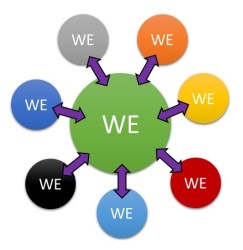
WE

When I read books or listen to someone speak about leadership, I notice the theme of building positive, supportive, and unified teams is everywhere. Heck, I often write about the power of teams here on the TBLL Blog and fully endorse the benefits of building strong teams. However, when it comes to accountability, especially leadership accountability, it is not a team concept. The idea of “you hold me accountable and I, the leader, will hold you accountable” sounds great on paper or when said aloud, but there is one significant flaw in this logic. There is a complete lack of internal accountability being demonstrated where I recognize that I have the power to control both my expectations and my performance. If I am relying on someone else to hold me accountable, am I really being accountable at all? The team accountability concept is based upon others controlling or setting my expectations for me. It means I am turning over the power of controlling my actions, attitude, and effort to say I need you to watch me and make sure I stay on the right path or do the right thing. Ultimately, the most significant issue with leadership accountability under this model becomes who is really leading, forging ahead, and setting the example?

MYTH #2: Accountability is something I, the leader, bestow upon other people.

THEMThe second myth of accountability is that accountability is only something I do to other people. Specifically, the people that work on my squad or unit. If my view is that accountability is an external process of me holding others to my expectations or those of the department, then I am creating a culture of “them” and “they.” With this idea of accountability, I believe I must hold them accountable at all times and attempt to control their performance towards my expectations. This often comes across as micromanaging to those being led and to me it feels as if my entire job has become running around putting out fires all day. To those I am holding accountable, their perspective becomes one of contempt and I have now become part of the infamous “they.” The generic pronoun used to describe those higher in power within an organization when we feel there is not a choice in whatever matter is at hand. Ultimately, this style of accountability is only sustainable for as long as the leader can manage the energy to keep it up and are physically present around those they are “leading” to enforce their expectations. Once the leader becomes too tired to keep it up, they retract to the confines of their office to hide because they just cannot manage the level of effort required to constantly hold six to eight people constantly accountable. Worst of all is that none of those on the squad or unit have ever learned how to hold themselves accountable to these expectations because the boss has always done it for them.

TRUTH: Accountability, especially leadership accountability, is all about me.

METhe truth about leadership accountability is that it is all about ME. It starts with ME. It sustains with ME. It grows with ME. It can be ended by ME. The concept of anything in leadership being “all about me” is a colossal departure from 99.9% of what I read and hear about good leadership, but when it comes to leadership accountability it truly is controlling MY actions, MY attitude, and MY effort that dictate my application of accountability. Leadership accountability is an inside out process. It is through internal accountability that I set the proverbial bar or expectations. Those I am leading see what I am doing, how I am doing it, and most importantly I explain why I am doing what I am doing. As the example is set, then I have earned the right to set external expectations of those I am leading because they know that I am not and never would ask them to do something I am not doing or willing to do myself. In other words, I must exemplify accountability before I can ever expect it from those I lead – that is leadership accountability.

Once the example of leadership accountability is set, then it begins to grow. In the next TBLL Blog, we will discuss how accountability grows through the leader’s example.

Questions to ponder . . .

  • In my current leadership position, did I set the expectations first or set the example first?
  • What are the benefits to be gained from exemplifying a solid foundation of leadership accountability?
  • As a leader, do I control those I am leading or do I influence them?

The mission at Thin Blue Line of Leadership is to inspire law enforcement supervisors to be the best leaders they can be by providing positive leadership tactics and ideas. Positive leadership and creating a positive squad culture are on-going commitments that must be nurtured and developed over time. Thin Blue Line of Leadership is here to help.

Please do not hesitate to contact us if you have ideas to share or suggestions for improvement. Your thoughts or comments on this blog are always appreciated either below or on our Facebook page. You can also follow us on Twitter at @tbl_leadership.

Continue saving the world one call at a time and as always, LEAD ON!

*** Parts of this blog are paraphrased from the excellent book, QBQ: The Questions Behind the Question by John G. Miller.

Internal vs. External Leadership Accountability

What is accountability? Take a brief moment to ask yourself what this word truly means to you. Can you define it? Put it into words? Does it involve other people or just yourself?

What is leadership accountability? Once you take on a leadership role, does the definition of accountability change? If so, how does it change? Does it involve other people or just yourself?

These are questions leaders need to consider and have a grasp upon for themselves. Over the next few Thin Blue Line of Leadership blogs, I am going to attempt to answer these questions on accountability and leadership accountability.

From this point forward in the blog, I am going to write in the first-person because I am a leader, too. A leader that has made leadership mistakes, struggled with my own accountability, and asked myself questions about how to appropriately hold other people accountable. When writing or speaking about accountability, it is too easy to hear the pronoun “you” as a challenge or an attack. So, as you read this blog further, please personalize this information for the benefit of yourself and your specific situation.

Slide2

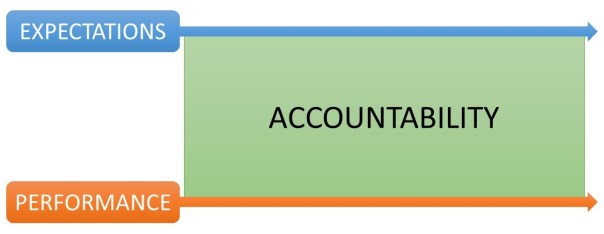
Accountability in this diagram is represented by the green rectangle filling the void between expectations and performance. Here is how I define accountability – Accountability is the actions, attitude, and effort necessary to merge expectations with performance.

Why actions, attitude, and effort? Because in life, the only things I truly have control over are my actions, my attitude, and my effort. Those three things are the building blocks I have to work with for solving any problem I may face; including problems related to accountability. My actions, my attitude, and my effort are not only the lens through which I react to my perceptions of my world, but also serve as the ammunition with which I have to influence the world around me.

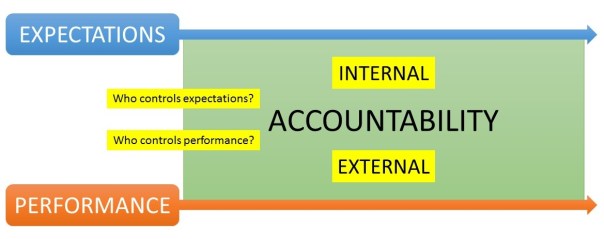
There are two types of accountability to consider before moving on: internal and external. Internal accountability is when I control or support the expectation and I also control the related performance of the a situation or circumstance. One example of an internal accountability issue would be body weight. If I have an expectation that my goal weight should be 200 pounds, then it is only through my performance, control of my actions, attitude, and effort, that I have any real chance of meeting that expectation.

Slide4

External accountability is when I control or support the expectation, but the performance is controlled by another person. Specifically, it is controlled by their actions, attitude, and effort. For example, if my police department has an expectation that officers should always wear their seatbelt when driving in their patrol vehicle, then that would be an expectation that I must support through my actions, attitude, and effort. However, in carrying out the performance associated with this expectation, it will be the officers’ actions, attitude, and effort that will determine if performance meets expectations. The difference in between and closing that gap is where leadership accountability comes into play.

It has often been my failure, or maybe reluctance at times, to recognize who controls expectations and who controls performance that has led to my worst leadership decisions. Whether it was setting unrealistic expectations, expectations that did not challenge, or failing to take into account who really controls the performance of an expectation; all of these can cause a leadership accountability failure. Ultimately, when speaking on accountability, it is the responsibility of the leader to recognize what they control versus that which they influence.

Over the next few weeks, Thin Blue Line of Leadership will continue to explore the topic of leadership accountability and attempt to answer this question – Why does leadership accountability seem so simple on its face, but often times is incredibly challenging to put into practice?

Questions to ponder . . .

  • Do we really control our actions, attitude, and effort? At all times? What gets in the way?
  • What is the difference for a leader between control and influence? Which lasts longer?
  • What are a leader’s options for merging expectations with performance?

The mission at Thin Blue Line of Leadership is to inspire law enforcement supervisors to be the best leaders they can be by providing positive leadership tactics and ideas. Positive leadership and creating a positive squad culture are on-going commitments that must be nurtured and developed over time. Thin Blue Line of Leadership is here to help.

Please do not hesitate to contact us if you have ideas to share or suggestions for improvement. Your thoughts or comments on this blog are always appreciated either below or on our Facebook page. You can also follow us on Twitter at @tbl_leadership.

Continue saving the world one call at a time and as always, LEAD ON!

Change and Reputation

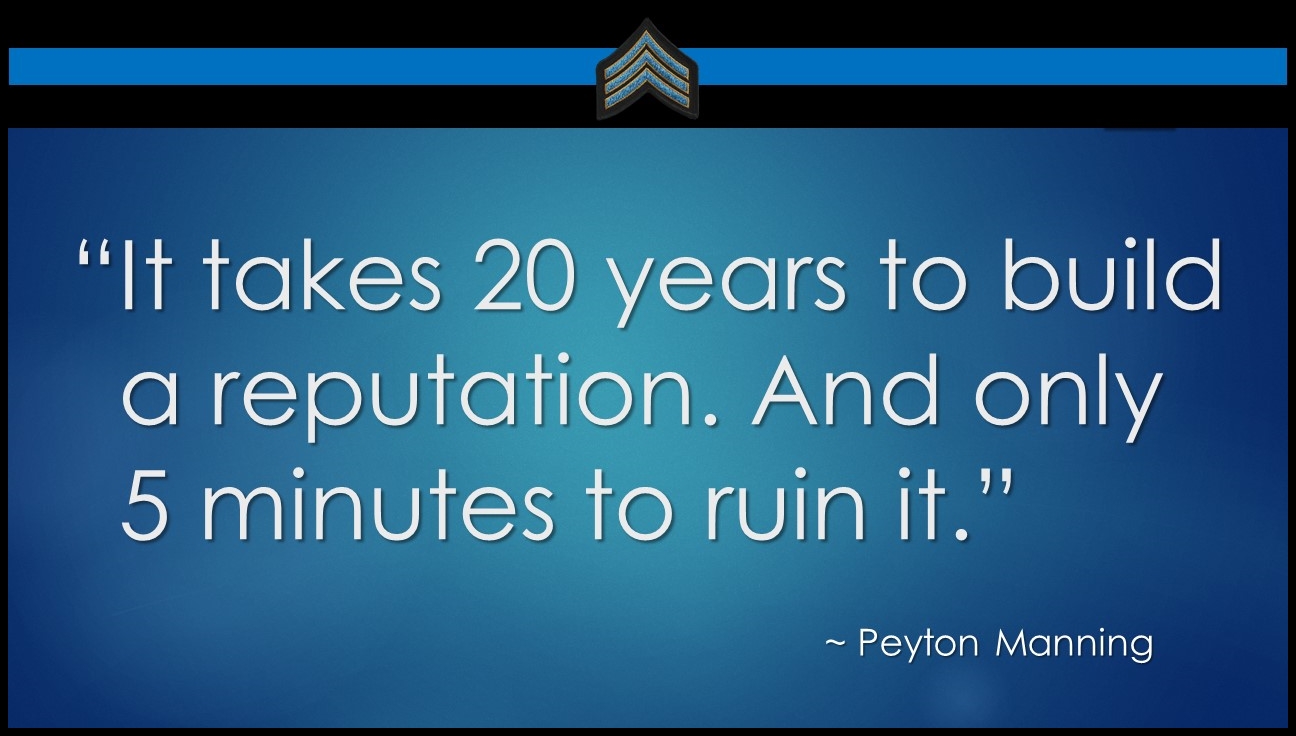
Reputation1

As a police sergeant, I have 2 primary goals regarding the officers on my squad: 1. Keep them safe. 2. Assist them in being successful at reaching their goals. To assist them in being successful with their goals, I find it is necessary to help give them perspective on the “big picture.” In law enforcement, it is easy to get caught up in short-sighted issues that demoralize a squad like staffing, compensation, negative public perceptions, etc. With that being said, I wrote this and read it in one of my recent briefings.

Change and your reputation go hand in hand in any organization, but in a mid-sized police department it is even truer – there is nowhere to hide within a 400 person department. We all know the phenomenal street cop whose career was or is being derailed by their poor attitude and/or reputation. More times than not, their poor attitude and/or reputation is related to their inability to deal with change effectively.

Change is inevitable. The only thing that stays constant is that circumstances and situations are always changing. How you deal with change comes down to your own personal responsibility and accountability – What do you expect of yourself? This defines not only your ability to deal with change, but also develops your reputation within the organization. Are you a whiny victim of change or are you someone who can deal and work within the system that is present?

The sooner it is accepted that the system is what it is and will always be slow to respond, the easier it becomes to deal with organizational lapses. Organizations, like people, are inherently flawed – no organization is perfect because they are run by human beings who are made up of attitudes, egos, and emotions. To move beyond the lapses, though, you have to take the long view and not be focused on just the short-term. So, the question becomes, how do you react to change to get the best outcome and solidify a reputation as a positive, forward thinker?

First, when change is approaching, ask this question of yourself, “What can I do?” This is the most direct and proactive response you can have. Sometimes you’ll have the ability to affect change before it is upon you and sometimes you won’t. The key is to remember that working within yourself is the only thing you actually have true control over – your actions, your attitude, and your effort.. By taking initiative and working from the front, you can often help direct change in a more palatable direction.

But, what if there is nothing you can do to directly affect the change that is coming? I answer that question with a quote from Maya Angelou, “If you don’t like something, change it. If you can’t change it, change your attitude.”

If you can’t affect the situation directly, then whining, complaining, or having beat office bitch sessions will do nothing but hurt YOUR reputation. The perceived “problem” will rarely be blamed because it is so ambiguous and comes from “they” levels. You know who “they” are, right? I implore you not to see change as something that is out to get you – it is vital to your career success to be a person who can identify the positives and opportunities that come with change.

There are 3 things you are always in control of when it comes to change – your actions, your attitude, and your effort. The common denominator to all 3 of those is YOU – you are in control and no one can take that away unless you let them. It is all about being proactive, not reactive.

Here are 5 steps to help deal with change in a positive, forward-thinking manner. These steps are adapted from the book Who Moved My Cheese? by Spencer Johnson.

Change Awareness

  1. Accept that change happens.
  2. Anticipate change.
  3. Affect change, if possible.
  4. Adapt to change quickly by adjusting your perspective.
  5. Enjoy change by being in personal control of your response to it.

Ultimately to succeed, not just within an organization, but in life, it is about survival of the fittest – your ability to adapt and overcome to change. Just like responding to a call, the situation is always going to be fluid. How you respond is your choice and builds your reputation either for better or for worse!

The mission at Thin Blue Line of Leadership is to share positive leadership tactics with the field of law enforcement. Positive leadership and creating a positive squad culture are on-going commitments that must be nurtured and developed over time by anyone in a law enforcement leadership position. By discussing topics like this, law enforcement leaders are tending to the welfare of the “whole” officer, not just the one in uniform.

Share your thoughts or comments with us below or on our Facebook page. Continue saving the world one call at a time and as always, LEAD ON!

The 3 Accountability Relationships in Law Enforcement

Accountability is defined as the obligation of an individual or organization to account for its activities, accept responsibility for them, and disclose the results in a transparent manner. There are 3 primary accountability relationships within law enforcement:

  • Department <–> Community
  • Department <–> Officers
  • Supervisors <–> Officers.

Each accountability relationship is a two-way street that must be equally travelled on both sides in order for there to be shared successes.

Department <–> Community

The relationship between a community and a police department is vital to both the safety of the community and the success of the department in providing that safety. Police departments are funded by tax dollars from the community they are entrusted to protect. The community is accountable to the department by giving them the funding to hire the proper number of officers, compensate them appropriately, and obtain the necessary resources to meet the needs and expectations of the community. In turn, the department is expected to serve their community by treating them with dignity and respect at all times. Communities accept that police departments must at times use force, but expect it to be done with the utmost responsibility. Support from the community ultimately gives police departments the authority they need to get the job done. There cannot be an “Us versus Them” mentality in order for both side of this relationship to succeed.

Department <–> Officers

The relationship between a police department and their officers must be one of mutual respect and understanding. Officers must be accountable to the department that has hired them to hit the streets each day and keep the community they serve safe. The department must provide the necessary equipment, training, recognition, and pay to give their officers the most advantageous position possible for dealing with the law-breakers of the community. In other words, departments must take care of their officers and find ways to set them up for success. In order to demonstrate their success, officers must show through their community interactions and production that they are working for the wage they are being paid by meeting the mission and standards set forth by the department. Officers must have respect for the power bestowed upon them and be diligent in upholding the Law Enforcement Code of Ethics. Without officers there is no police department and without a police department there are no officers.

Supervisors <–> Officers

The relationship between supervisors and officers is the most direct accountability relationship of the three. There is direct influence on both sides based on the amount of contact, level of communication, and strength of connection developed while serving the community as a team. The supervisor must walk the tightrope of being the translator between the needs of the department and those of the officers. By taking the time to establish a positive squad culture with their officers and developing trust, the supervisor can take any department initiative, present it to their officers, and get buy-in. In turn, officers must be able to trust their direct supervisor and truly believe that the supervisor has their best interests in mind. As discussed in the blog “7 Macro and 7 Micro Ways of Creating a Positive Squad Culture” it is up to the supervisor to give their squad the “gift of going second” in establishing a trust-based relationship. Each side of this accountability relationship must give a little to gain a lot.

As written in multiple other Thin Blue Line of Leadership blogs, people are policing. Without strong relationships in these 3 areas of accountability; morale, trust, production, compensation and many other areas suffer. It would not be a stretch to say that on some level the events last month in Ferguson, Missouri are attributable to issues in at least one, if not all, of these accountability relationships. This is why these 3 relationships are so vital to policing.

Do you feel there is a more important accountability relationship we missed?

The mission at Thin Blue Line of Leadership is to share positive leadership tactics with the field of law enforcement. Positive leadership cannot be achieved without recognizing the various levels of accountability that exist in law enforcement and learning to work those relationships.

Share your thoughts or comments with us below or on our Facebook page. Continue saving the world one call at a time and as always, LEAD ON!

Leadership Accountability – It’s All About ME

Accountability – the actions, attitude, and effort necessary to merge expectations with performance.

As we move forward with our discussion about leadership accountability, I must address two common myths that often send leaders down incorrect paths, or worse, make them appear to be hypocrites.

MYTH #1: Accountability is a team thing.

WE

When I read books or listen to someone speak about leadership, I notice the theme of building positive, supportive, and unified teams is everywhere. Heck, I often write about the power of teams here on the TBLL Blog and fully endorse the benefits of building strong teams. However, when it comes to accountability, especially leadership accountability, it is not a team concept. The idea of “you hold me accountable and I, the leader, will hold you accountable” sounds great on paper or when said aloud, but there is one significant flaw in this logic. There is a complete lack of internal accountability being demonstrated where I recognize that I have the power to control both my expectations and my performance at all times. If I am relying on someone else to hold me accountable, am I really being accountable at all? The team accountability concept is based upon others controlling or setting my expectations for me. It means I am turning over the power of controlling my actions, attitude, and effort to say I need you to watch me and make sure I stay on the right path or do the right thing. Ultimately, the most significant issue with leadership accountability under this model becomes who is really leading, forging ahead, and setting the example?

MYTH #2: Accountability is something I, the leader, bestow upon other people.

THEMThe second myth of accountability is that accountability is only something I do to other people. Specifically, the people that work on my squad or unit. If my view is that accountability is an external process of me holding others to my expectations or those of the department, then I am creating a culture of “them” and “they.” With this idea of accountability, I believe I must hold them accountable at all times and attempt to control their performance towards my expectations. This often comes across as micromanaging to those being led and to me it feels as if my entire job has become running around putting out fires all day. To those I am holding accountable, their perspective becomes one of contempt and I have now become part of the infamous “they.” The generic pronoun used to describe those higher in power within an organization when we feel there is not a choice in whatever matter is at hand. Ultimately, this style of accountability is only sustainable for as long as the leader can manage the energy to keep it up and are physically present around those they are “leading” to enforce their expectations. Once the leader becomes too tired to keep it up, they retract to the confines of their office to hide because they just cannot manage the level of effort required to constantly hold six to eight people constantly accountable. Worst of all is that none of those on the squad or unit have ever learned how to hold themselves accountable to these expectations because the boss has always done it for them.

TRUTH: Accountability, especially leadership accountability, is all about me.

METhe truth about leadership accountability is that it is all about ME. It starts with ME. It sustains with ME. It grows with ME. It can be ended by ME. The concept of anything in leadership being “all about me” is a colossal departure from 99.9% of what I read and hear about good leadership, but when it comes to leadership accountability it truly is controlling MY actions, MY attitude, and MY effort that dictate my application of accountability. Leadership accountability is an inside out process. It is through internal accountability that I set the proverbial bar or expectations. Those I am leading see what I am doing, how I am doing it, and most importantly I explain why I am doing what I am doing. As the example is set, then I have earned the right to set external expectations of those I am leading because they know that I am not and never would ask them to do something I am not doing or willing to do myself. In other words, I must exemplify accountability before I can ever expect it from those I lead – that is leadership accountability.

Once the example of leadership accountability is set, then it begins to grow. In the next TBLL Blog, we will discuss how accountability grows through the leader’s example.

Questions to ponder . . .

  • In my current leadership position, did I set the expectations first or set the example first?
  • What are the benefits to be gained from exemplifying a solid foundation of leadership accountability?
  • As a leader, do I control those I am leading or do I influence them?

The mission at Thin Blue Line of Leadership is to inspire law enforcement supervisors to be the best leaders they can be by providing positive leadership tactics and ideas. Positive leadership and creating a positive squad culture are on-going commitments that must be nurtured and developed over time. Thin Blue Line of Leadership is here to help.

Please do not hesitate to contact us if you have ideas to share or suggestions for improvement. Your thoughts or comments on this blog are always appreciated either below or on our Facebook page. You can also follow us on Twitter at @tbl_leadership.

Continue saving the world one call at a time and as always, LEAD ON!

*** Parts of this blog are paraphrased from the excellent book, QBQ: The Questions Behind the Question by John G. Miller.
7 Core Values for Building a Team (Videos)

For my police department, I created a leadership training based upon the TBLL Blog entitled, “7 Core Values for Building a Team.” Within this training were 7 short videos that utilize modified interviews from the EntreLeadership Podcast by Dave Ramsey which were set to law enforcement related images and words. These videos served as an excellent starting point for discussion and debate over the 7 Core Values for Building a Team.

Feel free to utilize these videos with your leaders, units, and squads. They are excellent for starting discussions…

VIDEO LINKS:


The mission at Thin Blue Line of Leadership is to inspire law enforcement supervisors to be the best leaders they can be by providing positive leadership tactics and ideas. Positive leadership and creating a positive squad culture are on-going commitments that must be nurtured and developed over time. Thin Blue Line of Leadership is here to help.

Please do not hesitate to contact us if you have ideas to share or suggestions for improvement. Share your thoughts or comments on this blog below or on our Facebook page. You can also follow us on Twitter at @tbl_leadership.

Continue saving the world one call at a time and as always, LEAD ON!

Leadership Accountability – Control vs. Influence

KEY POINTS PREVIOUSLY DISCUSSED ABOUT LEADERSHIP ACCOUNTABILITY

Accountability is the actions, attitude, and effort necessary to merge expectations with performance.

Understanding who controls the expectations and who controls the performance is key to understanding leadership accountability.

Leadership accountability is all about ME. It start with ME. It sustains with ME. It grows with ME. It can be ended by ME. My ACTIONS, ATTITUDE, and EFFORT.

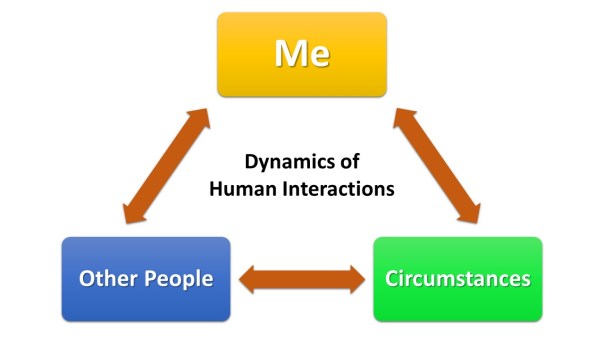
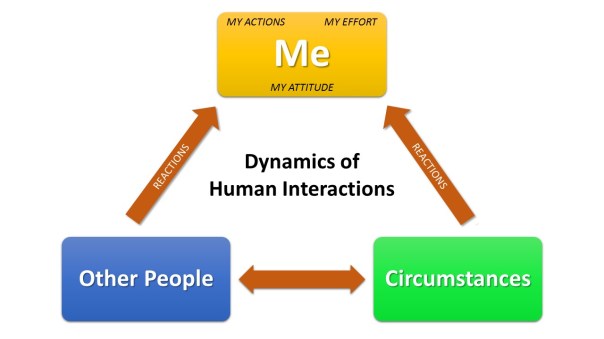
Before I can even begin to discuss control versus influence, we must be on the same page regarding the Dynamics of Human Interactions. Whether we are discussing leadership accountability, a use of force situation, handling a “routine” call for service, or any other leadership situation, the same three components always come into play.

As a leader, I must understand these dynamics in order to truly comprehend what I control and what I influence in the world around me. The most significant mistakes ever made in leadership commonly originate from the leader attempting to control something they do not truly have control over. If they had merely asked themself, “How can I influence this?” interaction with this other person or circumstance, the situation may have turned out much differently.

Slide9

In every interaction we have as human beings, there are three basic components: ME, OTHER PEOPLE, and the CIRCUMSTANCES that bring us together.

Slide10

Of these three components, it is vital that I recognize and understand there is only one of these that I have true control over – MYSELF. I cannot control other people and I cannot control the circumstances that brought everything together. So, within myself, the things I truly have control over are my actions, my attitude, and my effort.

  • What actions do I have the ability to take? Options?
  • What attitude is the best approach for the situation?
  • How much effort is necessary to properly handle this situation?

Slide11

If I take responsibility for and own my actions, attitude, and effort, then I also have to accept that I control my Reactions to the external components of these Dynamics of Human Interactions. As information comes in from Other People, Circumstances, and their Interactions, I must accept that I have NO control over them at all. I initially can only control my reactions to the information coming in about them through the actions, attitude, and effort I CHOOSE to respond with.

But, this is not easy. I, as a human being, am an emotional and reactional creature by nature. It has been programmed into me over thousands of years to survive. Sometimes those survival instincts are beneficial and sometimes they are not. When my survival instincts tell me to strike back quickly, act in a manner that is solely based upon self-preservation, and is the path of least resistance, then I must find a way to freeze the moment and remember what I control. This is especially true in leadership situations.

Slide12

I must accept I cannot CONTROL Other People, Circumstances, and their Interactions. As a leader, I must also accept I can INFLUENCE them. By recognizing that my actions, my attitude, and my effort are the tools I possess to positively influence them, I can begin to see leadership situations in a much different light. The greater my influence, the greater my leadership. The greater my leadership, the more vital it becomes for me to act consistently to maximize my influence.

Slide13

How do I maximize my influence in regards to leadership accountability? I practice personal accountability myself day in and day out by controlling that which I control. I set clear expectations that provide a vision of the future, not just repeat rules and policies. I provide training, instruction, coaching, counselling, and mentoring. I discipline when necessary to educate, not punish. Finally, I recognize good work and positively reinforce it every chance I get. All of these are methods for me to influence those I lead and the circumstances I am a part of through my actions, my attitude, and my effort.

Whenever I find myself feeling stress while handling a situation of leadership, I simply hit my mental pause button and change the internal question I am asking myself from “How can I control this?” to “How can I influence this?” Suddenly, the feelings of stress and anxiety begin to dissipate and I begin working with what I control – MYSELF.

The mission at Thin Blue Line of Leadership is to inspire law enforcement supervisors to be the best leaders they can be by providing positive leadership tactics and ideas. Positive leadership and creating a positive squad culture are on-going commitments that must be nurtured and developed over time. Thin Blue Line of Leadership is here to help.

Please do not hesitate to contact us if you have ideas to share or suggestions for improvement. Your thoughts or comments on this blog are always appreciated either below or on our Facebook page. You can also follow us on Twitter at @tbl_leadership.

Continue saving the world one call at a time and as always, LEAD ON!

Leadership Accountability – It’s All About Me!

Accountability – the actions, attitude, and effort necessary to merge expectations with performance.

As we move forward with our discussion about leadership accountability, I must address two common myths that often send leaders down incorrect paths, or worse, make them appear to be hypocrites.

MYTH #1: Accountability is a team thing.

WE

When I read books or listen to someone speak about leadership, I notice the theme of building positive, supportive, and unified teams is everywhere. Heck, I often write about the power of teams here on the TBLL Blog and fully endorse the benefits of building strong teams. However, when it comes to accountability, especially leadership accountability, it is not a team concept. The idea of “you hold me accountable and I, the leader, will hold you accountable” sounds great on paper or when said aloud, but there is one significant flaw in this logic. There is a complete lack of internal accountability being demonstrated where I recognize that I have the power to control both my expectations and my performance at all times. If I am relying on someone else to hold me accountable, am I really being accountable at all? The team accountability concept is based upon others controlling or setting my expectations for me. It means I am turning over the power of controlling my actions, attitude, and effort to say I need you to watch me and make sure I stay on the right path or do the right thing. Ultimately, the most significant issue with leadership accountability under this model becomes who is really leading, forging ahead, and setting the example?

MYTH #2: Accountability is something I, the leader, bestow upon other people.

THEMThe second myth of accountability is that accountability is only something I do to other people. Specifically, the people that work on my squad or unit. If my view is that accountability is an external process of me holding others to my expectations or those of the department, then I am creating a culture of “them” and “they.” With this idea of accountability, I believe I must hold them accountable at all times and attempt to control their performance towards my expectations. This often comes across as micromanaging to those being led and to me it feels as if my entire job has become running around putting out fires all day. To those I am holding accountable, their perspective becomes one of contempt and I have now become part of the infamous “they.” The generic pronoun used to describe those higher in power within an organization when we feel there is not a choice in whatever matter is at hand. Ultimately, this style of accountability is only sustainable for as long as the leader can manage the energy to keep it up and are physically present around those they are “leading” to enforce their expectations. Once the leader becomes too tired to keep it up, they retract to the confines of their office to hide because they just cannot manage the level of effort required to constantly hold six to eight people constantly accountable. Worst of all is that none of those on the squad or unit have ever learned how to hold themselves accountable to these expectations because the boss has always done it for them.

TRUTH: Accountability, especially leadership accountability, is all about me.

METhe truth about leadership accountability is that it is all about ME. It starts with ME. It sustains with ME. It grows with ME. It can be ended by ME. The concept of anything in leadership being “all about me” is a colossal departure from 99.9% of what I read and hear about good leadership, but when it comes to leadership accountability it truly is controlling MY actions, MY attitude, and MY effort that dictate my application of accountability. Leadership accountability is an inside out process. It is through internal accountability that I set the proverbial bar or expectations. Those I am leading see what I am doing, how I am doing it, and most importantly I explain why I am doing what I am doing. As the example is set, then I have earned the right to set external expectations of those I am leading because they know that I am not and never would ask them to do something I am not doing or willing to do myself. In other words, I must exemplify accountability before I can ever expect it from those I lead – that is leadership accountability.

Once the example of leadership accountability is set, then it begins to grow. In the next TBLL Blog, we will discuss how accountability grows through the leader’s example.

Questions to ponder . . .

  • In my current leadership position, did I set the expectations first or set the example first?
  • What are the benefits to be gained from exemplifying a solid foundation of leadership accountability?
  • As a leader, do I control those I am leading or do I influence them?

The mission at Thin Blue Line of Leadership is to inspire law enforcement supervisors to be the best leaders they can be by providing positive leadership tactics and ideas. Positive leadership and creating a positive squad culture are on-going commitments that must be nurtured and developed over time. Thin Blue Line of Leadership is here to help.

Please do not hesitate to contact us if you have ideas to share or suggestions for improvement. Your thoughts or comments on this blog are always appreciated either below or on our Facebook page. You can also follow us on Twitter at @tbl_leadership.

Continue saving the world one call at a time and as always, LEAD ON!

*** Parts of this blog are paraphrased from the excellent book, QBQ: The Questions Behind the Question by John G. Miller.

Leadership Accountability – Internal and External Accountability

What is accountability? Take a brief moment to ask yourself what this word truly means to you. Can you define it? Put it into words? Does it involve other people or just yourself?

What is leadership accountability? Once you take on a leadership role, does the definition of accountability change? If so, how does it change? Does it involve other people or just yourself?

These are questions leaders need to consider and have a grasp upon for themselves. Over the next few Thin Blue Line of Leadership blogs, I am going to attempt to answer these questions on accountability and leadership accountability.

From this point forward in the blog, I am going to write in the first-person because I am a leader, too. A leader that has made leadership mistakes, struggled with my own accountability, and asked myself questions about how to appropriately hold other people accountable. When writing or speaking about accountability, it is too easy to hear the pronoun “you” as a challenge or an attack. So, as you read this blog further, please personalize this information for the benefit of yourself and your specific situation.

Slide2

Accountability in this diagram is represented by the green rectangle filling the void between expectations and performance. Here is how I define accountability – Accountability is the actions, attitude, and effort necessary to merge expectations with performance.

Why actions, attitude, and effort? Because in life, the only things I truly have control over are my actions, my attitude, and my effort. Those three things are the building blocks I have to work with for solving any problem I may face; including problems related to accountability. My actions, my attitude, and my effort are not only the lens through which I react to my perceptions of my world, but also serve as the ammunition with which I have to influence the world around me.

There are two types of accountability to consider before moving on: internal and external. Internal accountability is when I control or support the expectation and I also control the related performance of the a situation or circumstance. One example of an internal accountability issue would be body weight. If I have an expectation that my goal weight should be 200 pounds, then it is only through my performance, control of my actions, attitude, and effort, that I have any real chance of meeting that expectation.

Slide4

External accountability is when I control or support the expectation, but the performance is controlled by another person. Specifically, it is controlled by their actions, attitude, and effort. For example, if my police department has an expectation that officers should always wear their seatbelt when driving in their patrol vehicle, then that would be an expectation that I must support through my actions, attitude, and effort. However, in carrying out the performance associated with this expectation, it will be the officers’ actions, attitude, and effort that will determine if performance meets expectations. The difference in between and closing that gap is where leadership accountability comes into play.

It has often been my failure, or maybe reluctance at times, to recognize who controls expectations and who controls performance that has led to my worst leadership decisions. Whether it was setting unrealistic expectations, expectations that did not challenge, or failing to take into account who really controls the performance of an expectation; all of these can cause a leadership accountability failure. Ultimately, when speaking on accountability, it is the responsibility of the leader to recognize what they control versus that which they influence.

Over the next few weeks, Thin Blue Line of Leadership will continue to explore the topic of leadership accountability and attempt to answer this question – Why does leadership accountability seem so simple on its face, but often times is incredibly challenging to put into practice?

Questions to ponder . . .

  • Do we really control our actions, attitude, and effort? At all times? What gets in the way?
  • What is the difference for a leader between control and influence? Which lasts longer?
  • What are a leader’s options for merging expectations with performance?

The mission at Thin Blue Line of Leadership is to inspire law enforcement supervisors to be the best leaders they can be by providing positive leadership tactics and ideas. Positive leadership and creating a positive squad culture are on-going commitments that must be nurtured and developed over time. Thin Blue Line of Leadership is here to help.

Please do not hesitate to contact us if you have ideas to share or suggestions for improvement. Your thoughts or comments on this blog are always appreciated either below or on our Facebook page. You can also follow us on Twitter at @tbl_leadership.

Continue saving the world one call at a time and as always, LEAD ON!

3 Signs of a Miserable Law Enforcement Job

“High school kids at In-N-Out Burger and Chick-fil-A are doing largely the same job that kids at any other fast-food restaurant are doing, and yet there are a lot fewer miserable jobs at In-N-Out and Chick-fil-A. The difference is not the job itself. It is the management. And one of the most important things that managers must do is help employees see why their work matters to someone. Even if this sounds touchy-feely to some, it is a fundamental part of human nature.”     – Patrick Lencioni

3signs

The premise of the book “3 Signs of a Miserable Job” by Patrick Lencioni is simply this – staying in a miserable job can have severely negative consequences on a person mentally, physically, and emotionally. These consequences can affect a person’s life both personally and professionally and it does not have to be that way. The good news is that, as supervisors, we have the ability to combat the 3 signs of a miserable job and it really is not that complicated.

Here are the 3 signs of a miserable job . . .

  1. ANONYMITY

“People cannot be fulfilled in their work if they are not known. All human beings need to be understood and appreciated for their unique qualities by someone in a position of authority. . . . People who see themselves as invisible, generic, or anonymous cannot love their jobs, no matter what they are doing.”

  1. IRRELEVANCE

“Everyone needs to know that their job matters, to someone. Anyone. Without seeing a connection between the work and the satisfaction of another person or group of people, an employee simply will not find lasting fulfillment. Even the most cynical employees need to know that their work matters to someone, even if it’s just the boss.”

  1. IMMEASUREABILITY

“Employees need to be able to gauge their progress and level of contribution for themselves. They cannot be fulfilled in their work if their success depends on the opinions or whims of another person, no matter how benevolent that person may be. Without a tangible means for assessing success or failure, motivation eventually deteriorates as people see themselves as unable to control their own fate.”

In relation to law enforcement, if an officer is miserable in their job due to the factors of anonymity, irrelevance, and immeasurability, then what is the cost to them personally, their squad, their department, and the community they are supposed to be serving? Personally, they carry their misery home which adversely affects their family life. They become the salty grump in the back of the briefing room that complains about everything and sucks the energy out of all around them. To the department they are a liability because of the negative impact on the culture and the unpredictability of their actions on the road. The community suffers because the miserable officer represents the worst of the police department which erodes public trust and makes the job that much more difficult for the officers that are not miserable. How many officers are you picturing in your head right now that match this description of a miserable officer?

Here are 25 ways law enforcement supervisors can combat anonymity, irrelevance, and immeasurability . . .

ANONYMITY

  1. Create a team atmosphere within the squad where it is believed that we is greater than I.
  2. When you get a new officer, meet with them individually and get them on board with the squad culture from day one.
  3. Recognize good police work in briefing. What you reward will be repeated.
  4. Have officers debrief good calls for service and share their expertise and successes with others.
  5. Get out of the office and on the road with your officers. Try to get on a call for service or backup each of your officers during each shift, if time allows.
  6. Rotating having officers conduct briefing training based upon their policing strengths and interests.
  7. Meet with officers regularly to discuss their career goals and seek out opportunities to help them fulfill those goals.
  8. Get to know your officers’ families. Create opportunities for them to all get together with the other families of the squad.
  9. Send handwritten thank you notes to your officers’ spouses or significant others to let them know that you appreciate the commitment that the families make to law enforcement, too.

IRRELEVANCE

  1. Making policing relevant is about getting back to the “why.” Know why you chose to become a police officer. Know why you chose to be a supervisor. Share your why with your officers. Get to know their why, find opportunities to relate their why to calls for service, and discuss the relationship in briefing.
  2. As a supervisor, you set the tone and create value in community service. If it is important to you, it will be important to them.
  3. Promote public commendations in briefing by reading them aloud for all your officers to hear.
  4. Teach your officers to be good beat cops and take pride in their assigned part of the city.
  5. Get away from the term customer service and focus on community service. The term customer service cheapen what we do as police officers and builds irrelevance.
  6. Have discussions in briefing regarding who your officers serve. Point out that they serve not only the community, but they also serve each other. Discuss that you, the supervisor, are there to serve them.
  7. Teach your squad to have a focus on finding solutions while on calls for serve; not on producing statistics, being a band aid, or handling them as quickly as possible.
  8. Exemplify and promote a culture of positivity on your squad through your actions, attitude, and effort.
  9. Provide good feedback and evaluations to your officers. In return, ask for them to do the same for you.

IMMEASUREABILITY

Of the 3 signs of a miserable job, immeasureability is the most difficult for law enforcement supervisors to deal with directly. There is no limit to the number of statistics that can be measured for each officer: calls for service responded to, self-initiated activities, arrests made, tickets written, response times, amount of time spent on each call, number of community policing activities, etc. The question becomes, are we measuring the right things?

  1. Clearly define what the “rock star” police officer would do on a “perfect” shift based upon the mission, vision, and operational goals of the department.
  2. Determine what statistics officers and/or the department have the ability to capture that correspond to the “perfect” shift. If part of the “perfect” shift includes community policing and/or positive interactions with the community, then a way to count those interactions must be determined, as well.
  3. Set specific goals based upon what the “perfect” shift would look like that clearly define what success looks like for officers and provide them with a way to track those numbers.
  4. Ultimately, whatever is chosen to be measured must be supported by the officers’ direct supervisors because the direct supervisors will give the statistics being measure their value.
  5. Supervisors must assist officers in seeing the positive perspective to their seemingly negative activities like making arrests or writing tickets.
  6. The question to be answered is how do you measure community policing activity effectiveness? Do you count the number of positive citizen commendations, the number of people that say “thank you” after being arrested/written a ticket, or the amount of time dedicated to solving beat problems? This is where the difficulty in the measurability of policing comes into play and must be answered by departments everywhere.

There are many more ways to combat anonymity, irrelevance, and immeasurability in policing. If these 3 signs of a miserable job are not addressed by law enforcement supervisors, then they will have to deal with the miserable officers they are allowing to be created.

“If you’re still not convinced that this makes sense or that it applied to you, this would be a good time to consider resigning your position as a manager and finding a role as an individual contributor.”  – Patrick Lencioni

The mission at Thin Blue Line of Leadership is to inspire law enforcement supervisors to be the best leaders they can be by providing positive leadership tactics and ideas. Positive leadership and creating a positive squad culture are on-going commitments that must be nurtured and developed over time. Thin Blue Line of Leadership is here to help.

Please do not hesitate to contact us if you have ideas to share or suggestions for improvement. Your thoughts or comments on this blog are always appreciated either below or on our Facebook page. You can also follow us on Twitter at @tbl_leadership.

Continue saving the world one call at a time and as always, LEAD ON!