Tag Archives: Performance

10 Tips for New Sergeants

For the last 8 years, I have been a Field Training Sergeant. It is truly a pleasure knowing that I am having an impact on the future of my police department by training these new leaders. I see this responsibility as a vital one. If I do not do a good job, I am not just affecting that new sergeant, but every officer that serves on his or her squad.

Just so we are on the same page, here is how my department handles sergeant training. Sergeant field training is a 5 week process – 2 weeks with one training sergeant, 2 weeks with a different training sergeant, and then one final week back with the first training sergeant. At the end of each shift, the Field Training Sergeant completes a daily observation report (similar to FTO) that summarizes and scores everything the prospective new sergeant did throughout that shift. While writing these daily observation reports, I have noticed that there are certain bits of advice that I seem to be repeatedly writing for every sergeant I help train.

So, here are my 10 tips for new sergeants . . .

  1. Successful sergeants spend 80% of their time working with people and 20% doing everything else. Sergeants that fail to inspire, have a poor squad culture, and breed negative officers focus more on everything else rather than people and building relationships.
  2. Successful sergeants find ways to teach their officers to be adaptive decision-makers; not robots that only understand how to solve problems with checklists. When opportunities present themselves, sergeants explain their process for making difficult decisions and everything they took into account. Then, when their officers face similar situations they have been taught to apply their own similar process.
  3. Successful sergeants never waste briefing time. There is always something that could be discussed, debated, trained, or learned in briefing. This is one of the few opportunities when sergeants have their entire squad’s attention at the same time; make the most of it.
  4. Successful sergeants understand that policing is a complicated profession. Both sergeants and their officers are going to make mistakes at some point. Do not hide mistakes, share them openly and turn them into learning opportunities focused on improvement. Mistakes are fine, just don’t make the same one twice.
  5. Successful sergeants recognize, reward, and promote good police work by their officers. They use whatever methods are available at their department to make this happen anytime an officer goes above and beyond. Not only does this create a more positive culture, but it also spurs on more officers to look for opportunities to go above and beyond. What a sergeant rewards will be repeated.
  6. Successful sergeants have a vision of the culture they want to have on their squad. Squad culture is defined as the conglomeration of your officers’ actions, attitude, and effort. If you asked another sergeant to describe your squad in 4 words, what words would they use? That is your culture. If you don’t like those words, do something about it.
  7. Successful sergeants do not lead from their desks. They get out on the road with their officers and find ways to serve them throughout each shift. They never believe themselves to be too good for the “grunt” work of being a patrol officer; they get in there and get their hands dirty occasionally.
  8. Successful sergeants recognize that their actions, attitude, and effort tell their officers what is important to them. If a sergeant speaks negatively about their schedule, some situation at the department, or some aspect of the job, then don’t be surprised when the officers have that same opinion or are representing that opinion openly. Negativity breeds negativity.
  9. Successful sergeants know what they do not know, then they find ways to compensate for those areas. If they are not good at tactical situations, they talk to the department’s SWAT officers about various scenarios and how they would handle them. If they are not good at traffic or investigations, they build relationships with motors or detectives that are respected. The most important aspect of this tip is that a sergeant never fakes knowledge and gives bad advice to an officer. This will kill their credibility. If an officer has a question that the sergeant does not know the answer to, the best thing they can do is say, “That is a great question, I don’t know, but I know someone who will. Standby and I’ll call you right back.”
  10. Successful sergeants never allow themselves or their officers to stop learning. The minute a sergeant thinks they know it all is the moment they begin sliding towards mediocrity. A sergeant values training and realizes that the more training they can get for their officers, the better their officers will be on the road.

Got a tip you would give to a new sergeant?

The mission at Thin Blue Line of Leadership is to inspire law enforcement supervisors to be the best leaders they can be by providing positive leadership tactics and ideas. Positive leadership and creating a positive squad culture are on-going commitments that must be nurtured and developed over time. Thin Blue Line of Leadership is here to help.

Please do not hesitate to contact us if you have ideas to share or suggestions for improvement. Your thoughts or comments on this blog are always appreciated either below or on our Facebook page. You can also follow us on Twitter at @tbl_leadership.

Continue saving the world one call at a time and as always, LEAD ON!

3 Signs of a Miserable Law Enforcement Job

“High school kids at In-N-Out Burger and Chick-fil-A are doing largely the same job that kids at any other fast-food restaurant are doing, and yet there are a lot fewer miserable jobs at In-N-Out and Chick-fil-A. The difference is not the job itself. It is the management. And one of the most important things that managers must do is help employees see why their work matters to someone. Even if this sounds touchy-feely to some, it is a fundamental part of human nature.”     – Patrick Lencioni

3signs

The premise of the book “Three Signs of a Miserable Job” by Patrick Lencioni is simply this – staying in a miserable job can have severely negative consequences on a person mentally, physically, and emotionally. These consequences can affect a person’s life both personally and professionally and it does not have to be that way. The good news is that, as supervisors, we have the ability to combat the 3 signs of a miserable job and it really is not that complicated.

Here are the 3 signs of a miserable job . . .

  1. ANONYMITY

“People cannot be fulfilled in their work if they are not known. All human beings need to be understood and appreciated for their unique qualities by someone in a position of authority. . . . People who see themselves as invisible, generic, or anonymous cannot love their jobs, no matter what they are doing.”

  1. IRRELEVANCE

“Everyone needs to know that their job matters, to someone. Anyone. Without seeing a connection between the work and the satisfaction of another person or group of people, an employee simply will not find lasting fulfillment. Even the most cynical employees need to know that their work matters to someone, even if it’s just the boss.”

  1. IMMEASUREABILITY

“Employees need to be able to gauge their progress and level of contribution for themselves. They cannot be fulfilled in their work if their success depends on the opinions or whims of another person, no matter how benevolent that person may be. Without a tangible means for assessing success or failure, motivation eventually deteriorates as people see themselves as unable to control their own fate.”

In relation to law enforcement, if an officer is miserable in their job due to the factors of anonymity, irrelevance, and immeasurability, then what is the cost to them personally, their squad, their department, and the community they are supposed to be serving? Personally, they carry their misery home which adversely affects their family life. They become the salty grump in the back of the briefing room that complains about everything and sucks the energy out of all around them. To the department they are a liability because of the negative impact on the culture and the unpredictability of their actions on the road. The community suffers because the miserable officer represents the worst of the police department which erodes public trust and makes the job that much more difficult for the officers that are not miserable. How many officers are you picturing in your head right now that match this description of a miserable officer?

Here are 25 ways law enforcement supervisors can combat anonymity, irrelevance, and immeasurability . . .

ANONYMITY

  1. Create a team atmosphere within the squad where it is believed that we is greater than I.
  2. When you get a new officer, meet with them individually and get them on board with the squad culture from day one.
  3. Recognize good police work in briefing. What you reward will be repeated.
  4. Have officers debrief good calls for service and share their expertise and successes with others.
  5. Get out of the office and on the road with your officers. Try to get on a call for service or backup each of your officers during each shift, if time allows.
  6. Rotating having officers conduct briefing training based upon their policing strengths and interests.
  7. Meet with officers regularly to discuss their career goals and seek out opportunities to help them fulfill those goals.
  8. Get to know your officers’ families. Create opportunities for them to all get together with the other families of the squad.
  9. Send handwritten thank you notes to your officers’ spouses or significant others to let them know that you appreciate the commitment that the families make to law enforcement, too.

IRRELEVANCE

  1. Making policing relevant is about getting back to the “why.” Know why you chose to become a police officer. Know why you chose to be a supervisor. Share your why with your officers. Get to know their why, find opportunities to relate their why to calls for service, and discuss the relationship in briefing.
  2. As a supervisor, you set the tone and create value in community service. If it is important to you, it will be important to them.
  3. Promote public commendations in briefing by reading them aloud for all your officers to hear.
  4. Teach your officers to be good beat cops and take pride in their assigned part of the city.
  5. Get away from the term customer service and focus on community service. The term customer service cheapen what we do as police officers and builds irrelevance.
  6. Have discussions in briefing regarding who your officers serve. Point out that they serve not only the community, but they also serve each other. Discuss that you, the supervisor, are there to serve them.
  7. Teach your squad to have a focus on finding solutions while on calls for serve; not on producing statistics, being a band aid, or handling them as quickly as possible.
  8. Exemplify and promote a culture of positivity on your squad through your actions, attitude, and effort.
  9. Provide good feedback and evaluations to your officers. In return, ask for them to do the same for you.

IMMEASUREABILITY

Of the 3 signs of a miserable job, immeasureability is the most difficult for law enforcement supervisors to deal with directly. There is no limit to the number of statistics that can be measured for each officer: calls for service responded to, self-initiated activities, arrests made, tickets written, response times, amount of time spent on each call, number of community policing activities, etc. The question becomes, are we measuring the right things?

  1. Clearly define what the “rock star” police officer would do on a “perfect” shift based upon the mission, vision, and operational goals of the department.
  2. Determine what statistics officers and/or the department have the ability to capture that correspond to the “perfect” shift. If part of the “perfect” shift includes community policing and/or positive interactions with the community, then a way to count those interactions must be determined, as well.
  3. Set specific goals based upon what the “perfect” shift would look like that clearly define what success looks like for officers and provide them with a way to track those numbers.
  4. Ultimately, whatever is chosen to be measured must be supported by the officers’ direct supervisors because the direct supervisors will give the statistics being measure their value.
  5. Supervisors must assist officers in seeing the positive perspective to their seemingly negative activities like making arrests or writing tickets.
  6. The question to be answered is how do you measure community policing activity effectiveness? Do you count the number of positive citizen commendations, the number of people that say “thank you” after being arrested/written a ticket, or the amount of time dedicated to solving beat problems? This is where the difficulty in the measurability of policing comes into play and must be answered by departments everywhere.

There are many more ways to combat anonymity, irrelevance, and immeasurability in policing. If these 3 signs of a miserable job are not addressed by law enforcement supervisors, then they will have to deal with the miserable officers they are allowing to be created.

“If you’re still not convinced that this makes sense or that it applied to you, this would be a good time to consider resigning your position as a manager and finding a role as an individual contributor.”  – Patrick Lencioni

The mission at Thin Blue Line of Leadership is to inspire law enforcement supervisors to be the best leaders they can be by providing positive leadership tactics and ideas. Positive leadership and creating a positive squad culture are on-going commitments that must be nurtured and developed over time. Thin Blue Line of Leadership is here to help.

Please do not hesitate to contact us if you have ideas to share or suggestions for improvement. Your thoughts or comments on this blog are always appreciated either below or on our Facebook page. You can also follow us on Twitter at @tbl_leadership.

Continue saving the world one call at a time and as always, LEAD ON!

Trickle-Down Leadership

In the 1980’s, the term “trickle-down economics” was coined to describe the economic policies of President Ronald Reagan. To completely over simplify, these policies favored the wealthy with the thought being that the wealthy’s financial success would trickle-down to those lower on the socio-economic food chain by way of more jobs, better advancement opportunities, and higher wages. Translation – Having it better at the top would make it better on those towards the bottom.

When it comes to the paramilitary model that law enforcement agencies are built upon, a similar “trickle-down” concept applies to leadership. There will not be a “flattening” of this model anytime soon; therefore, it is vital that leaders within law enforcement agencies recognize the role they play in this “trickle-down” leadership model. Unlike the economics concept which was based upon having it “better” at the top, the law enforcement version must be built upon leaders demonstrating such high levels of values-based, servant leadership that those positive leadership qualities “trickle-down” onto each tier of leadership below it.

wineframe

When there is a dedicated, consistent flow of positive leadership from the top, over time it will fill its own vessel and trickle over the edges. If the vessel below is in position to catch it, then it too will begin to fill and subsequently trickle over its edges into the vessel below that. This will continue until eventually positive leadership will fill the lowest level of the structure and begin to overflow onto its base.

While the structure mentioned above is obviously a metaphor for the paramilitary model, the base is typically not considered to be part of the structure, but it most definitely is. The base in this example is representative of the community the department serves. Just as a structure cannot stand without a base, without the community, the existence of law enforcement to protect it is futile. The other key component to this metaphor is that what begins at the top has a direct correlation to the bottom of the structure and what happens to its base. One misguided or negative leader, at any point in the structure, can derail the messages and gains of positive leadership from above and prevent them from ever reaching the lower levels of the chain. This ultimately effects the community.

8 Trickle-Down Leadership Thoughts:

  • A law enforcement agency’s leadership style starts at the top, flows through the organization, and has a direct impact on the community it serves – positive or negative.
  • Leaders throughout the agency, not through carrots and sticks, but by example teach officers how to act, how to treat, and how much effort to give the community it serves.
  • The strength of the paramilitary model of leadership is also its greatest weakness if its values are not clearly defined and communicated through all levels. Create a written document of positive core leadership expectations that every officer is raised on from their first days in patrol.
  • Develop a testing process that promotes leaders within the organization who best represent the positive core leadership expectations of the organization; not just statistical producers or those with good managerial skills.
  • Successful law enforcement agencies that spend more time defining and reinforcing their mission, purpose, culture, and values spend less time creating policies, handling complaints, and dealing with discipline.
  • There is a direct connection between patrol officers and the community. Therefore, it is vital that law enforcement leaders treat their patrol officers with the same trust, dignity, and respect that the agency wants them to treat the community with.
  • Positive leadership is infectious (likely to be spread through the environment) and has long-term effectiveness on those around it. Negative, fear-based leadership is contagious (likely to be spread through direct contact) and has short-term effectiveness on those around it, but creates many long-term, negative consequences for both the people under that leadership and the agency.
  • At every level of the organization, each individual person has total control over the actions they take, the attitude they have, and the effort they give. True leaders provide the direction and an environment for them to succeed.

The concept is simple – Inspired leadership, improved policing, better communities. It all trickles down.

Serve

The mission at Thin Blue Line of Leadership is to inspire law enforcement supervisors to be the best leaders they can be by providing positive leadership tactics and ideas. Positive leadership and creating a positive squad culture are on-going commitments that must be nurtured and developed over time. Thin Blue Line of Leadership is here to help.

Please do not hesitate to contact us if you have ideas to share or suggestions for improvement. Your thoughts or comments on this blog are always appreciated either below or on our Facebook page. You can also follow us on Twitter at @tbl_leadership.

Continue saving the world one call at a time and as always, LEAD ON!

Culture in Just 4 Words

THE SETUP: Another sergeant asked how my squad of mostly brand new police officers was having such great success on the road and in the community. I attributed it to the culture that we had created as a squad in the briefing room and then worked hard to exemplify each shift on the road. When he asked what my squad’s culture was, I quickly rattled off just 4 words – Positivity, Activity, Teamwork, and Humility. As I said these 4 words aloud, the other sergeant looked at me like I was holding out on him and I replied, “No really . . . that is our culture in just 4 words and it works.”

THEN IT HITS ME: The realization that came to me as we continued this conversation was that a strong, sustainable culture should be just that easy to define, explain, understand, and apply. Culture has to be tangible and not just something that is said or posted on a wall. It also has to be easily articulated and reproducible by all involved with it.

THE HOW: I pulled out a piece of paper and divided it into 4 boxes. At the top of each box I wrote one of the words that I had told the other sergeant about – Positivity, Activity, Teamwork, and Humility. Knowing that culture is defined by our actions and attitudes, I made sure that I could define each of the words in terms of both; specifically actions and attitudes that I had seen these officers previously demonstrate. This would give me an easy way to talk about the culture with specific examples. Here is what I came up with . . .

POSITIVITY

  • Know your “why.”
  • Community service – treat everyone with dignity and respect.
  • Do the right thing, at the right time, for the right reasons.
  • Recognize each other for good police work.

ACTIVITY

  • Strive to be the most active squad in the city.
  • Calls for service are our priority, but initiative fills the gaps.
  • Take pride in your beat, know your beat, and work it as such.
  • Be a leader on calls – step up when others hesitate.

TEAMWORK

  • We before I.
  • Many hands make light work – have a “how can I help” mentality.
  • Back each other up – stay safe.
  • No gossip, no complaining – develop solutions.

HUMILITY

  • Get involved – policing is experiential learning.
  • Don’t fear mistakes, learn from them.
  • Remain humble and continue learning.
  • Take training seriously; continue growing throughout your career.

The above 4 words and defining bullet points are what best describe the actions and attitudes of our squad and what we want to project to everyone we interact with in the department and the community. The next step was presenting it to the squad.

THE PRESENTATION: On the presentation day, I explained to my 7 officers the conversation I had with that other sergeant and how this all got started. As I spoke about each of the 4 words and the corresponding bullet points, I used specific examples of times when I had seen these actions and attitudes displayed previously by them. I wrote each of the words on the outside of a box that I had drawn on the whiteboard. The conversation was amazing. Based on their comments the bullet points were altered to reflect their input.

When everything was said and done, I explained that if everything they said or did on this job could fall into the confines of this box then they would know they were doing policing the right way. It is only when actions and/or attitudes don’t fit into that box that problems occur and build distrust between the squad, police department, and their community.

REINFORCEMENT: Whenever a new officer comes to the squad, I go over these same 4 words in the same way as described above. The only thing that changes are newer, better examples. This serves two purposes. First, it reinforces the importance of our culture to the officers that have heard it before and keeps it fresh in their memory. Secondly, by going over this on the new officer’s very first day of joining the squad it solidifies how important we take our culture and begins to quickly assimilate them into the fold. If there are no new officers coming to the squad, then I make sure it gets repeated and discussed at least once every couple of months.

Between squad expectation presentations, it is vital to positively reinforce the desired culture. Whenever a member of the squad handles a difficult call, solves a problem, or demonstrates a great attitude about a tough situation; I make sure to mention it in briefing the next day and thank them for their outstanding service and commitment to our squad expectations. I make sure to specifically attribute whatever they did to the word(s) it best corresponds to. Culture in 4 words has gone over even better than I expected. In fact, they now recognize each other in briefing when they see something on a call that I was not able to get to. This reinforcement creates a positive cycle that just continues building and building and building.

THE CHALLENGE: Obviously, if you are still reading this far into the blog I have peaked your interest. Answer the following questions to get you started . . .

  1. If your squad was running exactly the way you wanted it to, what 4 words would you chose to describe your squad’s culture?
  2. Once you know your 4 words, list 3 – 5 specific actions or attitudes for each word that exemplify specifically how you would like to see that word expressed by your officers.
  3. Present your 4 words to your squad and have a discussion.
  4. Take the time and make opportunities to positively reinforce the 4 words of your culture.

Squad expectations need to be about establishing culture; not rules. Police departments have plenty of rules, laws, and policies to follow; that’s what those big books of general orders and revised statutes are for. If you get the culture right; the rules will take care of themselves. So, I challenge you to discover your 4 words and get them out there to your squad.

The mission at Thin Blue Line of Leadership is to inspire law enforcement supervisors to be the best leaders they can be by providing positive leadership tactics and ideas. Positive leadership and creating a positive squad culture are on-going commitments that must be nurtured and developed over time and Thin Blue Line of Leadership is here to help.

Please do not hesitate to contact us if you have ideas to share or suggestions for improvement. Your thoughts or comments on this blog are always appreciated either below or on our Facebook page. You can also follow us on Twitter at @tbl_leadership.

Continue saving the world one call at a time and as always, LEAD ON!

3 Components to Law Enforcement Leadership

There is a simple formula for effective law enforcement leadership and it’s made up of just 3 components. First, build positivity within your officers. Next, make your officers feel like they belong. Lastly, give your officers direction. Below are the 3 components to law enforcement leadership and a few examples of how leaders can apply each of them to their team, squad, district, precinct, or department.

  1. Build positivity within your officers.

People are instinctively drawn to things that make them feel positive about themselves. As a leader it is imperative to consider how your actions and attitude make others feel about themselves. After someone is done talking to you or after you finish conducting a briefing, what is the general feeling when it is over – do they feel positive or negative? Here are 3 ways to make officers feel positive about themselves when you are around . . .

  • Help officers identify and remember their “why.”
  • Recognize and reward good police work routinely.
  • Find ways to serve those you wish to lead.
  1. Make your officers feel like they belong.

As police officers, there is already a jump start on this component due to the natural brother/sisterhood created just by putting on the badge. But, it is vital to maintain that feeling throughout the entirety of a 20 – 30 year career and to do that it must be a major component of your leadership. Develop a team within your realm of leadership and bring the officers that work with you into the fold as quickly as possible.

  • Build a team atmosphere where everyone works together to create success.
  • Create a positive environment that focuses on solutions to problems as opposed to mindlessly complaining.
  • Develop a “what can I do” mentality among your officers.
  1. Give your officers a direction.

Some call it a vision, some call it a mission; whatever term is used officers need to know the direction they are expected to go and the plan to get there. Therefore, it is incumbent on the leader to define the officers’ roles with clear expectations about every aspect of policing: how to treat people, production, attitude, etc.

  • Build culture with clear squad expectations that address both actions and attitudes.
  • Develop informal leaders within the squad to assist in perpetuating the squad culture.
  • Be out on the road with your officers demonstrating your expectations.

What’s challenging about these components is that they require working with both people and their feelings. Those are not simple challenges to address in the law enforcement world; especially feelings. Not many supervisors are willing to venture into that realm, but those that strive to be the best leaders will because they recognize the benefits that can be had.

What’s rewarding about these components is that when they all come together, it creates an environment that is just incredible to work in for both the supervisor and the officers. It allows the spirit of leadership to thrive and the officers within that environment to be both inspired and motivated to do policing and serve their communities.

The mission at Thin Blue Line of Leadership is to inspire law enforcement supervisors to be the best leaders they can be by providing positive leadership tactics and ideas. Positive leadership and creating a positive squad culture are on-going commitments that must be nurtured and developed over time and Thin Blue Line of Leadership is here to help.

Please do not hesitate to contact us if you have ideas to share or suggestions for improvement. Share your thoughts or comments on this blog below or on our Facebook page. You can also follow us on Twitter at @tbl_leadership.

Continue saving the world one call at a time and as always, LEAD ON!

Loeb’s Rules of Medicine Applied to Law Enforcement

I came across an interesting retweet this week from a friend that happens to be an emergency room doctor. This is where I read Loeb’s Rules of Medicine for the first time and immediately felt they had multiple connections to law enforcement and leadership.

Robert F. Loeb (1895 – 1973) was a well-respected physician and professor at Columbia University Medical School. Dr. Loeb offered a simple set of four rules to cut through the complicated nature of being a physician. Here they are…

Loeb’s Rules of Medicine

  1. If what you are doing is working, keep doing it.
  2. If what you are doing isn’t working, stop doing it.
  3. If you don’t know what you are doing, do nothing.
  4. Never make the treatment worse than the disease.

As I read these rules, they got me thinking of their applications to policing of which I could think of many. But the most appropriate application that struck me was how we, as law enforcement leaders, should be handling critical incidents. Critical incidents are complex situations involving witnesses, victims, suspects, and officers all experiencing various overlapping states of volatility, uncertainty, chaos, and anxiety. All of these individuals have been brought together by the one thing they have in common, the circumstances of the particular situation.

How the law enforcement leader leads these situations not only influences and affects the officers that work with them, but also leaves a lasting impact on the witnesses, victims, and suspects involved. That impact can be a positive one in which those involved feel like the situation was made better by the presence of law enforcement. Or it can be a negative one in which the presence of law enforcement only served to make the situation worse.

So, as we head into these critical incidents, it is vital to understand what the appropriate role is for law enforcement to play, what our priorities are, and what our range of acceptable outcomes is for the particular situation. Knowing and having an understanding of these three things emphasizes good practice and process while also taking into account the range of acceptable outcomes. As we begin to apply what we believe to be the correct role and priorities for those responding, that is where the connections to Loeb’s Rules of Medicine really start to come into play.  They help create a mindset of adaptability in the leader’s actions, attitude, and effort regarding the handling of the critical incident and steer them away from the perspective that there is only a single solution to these complex events.

Loeb’s Rules of Medicine Applied to Law Enforcement

RULE# 1: If what you are doing is working, keep doing it. Consistently assessing the impact of our decisions as we lead critical incidents is vital. If we are going in a certain direction and it is working toward the already identified acceptable range of solutions, then keep pushing forward so long as appropriate practices and processes are being applied. This can be accomplished by understanding the hierarchy of life and applying it correctly for the benefit of all involved. Then looking to stabilize the situation as much as possible while continuing to work towards a solution to the issue at hand. The key is continuous evaluation. Just because something is working now, does not guarantee it will still be working 5 minutes from now. That is the very nature of a complex critical incident.

RULE# 2: If what you are doing isn’t working, stop doing it. In contrast to Rule #1, the minute we identify what we are doing is not working, then we must be willing to stop…and adjust. Law enforcement does not have the luxury to just stop, so adapting is key. We know when our actions in a critical incident are not working because we start to internalize the building stress and pressure of the situation. We begin to think in terms of control when we should be thinking in terms of influence. We focus more on trying to control the other people involved and/or the circumstances of the situation rather than the things we truly have control over. So, when we begin to feel overwhelmed by the demands of the situation, we need to stop and adapt by asking what are the actions I can adjust, what is a better attitude to approach this situation with, and what is the effort level needed for success. Obviously, something is not working, so control what you can control and influence all of the rest.

RULE# 3: If you don’t know what you are doing, do nothing. No law enforcement leader ever wants to admit they do not know what they are doing – there is just too much pride, ego, and reputation on the line for that to happen, right? But this is exactly what we need to be able to do, especially if we want to call ourselves leaders. We need to be able to admit to and identify our areas for improvement, especially in regards to handling critical incidents, prior to finding ourselves in the moment of running one. This is the only way we can work towards minimizing the likelihood of the “I don’t know what I’m doing” moment. The world of handling critical incidents is unpredictable and complex. If we find ourselves in a moment when we do not know what we are doing, then we must know the resources that are available and how to best utilize their strengths to accomplish what we cannot because in these critical incidents we cannot just do nothing.

 RULE #4 (Adapted): Never make the situation worse by our presence. Law enforcement was called to the critical incident for a reason, it is already a bad day for those involved. We must account for our actions, attitude, and effort with every decision we make to continually be moving towards both solving and stabilizing the situation. To stabilize the situation means to prevent it from getting worse and make it as safe as possible to work in for all involved. This could be setting containment, evacuations, road closures, calling in additional resources, and many other available options. If we find it necessary to momentarily de-stabilize a situation, then it must be done deliberately and with an intentional purpose. A momentary destabilization could be the use of a flashbang, deploying gas/smoke, breaking out a window, breaching a door, or making a crisis entry. These are all momentary de-stabilizations of the incident that must be justified by a priority higher than stabilization such as saving life.

Where else do you see Loeb’s Rules of Medicine applying to law enforcement?

The mission at Thin Blue Line of Leadership is to inspire law enforcement supervisors to be the best leaders they can be by providing positive leadership tactics and ideas. Positive leadership and creating a positive squad culture are on-going commitments that must be nurtured and developed over time. Thin Blue Line of Leadership is here to help.

Please do not hesitate to contact us if you have ideas to share or suggestions for improvement. Your thoughts or comments on this blog are always appreciated either below or on our Facebook page. You can also follow us on Twitter at @tbl_leadership.

Continue saving the world one call at a time and as always, LEAD ON!

Change and Reputation

Reputation1

As a police sergeant, I have 2 primary goals regarding the officers on my squad: 1. Keep them safe. 2. Assist them in being successful at reaching their goals. To assist them in being successful with their goals, I find it is necessary to help give them perspective on the “big picture.” In law enforcement, it is easy to get caught up in short-sighted issues that demoralize a squad like staffing, compensation, negative public perceptions, etc. With that being said, I wrote this and read it in one of my recent briefings.

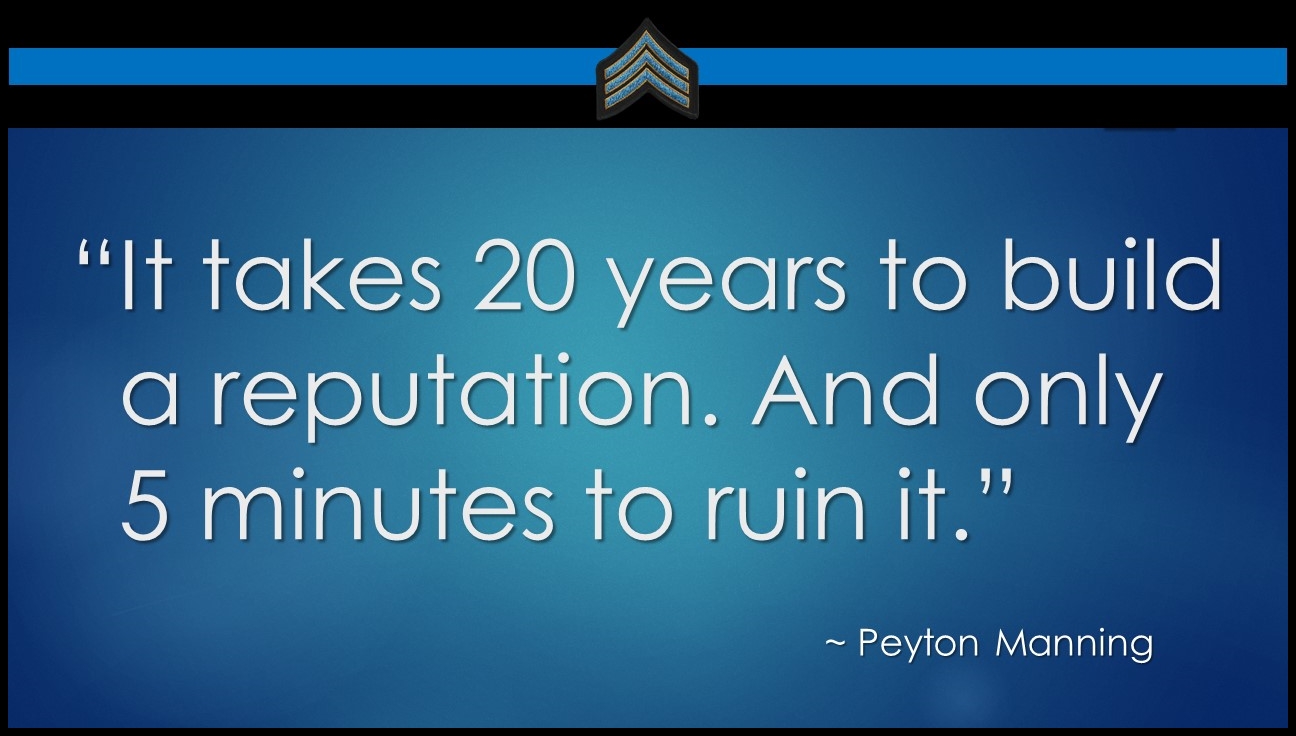
Change and your reputation go hand in hand in any organization, but in a mid-sized police department it is even truer – there is nowhere to hide within a 400 person department. We all know the phenomenal street cop whose career was or is being derailed by their poor attitude and/or reputation. More times than not, their poor attitude and/or reputation is related to their inability to deal with change effectively.

Change is inevitable. The only thing that stays constant is that circumstances and situations are always changing. How you deal with change comes down to your own personal responsibility and accountability – What do you expect of yourself? This defines not only your ability to deal with change, but also develops your reputation within the organization. Are you a whiny victim of change or are you someone who can deal and work within the system that is present?

The sooner it is accepted that the system is what it is and will always be slow to respond, the easier it becomes to deal with organizational lapses. Organizations, like people, are inherently flawed – no organization is perfect because they are run by human beings who are made up of attitudes, egos, and emotions. To move beyond the lapses, though, you have to take the long view and not be focused on just the short-term. So, the question becomes, how do you react to change to get the best outcome and solidify a reputation as a positive, forward thinker?

First, when change is approaching, ask this question of yourself, “What can I do?” This is the most direct and proactive response you can have. Sometimes you’ll have the ability to affect change before it is upon you and sometimes you won’t. The key is to remember that working within yourself is the only thing you actually have true control over – your actions, your attitude, and your effort.. By taking initiative and working from the front, you can often help direct change in a more palatable direction.

But, what if there is nothing you can do to directly affect the change that is coming? I answer that question with a quote from Maya Angelou, “If you don’t like something, change it. If you can’t change it, change your attitude.”

If you can’t affect the situation directly, then whining, complaining, or having beat office bitch sessions will do nothing but hurt YOUR reputation. The perceived “problem” will rarely be blamed because it is so ambiguous and comes from “they” levels. You know who “they” are, right? I implore you not to see change as something that is out to get you – it is vital to your career success to be a person who can identify the positives and opportunities that come with change.

There are 3 things you are always in control of when it comes to change – your actions, your attitude, and your effort. The common denominator to all 3 of those is YOU – you are in control and no one can take that away unless you let them. It is all about being proactive, not reactive.

Here are 5 steps to help deal with change in a positive, forward-thinking manner. These steps are adapted from the book Who Moved My Cheese? by Spencer Johnson.

Change Awareness

  1. Accept that change happens.
  2. Anticipate change.
  3. Affect change, if possible.
  4. Adapt to change quickly by adjusting your perspective.
  5. Enjoy change by being in personal control of your response to it.

Ultimately to succeed, not just within an organization, but in life, it is about survival of the fittest – your ability to adapt and overcome to change. Just like responding to a call, the situation is always going to be fluid. How you respond is your choice and builds your reputation either for better or for worse!

The mission at Thin Blue Line of Leadership is to share positive leadership tactics with the field of law enforcement. Positive leadership and creating a positive squad culture are on-going commitments that must be nurtured and developed over time by anyone in a law enforcement leadership position. By discussing topics like this, law enforcement leaders are tending to the welfare of the “whole” officer, not just the one in uniform.

Share your thoughts or comments with us below or on our Facebook page. Continue saving the world one call at a time and as always, LEAD ON!

Be Intentional About Culture

The mission at Thin Blue Line of Leadership is to share positive leadership tactics and training ideas with the field of law enforcement. Positive leadership and creating a positive squad culture are on-going commitments that must be nurtured and developed over time by anyone in a law enforcement leadership position. Development of a positive culture must be intentional; otherwise, who knows what will develop in its place.

For demonstrative purposes, I am going to discuss culture as it relates to the position of a sergeant with his/her squad, but these concepts are applicable at any level within an organization. When speaking of culture, I am specifically defining it as the prevailing actions and attitudes that a group demonstrates on a consistent basis. Actions and attitudes are the building blocks of culture and both must be guided in a desired direction.

Here are 4 ways to develop an intentional culture . . .

  1. Cultural development begins the minute you assume a leadership position. The minute you walk into your first briefing, you are already beginning to develop the culture of the squad. Were you early, late, or right on time? Officers are watching every step you take and are trying to decipher what you like, what you don’t like, what you expect of them, and what they can get away with. You must already know what direction you want to go or a power vacuum will form. The squad is seeking direction and leadership, either you give it to them or someone else will. There is not a minute to waste.
  2. Your style will teach your officers the culture. To be intentional about your squad’s culture, you must feed them examples of how you picture the culture. This cannot be done from the office. It requires being out on the road with them and demonstrating your style in action so they aren’t having to guess. Contact, communication, and connection between you and your officers is key. While in briefings, encourage your officers to ask “why” so they can better understand your decision-making process. The more they understand, the more the culture will begin to reflect the style you desire.
  3. What you reward will be repeated. You must reward desired actions and attitudes consistently. When you know within yourself the direction you want your squad to go, you will be able to easily recognize behaviors that deserve rewarding. This needs to be done even more blatantly if the desired behavior is a significant change from how things were prior to your arrival. Positive reinforcement is a very powerful tool for a leader, but you must be careful in what you reward because that behavior will be repeated. When giving compliments, specifically define what was good. Instead of just saying something like, “Nice job;” specifically define the action or attitude that you observed. For example, “Nice job, I like the way you kept your cool back there when that guy was yelling at us. You didn’t lose your temper and maintained officer safety without lowering yourself to that level.”
  4. What you ignore, you condone. When taking over a leadership role, such as a sergeant starting with a new squad, there are always going to be things you see that you don’t necessarily agree with and differ from your desired culture. It is incumbent of you to not ignore them. Ultimately, what you don’t address will be assumed to be acceptable. On the flip-side, you must also be careful not to just bark orders about how you want things done or you’ll very quickly take on the persona of a micromanager. To make your redirections acceptable, you must define why it is important to you and why it should be important to that officer.

Before your can have any effect on the culture of a squad, you have to know what the culture is that you would like to have. If you cannot picture in your head what the perfect squad culture would look like, then how can you lead other people in that direction? Take the time to write out your thoughts and think about what has or has not worked in your previous assignments. What qualities made up the best squad/unit you have been a part of? This is your squad’s culture, be intentional about it!

What do you do at your department to be intentional about culture?

Share your thoughts or comments with us below or on our Facebook page. Continue saving the world one call at a time and as always, LEAD ON!

A Law Enforcement Recognition Idea

The mission at Thin Blue Line of Leadership is to share positive leadership tactics and training ideas with the field of law enforcement. Positive leadership and creating a positive squad culture are ongoing commitments that must be nurtured and developed over time. One way to do this is by recognizing and rewarding great police work on a routine basis. Here is an idea that came to me a while back.

I found myself watching a college football game and was noticing the band, the cheerleaders, the crazy student section, the mascot, and of course the players. A thought struck me at that time regarding the strength of culture at these collegiate institutions. Then I began to pay particular attention to the helmets of the Florida State Seminoles and noticed that there were little tomahawk stickers on the player’s helmets. This was not something new as I have seen them on many other college team helmets, but this day I guess it just struck me at the right time.

helmetA Wikipedia search of “helmet stickers” revealed that recognition or pride stickers have been awarded to players since the mid-1950’s for making excellent plays, selfless plays, and even for hard work at practices. The idea stemmed from fighter pilots that marked their planes to signify the number of kills or successful missions they had flown. Then I started to make a connection to police work.

Most police departments have awards that are given out on an annual basis, but if you really want to positively reinforce behavior then it needs to be done on a much more consistent basis. So, I created some law enforcement recognition stickers using the Thin Blue Line of Leadership logo and had them printed at evermine.com.

sticker

For a very small cost ($15+shipping), I received over 100 custom recognition stickers (1″ diameter) to give out in briefings to reward the great things that officers do on a daily basis. I am not selling anything or being paid by evermine.com to tell you any of this; I am simply sharing an idea and Evermine happened to be the website that popped up first.

TYPES OF STICKERS: Walking into briefing with a couple of recognition stickers immediately makes everyone wonder who is being recognized and for what. It provides the perfect opportunity to reinforce more of the “smaller” things that do not rise to the level of an official ribbon or annual award. If you catch an officer changing a flat tire, give them a sticker. Have an officer that routinely volunteers to hold over a couple of extra hours to accommodate staffing needs, give them a sticker. If an officer does an amazing investigation or writes a great report, give them a sticker after they talk about it with the squad so everyone has a chance to learn from that officers great moment. Any action that supports what the squad is all about, the desired culture, should be recognized. This sticker is only given out when I, the sergeant, want to personally thank them or recognize them for some good work they did or a sacrifice they made for the betterment of the squad. What gets recognized and rewarded gets repeated.

After the success of the above recognition sticker,  I created a second sticker for our squad. These stickers could only be received by officers that are being recognized by a person outside of the squad or another officer on the squad.

r1lion

It is a squad logo created of a lion (think LE Memorial) and stars to represent the people on our squad. These stickers were used for two purposes. First, when someone from outside the squad wants to recognize a member of the squad for something. These commendations could come from citizens, other supervisors, upper staff, etc. Secondly, the most interesting use for these stickers was for officers to internally thank each other when someone sacrificed to help them out personally. For example, when an officer finds a good arrest with a ton of items to impound and their squadmates stay late to help them get it done quicker. The next shift, they would come ask me for however many stickers they needed and in briefing would thank the officers that helped them out. The coolest part of the stickers is that they ended up perpetuating officers going above and beyond for their fellow officers to a whole new level than I had ever seen in our department.

The officers decide where to accumulate their stickers, but consensus seemed to be their ticket clipboards. Some put them on their locker or some other place they see on a daily basis. This serves as a consistent reminder of their many accomplishments and makes a statement about having a positive squad culture.

clipboard

Do you have a similar way of rewarding officers in your department?

UPDATE: Here is the funny thing . . . I have since spoken to others around the department that knew of these stickers. When asked what the external perspective was of this idea, they all tell me that at first they thought I was crazy. Giving stickers to grown adults had a little too much of an elementary school ring to it. BUT, when they looked into it further, came into briefing to see it in action, and talked directly to the officers what they found out was that this wasn’t elementary or condescending at all. They all found themselves wishing they had done something to be recognized for. Here is the KEY TAKEAWAY, people long for attention, acceptance, and appreciation.  If a leader can find a way, even a way as simple as stickers, that addresses their officers’ needs of attention, acceptant, and appreciation; then they will have found a catalyst for positive culture, change, reinforcement, and team building. It doesn’t take much, but a little effort.

Share your thoughts or comments with us below or on our Facebook page. Continue saving the world one call at a time and as always, LEAD ON!

A Unique Sergeant Process

As a sergeant in my department’s training unit, one of my duties is the coordination and implementation of our Sergeant Testing Process. Over the last 4 years, I have been a member of the team tasked with the development of this unique process. Our overall goal is to identify and promote the department’s best leaders.  Here is an outline of how we are doing that…

  1. Department Leadership Development Program

We began by creating a leadership development program for anyone even remotely interested in possibly promoting within the department. Sworn or non-sworn, all are welcome to attend, learn, and discuss leadership from a law enforcement perspective. We offer 2 classes per month focusing on topics such as building teams, leadership accountability, ethical leadership, building influence, and many others. These are highly interactive courses designed to assist the attendees in developing their own unique leadership philosophy and not shoving one particular style down their throats. While being a part of this program is not mandatory for those interested in promoting to sergeant, it does provide an item for the resume and also exposes them to multiple perspectives of law enforcement leadership which greatly helps with later pieces of the Sergeant Testing Process. Approximately 75% of the people that we promote to sergeant were a part of this program.

  1. Sergeant Testing Process Announcement

The announcement for the Sergeant Testing Process comes out 6 months prior to the expiration of our current sergeant promotional list. The entire Sergeant Testing Process is a lengthy one which requires those interested in testing to be dedicated to the idea of promoting to sergeant. This helps to remove those “I’ll just throw my hat in the ring and see what happens” type people from trying to promote. This announcement spells out every one of the following steps in detail so the expectations are clear.

  1. The Written Test

Having a written test is nothing unique to any other Sergeant Testing Process, but it is only the beginning of our process. Our test is 50 multiple choice questions and designed to verify that those continuing in the process have a minimum baseline of knowledge and the ability to apply state law, policy/procedure, and case law. Where our test becomes unique is that the majority of the questions are patrol scenario-based. We are not looking for memorizers, we are looking for those that can apply their knowledge. All of the scenarios are real-world situations that have happened to current patrol sergeants and required the sergeant to know the answer “off the top of their head.” The tests are validated by having our current patrol sergeants take the test and utilizing an average of their scores to create the passing score. If a candidate does not meet the minimum passing score, then they are done with this process.

  1. The Standardized Resume

For the candidates that pass the written test, they must submit a standardized resume. This resume is designed to have the same sections of information, font, available space, and overall appearance for each candidate. This reduces the positive or negative style factors that can sometimes play a role when reviewing multiple resumes. Because all of these standardized resumes look alike, focus can be maintained on the information contained within. Our standardized resume highlights positions of leadership and contributions made to the department by providing specific space for sharing information regarding being a Field Trainer, General Instructor, and initiative taken to prepare for this process. These pieces of the resume go beyond just yes/no that it was done and asks for information about their last four trainees and what classes they have taught. The standardized resume is then made available throughout the remainder of the Sergeant Testing Process.

  1. Lieutenant Panel Interview

After passing the written test, the next step in the process is to participate in a Lieutenant Panel Interview. Our panel consists of three patrol lieutenants. They review each candidate’s standardized resume prior to the oral board. Questions on the oral board focus on leadership, emotional intelligence, tactical knowledge, and the transition to becoming a sergeant. There is no specific number for how many candidates can pass this part of the process. The goal for the Lieutenant Panel Interview is to assess who is ready to lead. The passing candidates will be taught the job of being a sergeant; it is leadership that is much more difficult to learn once promoted. Over the last 4 years, approximately 50 – 60% of the applying candidate make it through to the next step.

  1. Basic Sergeant School

Those that make it through the Lieutenant Panel Interview attend a week long Basic Sergeant School. The school consists of 12 topics of instructions that are presented by our in-house experts. Everything from emergency response strategy to payroll to mental health to patrol sergeant admin tasks gets covered. Because the focus of the process so far has been identifying leaders, we are able to focus the school on these more managerial topics and not waste time trying to teach leadership ineffectively. The Basic Sergeant School provides detailed knowledge of a sergeant’s job so when candidates begin field training they can combine and apply this knowledge and their leadership from the beginning. Each day of the school ends with a discussion panel. Panels in our most recent school included groups of Detective Supervisors, Lieutenants, New Patrol Sergeants, and Patrol Support Supervisors. Each of these panels provided an open forum for the candidates to asked questions of each unique group and also to assist them in developing their own network of department resources.

  1. Sergeant Field Training

It is during Sergeant Field Training that we learn who is and who is not ready to be a patrol sergeant. Each candidate goes through a 5 week Sergeant Field Training period. They are not promoted, but are given sergeant chevron pins for their collars so they stand out from a standard patrol officer. There are three phases and the candidates will spend time with 2 different patrol sergeants. The candidates essentially become the sergeant for the squads they are assigned with the Sergeant Field Trainer there to assist, coach, teach, and mentor them through learning the job of being a patrol sergeant. The Sergeant Field Trainers help them learn to apply the knowledge they were taught in the Basic Sergeant School. Each day, a Daily Observation Report (DOR) is completed and they are scored. At the end of each phase, both the Sergeant Field Trainer and their assigned Lieutenant write a Phase Summary Report that discusses the candidate’s ability to lead, manage the job, and handle any emergency traffic or significant investigations they were involved in. If a candidate cannot manage to perform the tasks of a patrol sergeants, they can be removed from the program at this point in the process. One of the most significant benefits of doing sergeant field training before promoting a candidate is that they can simply return to their current assignment if it is discovered that being a sergeant is not for them.

  1. Chiefs Oral Board

After Sergeant Field Training, all of the documentation regarding their performance is collected along with their Standardized Resume and a packet is created for each candidate. These packets are given to the Chief of Police and the two Assistant Chiefs of Police to review. After they have had sufficient time to review each candidate’s performance and information, the Chiefs Oral Board is schedule. The Chiefs ask a variety of questions related to the candidate’s learning and performance of the Patrol Sergeant position. From this oral board panel, the Chiefs create a ranked Promotional List.

  1. Auxiliary Sergeants

Because we have a ranked list of officers/detectives that have been trained in and shown proficiency at performing the duties of a patrol sergeant, we have also created a pool “auxiliary sergeants.” They can be utilized (as their schedules permit) to assist in covering patrol squads whenever a squad’s sergeant is off/out of duty a week or longer. This could be due to a vacation, illness, or injury. As the candidates are waiting on the ranked list to promote, helping to cover patrol squads maintains the patrol sergeant skill set they learned during this process. While serving as an “auxiliary sergeant,” they are paid at the base hourly rate of a new sergeant. This creates a win all around for both the department and those waiting on the list to promote.

It is usually at this point in the discussion of this process that someone asks what happens if they do not promote off of the list. The ranked list is good for 1 year. If a candidate on that list does not promote within the year and they have filled in where opportunities were available as an “auxiliary sergeant,” then when the next process begins they will be able to skip all the way to the Chief’s Oral Board. In the Chiefs Oral Board, they will be able to discuss how they have performed as an “auxiliary sergeant” without the aide of a field trainer. If they have proven themselves to be a reliable “auxiliary sergeant,” then they usually find their way near the top of the next year’s ranked list.

Over the last 4 years, this process has consistently produced some of the best Sergeant Promotional Lists we have ever seen. The candidates are better prepared and more comfortable stepping in and taking on the role of being a patrol sergeant.

A few key details – This process is utilized in a department of approximately 400 sworn. It requires someone dedicated to its coordination and implementation, as well as, commitment from Human Resources and the entire Chain of Command.

If you have questions, feel free to ask. It is only due to the success of this process that I share it with you here at Thin Blue Line of Leadership.

The mission at Thin Blue Line of Leadership is to inspire law enforcement supervisors to be the best leaders they can be by providing positive leadership tactics and ideas. Positive leadership and creating a positive squad culture are on-going commitments that must be nurtured and developed over time. Thin Blue Line of Leadership is here to help.

Please do not hesitate to contact us if you have ideas to share or suggestions for improvement. Your thoughts or comments on this blog are always appreciated either below or on our Facebook page. You can also follow us on Twitter at @tbl_leadership.

Continue saving the world one call at a time and as always, LEAD ON!