Tag Archives: positve

7 Core Values for Building a Team – Part 1

As leaders, there are terms you hear bantered about on a regular basis that are great conceptual ideas, but often lack real-world practice – culture, vision, mission, purpose, alignment, value. Typically, it is not the lack of desire to implement these concepts, but a lack of concrete know-how. So, Thin Blue Line of Leadership is going to give away the answer for effectively implementing the concepts of culture, vision, mission, purpose, alignment, and value with the least amount of time and effort necessary. Ready, here it comes . . . BUILD A TEAM!

Right about now, some people reading this might be thinking, “Wait, aren’t terms like culture, vision, and mission supposed to build the team for me?” The answer to that question is a simple “no.”

The concepts mentioned above are great for formulating the background of a team and defining the reason that a team needs to exist. But, in order to effectively implement culture, vision, mission, purpose, alignment, and value with a group of people, each individual must feel they are an integral part of something bigger than themselves. A part of something where each member feels like they truly belong and are among others that believe similarly to the way they do. Only then will they be willing to give their blood, sweat, and tears to make culture, vision, mission, purpose, alignment, and value work effectively for their squad, precinct, department, or organization.
corevalues

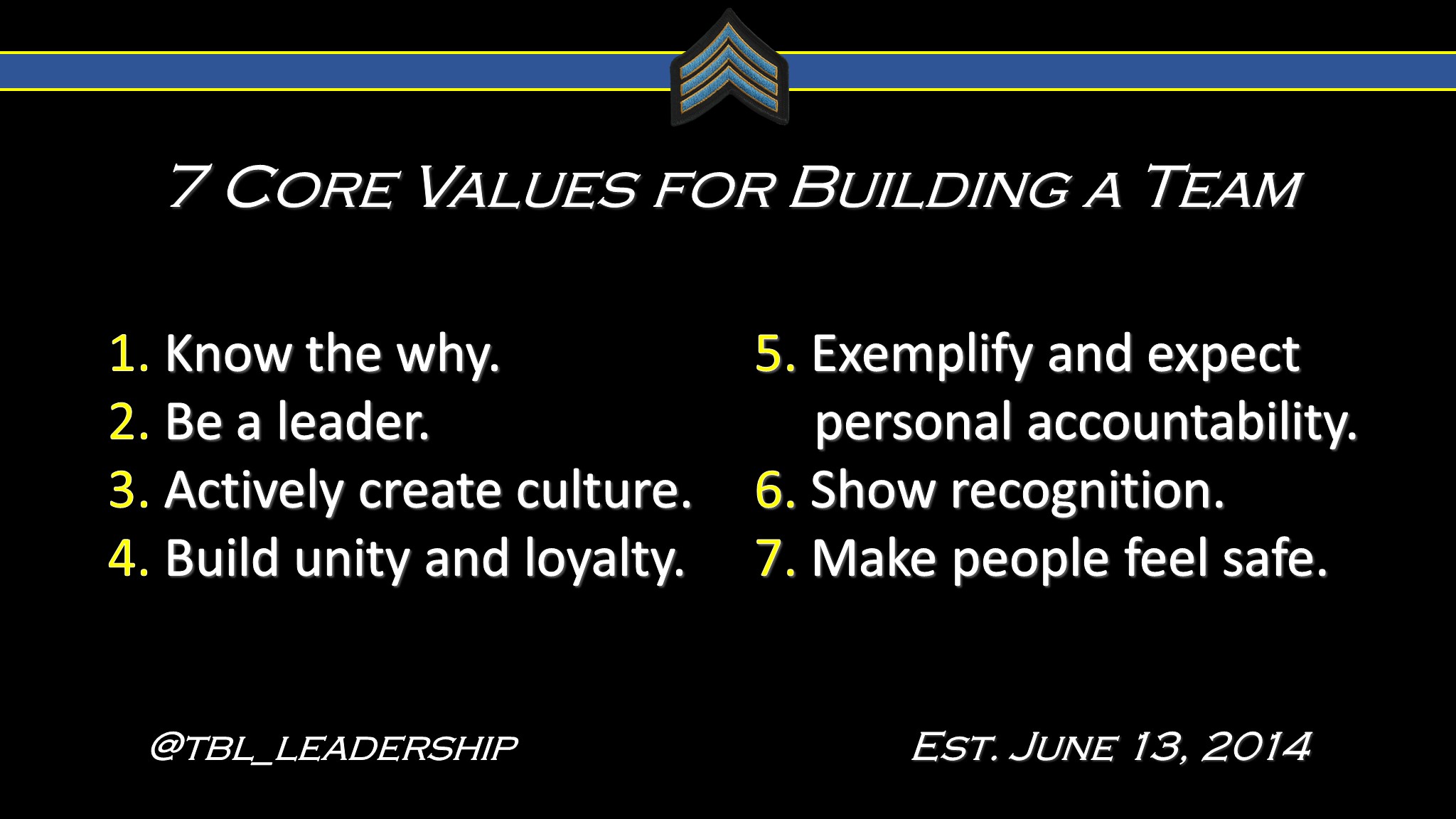
Here are 7 core values for building a law enforcement team . . .

  1. Know the why.

There are 3 pieces to every team: the what, the how, and the why. What and how are typically the easy parts to understand; they define what the team does and how they do it. For example, we are police officers that enforce the law and here is the ginormous book of General Orders that says how to be a police officer. The why is where it becomes a little more complicated. The why is referring to the reason a person ever wanted to be a police officer in the first place; that core belief inside that drives them to run towards danger for people they have never met. To build a team, the leader must know their why and maintain it as a strength throughout their career in both good and bad times. Then, a leader must learn their officers’ why’s and cultivate them in much the same way the leader does with their own why. Finally, the leader must be willing to talk about it. Talk about their why and their officers’ why’s on a regular basis to keep the why fresh in the front of their minds through each and every shift. This provides purpose, value, and clarity to the members of that team.

  1. Be a leader.

Being a good leader is not a theory. Being a good leader is taking concrete, positive actions for the good of the team and repeating them over and over and over. The key piece to the last sentence is that it must be for the good of the team. The leader must put the needs of the team above their own with the realization that ultimately the success of the team equates to their own success. A good leader must be authentic. They cannot walk around the department pretending to be something they are not because over time everyone will see through the charade. A good leaders knows their own character, strengths, weaknesses, and values to the extent that they can clearly articulate them to anyone who will listen. Lastly, a good leader recognizes that they must give long before they can expect to get from their team. Until a team knows that a leader cares for them and has their best interests at heart, they will still be just a group of individuals. To build a great team, there must be a great leader.

  1. Actively create culture.

Culture . . . one of those magical words that gets thrown about leadership circles, but only a few can define. So, here is the definition of culture – it is the prevailing actions and attitudes of a team demonstrated over time. Actions and attitudes, it really is that simple. To begin actively creating a culture, a leader must first know what they want their culture to be. What are the actions the leader would like to see their team value the most? Once the actions are defined, then a leader must nuture the attitude with which they want their team to carry out those actions. Recently in law enforcement, there has been a lot of discussion regarding the attitudes or mentalities with which officers do their job. Are we warriors or are we guardians? The leader of the team must make that distinction, exemplify it on every shift, and expect the same from their officers. The key is that the leader must be intentional about it. If the leader does not step up and steer the culture in a particular direction, then a culture will still form, but it may not be the desired one. The final question that must be answered is when do law enforcement leaders have the opportunity to actively create culture when officers work the majority of their time as one or two officer units? The answer to that is simple – to actively create culture, it must start in the briefing room or meeting room for leaders that are higher up in the department. By defining the actions and attitudes of the team over time in a briefing setting, where everyone hears the same words at the same time, the leader is able to efficiently share their cultural vision with the team. As law enforcement professionals, we have to win in the briefing room before we can truly expect to win in the community.

This is just Part 1 of 7 Core Values for Building a Team. If you would like to continue to Part 2, click here.

The mission at Thin Blue Line of Leadership is to inspire law enforcement supervisors to be the best leaders they can be by providing positive leadership tactics and ideas. Positive leadership and creating a positive squad culture are on-going commitments that must be nurtured and developed over time and Thin Blue Line of Leadership is here to help.

Please do not hesitate to contact us if you have ideas to share or suggestions for improvement. Share your thoughts or comments on this blog below or on our Facebook page. You can also follow us on Twitter at @tbl_leadership.

Continue saving the world one call at a time and as always, LEAD ON!

14 Ways to Create a Positive Squad Culture

“Workplace perks, which have been popular approaches to boosting workplace morale, ‘do not compare to the employee enjoying and feeling engaged in their work.'”   ~Doug Dickerson

Creating a positive squad culture must be at the top of the TBL Leader’s agenda. By frequently asking, “What can I do to enhance and support a positive squad culture?” the TBL Leader is steering the direction of their officer’s actions, attitudes, and effort for not only that shift, but well beyond.

Below are some specific actions that a TBL Leader can take to begin establishing, reengaging, or retaining a positive squad culture. These have been broken down into two categories – Macro and Micro Ideas. Macro are big, overall picture ideas and micro are small specific ideas. Both are necessary to achieving the overall goal of creating a positive squad culture.

MACRO IDEAS – The Big Picture

1. Don’t allow persistent negativity to permeate briefings. Identify issues, address them as a squad, and move on. In paramilitary organizations there is only so much control officers and sergeants have beyond themselves. Focus on your squad’s strengths and always ask what can we do better this shift. Nothing breeds positive squad culture as effectively as success.

2. Know the career goals of the officers on your squad. Continually be looking for ways to develop and promote them within the organization. Goal-specific trainings, temporary duty assignments, and public praise to higher-ups in the chain of command take very little effort on your part, but can yield great results.

3. Stop the gossip. Gossip is a killer within any organization by breeding mistrust and negativity. There will always be problems and frustrations, especially in law enforcement, but when the issue is being fueled by officers that have no way of or intention to solve the problem, then they are gossiping. If your squad has a gossip problem or a specific issue is creating gossip, step in quickly and either bring parties together that can address the issue directly or take the concern higher up the chain of command. Both of these options are moving towards a solution as opposed to just creating a larger contingent of gossipers. Once it is dealt with, it is done.

4. Be authentic with the officers on your squad. Share your values, goals, knowledge, and self on a regular basis. Tell officers about your family, calls you have experienced, mistakes you have made, and successes you have had. Leadership author Michael Hyatt says, “give them the gift of going second.” In other words, by going first you give your officers permission to trust, believe, and follow your leadership and then share themselves with you. As trained observers, it does not take a detective to pick up on a leader that it being guarded or has selfish motives.

5. Set clear expectations with your squad. Develop a framework for officers to work within so it is clear when they are meeting your expectations and know exactly what winning looks like under your leadership. There should be no guessing game when it comes to being successful. After reading this blog, write down 5 traits that define what a “rock star” officer would look like to you and then share that with your squad. If there is a vision you want officers to meet, it cannot be a secret.

6. Do not allow passivity and mediocrity. By allowing those behaviors to survive without consequence you are giving others permission to be that way as well. In the book EntreLeadership by Dave Ramsey he writes, “If you as a leader allow people to halfway do their jobs and don’t demand excellence as a prerequisite to keeping their job, you will create a culture of mediocrity. If you allow people to misbehave, under achieve, have a bad attitude, gossip, and generally avoid excellence, please don’t expect to attract and keep great talent. Please don’t expect to have a great culture.” What you inspire, you will create – this works for both positivity and negativity.

7. Have follow through. Just like pitching a baseball, without a good follow through, you have no idea where the ball is going to end up – over the catchers head, in the dirt, or in the batter’s ear. Every action you request or vision you share must be followed up on at regular intervals. Make your expectations known and then allow your officers to use their own ingenuity to accomplish the task or solve the problem. If you never come back to the request and just let it dissipate, your officers will feel like they have wasted their time, effort, and energy. How do you avoid this? Set clear expectations. Check in regularly. Praise progress. Reward results. Share success with your squad and give credit where credit is due.

MICRO IDEAS – The Close-Up Picture

1. Be the first one in the briefing room. Make this your priority, then being on time or even early will become the norm for your officers because you have set the example. Practice what you preach.

2. Set the tone with some good upbeat music prior to the start of briefing. You are in the briefing room early, might as well press play. Imagine walking into a briefing room with some AC/DC “Back in Black” playing or other artist depending on the taste of your squad – wouldn’t you feel more pumped up for the start of a shift? Stop the music just before you are ready to begin and it signifies to those in the room that you are ready to go.

3. Motivate with silent messages. Most briefing rooms have a white board or someplace where a good quote could be posted that speaks of hard work, motivation, success, officer safety, team work, leadership, etc. The best part is that you do not even have to say a word about it; just post it up and leave it for the week. With very little effort you have sent a message to your officers about what you believe. How many times do you think your officers will read it during that time? For example . . .

“What you do has far greater impact than what you say.” ~Stephen Covey

Unless you feel like it, you do not even have to search for the quotes – just follow @tbl_leadership on Twitter for multiple quote ideas each week.

4. Brief with a purpose. Take the time to plan out topics in advance that you would like to discuss with your squad throughout the week or, even better, the month. The key is to not be satisfied with briefings being a 30 minute “bull session” before hitting the road every day. Pulling up the occasional Police One video, while better than nothing, is still a far cry from what can be accomplished with advanced planning and a specific purpose. Obviously, given the fluidity of police work it is important to maintaining flexibility to allow for discussion regarding recent calls, successes, or issues that come up unexpectedly. Always be looking for “teachable” moments you can have with your squad.

5. Have your officers set monthly goals and share them with you. At the beginning of each month, have your officers email you or write down 2 – 3 goals/projects they want to focus on that month that are strengths of theirs – making more traffic stops, check subjects, contacting business owners, working a trouble address, spending more time in a particular neighborhood, finding DUIs, etc. It only takes them a couple of minutes, but provides you the invaluable opportunity to support/coach them on those goals/projects. By having consistent, on-going interactions with your officers regarding their monthly focus, you are in an excellent position to catch them doing good and making the most of their strengths. It also creates an easy conversation starter by saying something like, “Hey, how is it going in that neighborhood? Anything I can do to help you with that?”

6. Recognize success, winning, and commendations regularly in briefing. Read positive letters from citizens aloud and make them a big deal. Give out handwritten notes when you want to recognize an officer’s hard work, birthday, or support them through a rough time. Brag about an officer when a family member or friend comes on a ride-along. Post pictures up in the briefing room of officers after making a big arrest, demonstrating teamwork, initiative, or showing they are winning based on your definition. Simply put, spend more time catching people doing good rather than focusing on the negatives. Baseball players are All Stars for hitting the ball 3 out of every 10 at bats. A much higher success rate is expected of officers and their lives depend on it. Never talk down about the work done on a daily basis by your officers by using the excuse of “he just did his job.”

7. Identify the leader(s) on your squad. When something needs to change or a new policy implemented, talk to your squad leader(s) first and get them on board. Explain what the change is, how it is going to work, and then why it is important/necessary. The explanation must contain all 3 parts: what, how, and why in order for it to be effective. The squad leader(s) can then work behind the scenes to make the change or transition to the new policy a much smoother one than if it is just thrown out there and officers are told to “follow it or else.”

Inevitably, bad days and negative incidents are going to happen. As stated in last week’s blog, Robert Collier said “Success is the sum of small efforts repeated day in and day out.” By taking the time and making the extra effort to create a positive squad culture, a TBL Leader’s squad will be better prepared to “weather the storm” when those things that are out of your control present themselves. Why are they better prepared??? Because the TBL Leader’s officers believe in them and will do whatever it takes to protect the positive culture the squad has established.

What other ideas do you have for creating a positive squad culture?

Share your ideas and comments with us below or on our Facebook page.

The next blog at Thin Blue Line of Leadership will describe one way to establish a framework for squad expectations without setting quotas or limits . . . Continue saving the world one call at a time and as always, LEAD ON!