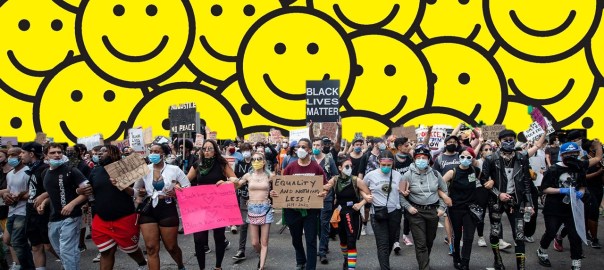
A little over a week ago, an affluent shopping mall in the City where I work was overrun by looters and rioters using the peaceful George Floyd Protests as a smoke screen for their lawless activities. I was off that night, but was called in the next evening to supervise a Rapid Response Squad to handle additional threats that were being posted over social media for other parts of the City.
I spoke that night with some of the newer officers, mostly with less than two years on, about what they had experienced. As they spoke, their eyes would open wide and they all said they had never seen or expected to be in the middle of anything like that – even as a police officers. There was fear behind those eyes and at the same time a twinge of anger for having been made to feel that fear. It was in that moment that I became truly worried about how things would play out if another similar incident took place and these officers had to respond. Are they professional? YES. Are they well trained? YES. Is fear an incredibly destructive force to professionalism and training? YES!
 The next day I was home for a few hours before needing to return to work as the police department was being mobilized in a way that I had never seen before. While working on some things in my home office, I opened a drawer and found a plastic bag full of almost 200 smile buttons that one of my daughters had given to me. They were leftover from a school project she had done a little over a year ago and she had given them to me assuming I would find a use for them someday. I immediately took them out and put them in my duffel bag to take to work. I did not know how they would be used, but in these unprecedented times I knew that they may be useful because as human beings a legitimate smile goes a long way and when I saw these in the drawer, they made me smile.
As part of my duties with the Training Unit, I have been studying Mirror Neurons and their affect on communication. These are the neurons in our brains that are responsible for helping with empathy, understanding context, imitation learning, and more. They also are the same neurons that fire off positive feelings when we observe someone do something nice for another person. Yes, just watching another person buy someone a coffee or pick up some items they dropped on the floor gives third party observers a little jolt of positive feelings. This is the internal mechanism that tries to connect us as human beings and positively support our further existence through helping one another. Mirror Neurons are also the reason when some looks at you and gives you a genuine smile you cannot help but to smile back – they are connection builders.
Fast forward a week to present day. The department has been mobilized and some officers are going on working straight 10 days with at least another four to go. Tension is high, nerves are fraying, and we are in a state of constant concern that the looters and rioters will return based upon continuing social media posts threatening to do so.
Then we get word of a planned protest for Sunday in our City with an expected turnout of approximately 1500 people. When the Ops Plan came out, I scrolled through to see what my assignment would be. I found that myself and my fellow Training Unit supervisor were assigned to be parking lot security for the three main parking lots being provided for the arriving protesters. It was in this moment that I immediately knew how we could use the smile buttons that I was still carrying around with me.

As myself and my fellow sergeant arrived at the all supervisors meeting, we both attached yellow smile buttons to the pockets of our uniform shirts. While at the meeting there were a couple of eye rolls and snickers, but there were also more than a few smiles with comments back that they liked the buttons. Some even asked for their own. The tension in the meeting was thick and it was clear that assisting this protest to go off peacefully was the goal of the day.
While driving from the meeting to our designated parking lot security spot, we started discussing our role for the day. We came to the conclusion that to be “standoff-ish tactical security” was not the way we wanted our first interactions with the arriving protesters to be. For lack of a better term, we decided to become the “Wal-Mart Greeters” of the protest. Our role was going to be to say “Hi” to everyone we see, explain why we were there, and offer them a smile button as a sign of peace and solidarity with the message they were there to share. The Message . . . Bad cops make the job of every good cop that much more dangerous and give the entire profession a black eye. We wanted them to know that we agreed.
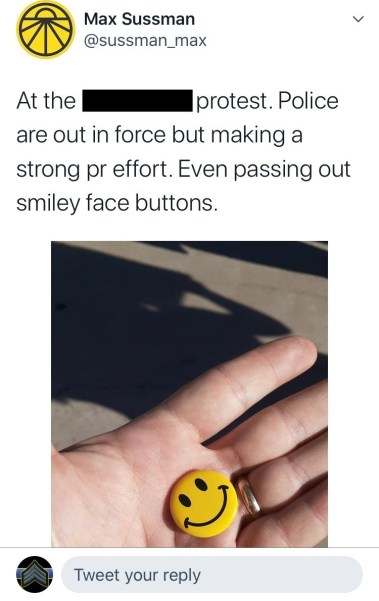
We began approaching arriving protesters as they were filtering from their vehicles to the staging area to await the start of the march. Everyone was greeted with the biggest smiles we could give them (without looking too awkward, I hope) and then we would ask if they would like a smile button as a sign of solidarity and hope for a peaceful protest. Unlike the tweet below states, this was not a PR effort on behalf of the department, it was just two cops trying to build connections.
The responses were overwhelmingly positive. It was amazing how a smile button could break the tension of the moment and tear down the barriers to allow positive communication to happen. People gave us handshakes, returned smiles, thanked us for being there, asked questions, and immediately put on the buttons. Multiple people explained to us that they support our specific police department, but were there to support the bigger message across the nation and we shared our agreement. The immediate connections that occurred in those brief encounters were undeniable. This was quite honestly one of the coolest moments of my entire policing career and I will never forget it.
The protest march lasted for nearly two and a half hours and could not have run any smoother. As they were leaving the area, my partner and I got about our duties of traffic control and assisting pedestrians across the street, it was awesome to see people still wearing the smile buttons. Even the ones that did not have a button had a real smile on because they felt like they had been able to voice their concerns about law enforcement and been heard. We made sure to smile back and ask how the march was activating those amazing little mirror neurons and building even more connections.
It is not going to be huge sweeping changes or reforms to the law enforcement profession that are going to make the difference. It is going to be continuous small acts of positivity and discussion that officers do every day to build positive connections that will make the difference.
I challenge other officers to break through the fear that may come from these challenging and changing times and find ways to build positive connections. Get a smile button, put it on your uniform, and then have a few extra in your pocket to share with someone to start a discussion. Even if they do not stop to talk, I guarantee they will at least smile at the attempt. Smile buttons can be found here….AMAZON LINK.
A genuine smile will get us a long way.

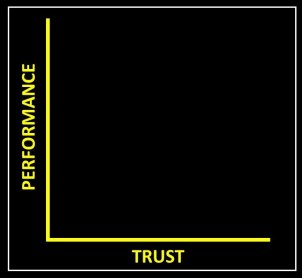 On the vertical axis they wrote “performance” and on the horizontal axis they wrote “trust.” Performance was defined as their skills and knowledge on the battlefield – shooting, tactics, orienteering, planning, endurance, etc. Trust was defined as how they are off of the battlefield – teamwork, integrity, respect, humble, etc. The Seals explained that they take each candidate and rank them on both of these criteria to see how they compare. Over time, they discovered the following…
 It was the next choice were the Seals discovered they were initially making mistakes in their selection process. Their next choice initially was the High Performer/Low Trust (HP/LT). The person who was a “rock star” in training and on the battlefield, but outside of that they weren’t really liked or trusted. The quote the Seals used was, “I would trust them with my life, but NOT my money or my wife.” This caused many, many issues within the ranks of one of the most elite special forces units in the world.


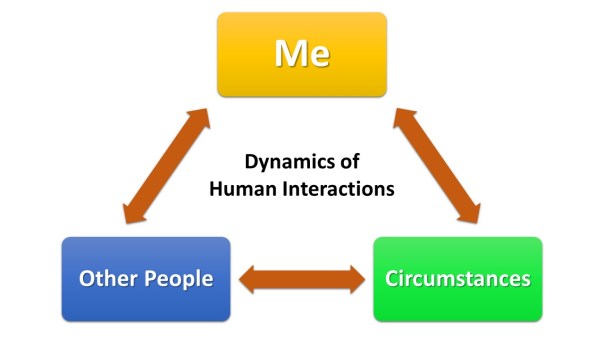

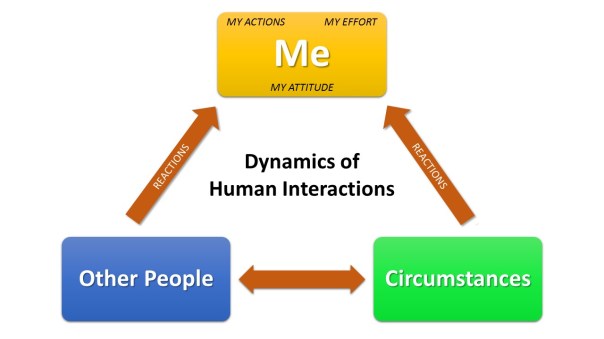


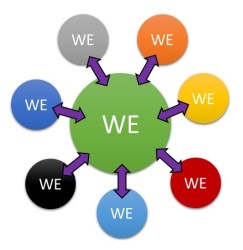
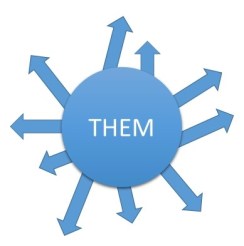 The second myth of accountability is that accountability is only something I do to other people. Specifically, the people that work on my squad or unit. If my view is that accountability is an external process of me holding others to my expectations or those of the department, then I am creating a culture of “them” and “they.” With this idea of accountability, I believe I must hold them accountable at all times and attempt to control their performance towards my expectations. This often comes across as micromanaging to those being led and to me it feels as if my entire job has become running around putting out fires all day. To those I am holding accountable, their perspective becomes one of contempt and I have now become part of the infamous “they.” The generic pronoun used to describe those higher in power within an organization when we feel there is not a choice in whatever matter is at hand. Ultimately, this style of accountability is only sustainable for as long as the leader can manage the energy to keep it up and are physically present around those they are “leading” to enforce their expectations. Once the leader becomes too tired to keep it up, they retract to the confines of their office to hide because they just cannot manage the level of effort required to constantly hold six to eight people constantly accountable. Worst of all is that none of those on the squad or unit have ever learned how to hold themselves accountable to these expectations because the boss has always done it for them.
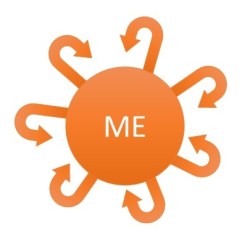 The truth about leadership accountability is that it is all about ME. It starts with ME. It sustains with ME. It grows with ME. It can be ended by ME. The concept of anything in leadership being “all about me” is a colossal departure from 99.9% of what I read and hear about good leadership, but when it comes to leadership accountability it truly is controlling MY actions, MY attitude, and MY effort that dictate my application of accountability. Leadership accountability is an inside out process. It is through internal accountability that I set the proverbial bar or expectations. Those I am leading see what I am doing, how I am doing it, and most importantly I explain why I am doing what I am doing. As the example is set, then I have earned the right to set external expectations of those I am leading because they know that I am not and never would ask them to do something I am not doing or willing to do myself. In other words, I must exemplify accountability before I can ever expect it from those I lead – that is leadership accountability.
 Thin Blue Line of Leadership