Tag Archives: relationships

Leadership Accountability – It’s All About ME

Accountability – the actions, attitude, and effort necessary to merge expectations with performance.

As we move forward with our discussion about leadership accountability, I must address two common myths that often send leaders down incorrect paths, or worse, make them appear to be hypocrites.

MYTH #1: Accountability is a team thing.
WE

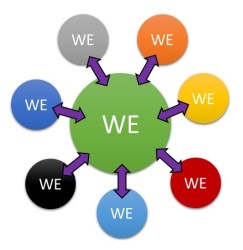
When I read books or listen to someone speak about leadership, I notice the theme of building positive, supportive, and unified teams is everywhere. Heck, I often write about the power of teams here on the TBLL Blog and fully endorse the benefits of building strong teams. However, when it comes to accountability, especially leadership accountability, it is not a team concept. The idea of “you hold me accountable and I, the leader, will hold you accountable” sounds great on paper or when said aloud, but there is one significant flaw in this logic. There is a complete lack of internal accountability being demonstrated where I recognize that I have the power to control both my expectations and my performance at all times. If I am relying on someone else to hold me accountable, am I really being accountable at all? The team accountability concept is based upon others controlling or setting my expectations for me. It means I am turning over the power of controlling my actions, attitude, and effort to say I need you to watch me and make sure I stay on the right path or do the right thing. Ultimately, the most significant issue with leadership accountability under this model becomes who is really leading, forging ahead, and setting the example?

MYTH #2: Accountability is something I, the leader, bestow upon other people.

THEMThe second myth of accountability is that accountability is only something I do to other people. Specifically, the people that work on my squad or unit. If my view is that accountability is an external process of me holding others to my expectations or those of the department, then I am creating a culture of “them” and “they.” With this idea of accountability, I believe I must hold them accountable at all times and attempt to control their performance towards my expectations. This often comes across as micromanaging to those being led and to me it feels as if my entire job has become running around putting out fires all day. To those I am holding accountable, their perspective becomes one of contempt and I have now become part of the infamous “they.” The generic pronoun used to describe those higher in power within an organization when we feel there is not a choice in whatever matter is at hand. Ultimately, this style of accountability is only sustainable for as long as the leader can manage the energy to keep it up and are physically present around those they are “leading” to enforce their expectations. Once the leader becomes too tired to keep it up, they retract to the confines of their office to hide because they just cannot manage the level of effort required to constantly hold six to eight people constantly accountable. Worst of all is that none of those on the squad or unit have ever learned how to hold themselves accountable to these expectations because the boss has always done it for them.

TRUTH: Accountability, especially leadership accountability, is all about me.

METhe truth about leadership accountability is that it is all about ME. It starts with ME. It sustains with ME. It grows with ME. It can be ended by ME. The concept of anything in leadership being “all about me” is a colossal departure from 99.9% of what I read and hear about good leadership, but when it comes to leadership accountability it truly is controlling MY actions, MY attitude, and MY effort that dictate my application of accountability. Leadership accountability is an inside out process. It is through internal accountability that I set the proverbial bar or expectations. Those I am leading see what I am doing, how I am doing it, and most importantly I explain why I am doing what I am doing. As the example is set, then I have earned the right to set external expectations of those I am leading because they know that I am not and never would ask them to do something I am not doing or willing to do myself. In other words, I must exemplify accountability before I can ever expect it from those I lead – that is leadership accountability.

Once the example of leadership accountability is set, then it begins to grow. In the next TBLL Blog, we will discuss how accountability grows through the leader’s example.

Questions to ponder . . .

  • In my current leadership position, did I set the expectations first or set the example first?
  • What are the benefits to be gained from exemplifying a solid foundation of leadership accountability?
  • As a leader, do I control those I am leading or do I influence them?

The mission at Thin Blue Line of Leadership is to inspire law enforcement supervisors to be the best leaders they can be by providing positive leadership tactics and ideas. Positive leadership and creating a positive squad culture are on-going commitments that must be nurtured and developed over time. Thin Blue Line of Leadership is here to help.

Please do not hesitate to contact us if you have ideas to share or suggestions for improvement. Your thoughts or comments on this blog are always appreciated either below or on our Facebook page. You can also follow us on Twitter at @tbl_leadership.

Continue saving the world one call at a time and as always, LEAD ON!

*** Parts of this blog are paraphrased from the excellent book, QBQ: The Questions Behind the Question by John G. Miller.
7 Core Values for Building a Team (Videos)

For my police department, I created a leadership training based upon the TBLL Blog entitled, “7 Core Values for Building a Team.” Within this training were 7 short videos that utilize modified interviews from the EntreLeadership Podcast by Dave Ramsey which were set to law enforcement related images and words. These videos served as an excellent starting point for discussion and debate over the 7 Core Values for Building a Team.

Feel free to utilize these videos with your leaders, units, and squads. They are excellent for starting discussions…

VIDEO LINKS:


The mission at Thin Blue Line of Leadership is to inspire law enforcement supervisors to be the best leaders they can be by providing positive leadership tactics and ideas. Positive leadership and creating a positive squad culture are on-going commitments that must be nurtured and developed over time. Thin Blue Line of Leadership is here to help.

Please do not hesitate to contact us if you have ideas to share or suggestions for improvement. Share your thoughts or comments on this blog below or on our Facebook page. You can also follow us on Twitter at @tbl_leadership.

Continue saving the world one call at a time and as always, LEAD ON!

Leadership Accountability – Control vs. Influence

KEY POINTS PREVIOUSLY DISCUSSED ABOUT LEADERSHIP ACCOUNTABILITY

Accountability is the actions, attitude, and effort necessary to merge expectations with performance.

Understanding who controls the expectations and who controls the performance is key to understanding leadership accountability.

Leadership accountability is all about ME. It start with ME. It sustains with ME. It grows with ME. It can be ended by ME. My ACTIONS, ATTITUDE, and EFFORT.

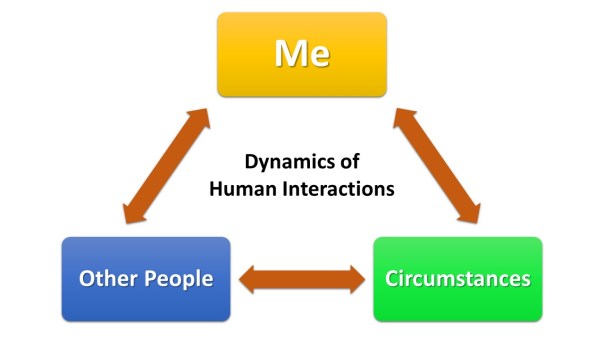
Before I can even begin to discuss control versus influence, we must be on the same page regarding the Dynamics of Human Interactions. Whether we are discussing leadership accountability, a use of force situation, handling a “routine” call for service, or any other leadership situation, the same three components always come into play.

As a leader, I must understand these dynamics in order to truly comprehend what I control and what I influence in the world around me. The most significant mistakes ever made in leadership commonly originate from the leader attempting to control something they do not truly have control over. If they had merely asked themself, “How can I influence this?” interaction with this other person or circumstance, the situation may have turned out much differently.

Slide9

In every interaction we have as human beings, there are three basic components: ME, OTHER PEOPLE, and the CIRCUMSTANCES that bring us together.

Slide10

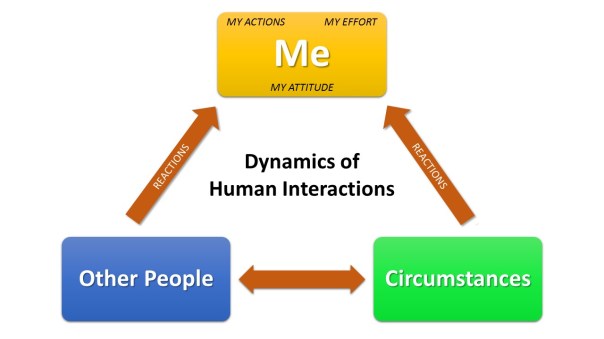
Of these three components, it is vital that I recognize and understand there is only one of these that I have true control over – MYSELF. I cannot control other people and I cannot control the circumstances that brought everything together. So, within myself, the things I truly have control over are my actions, my attitude, and my effort.

  • What actions do I have the ability to take? Options?
  • What attitude is the best approach for the situation?
  • How much effort is necessary to properly handle this situation?

Slide11

If I take responsibility for and own my actions, attitude, and effort, then I also have to accept that I control my Reactions to the external components of these Dynamics of Human Interactions. As information comes in from Other People, Circumstances, and their Interactions, I must accept that I have NO control over them at all. I initially can only control my reactions to the information coming in about them through the actions, attitude, and effort I CHOOSE to respond with.

But, this is not easy. I, as a human being, am an emotional and reactional creature by nature. It has been programmed into me over thousands of years to survive. Sometimes those survival instincts are beneficial and sometimes they are not. When my survival instincts tell me to strike back quickly, act in a manner that is solely based upon self-preservation, and is the path of least resistance, then I must find a way to freeze the moment and remember what I control. This is especially true in leadership situations.

Slide12

I must accept I cannot CONTROL Other People, Circumstances, and their Interactions. As a leader, I must also accept I can INFLUENCE them. By recognizing that my actions, my attitude, and my effort are the tools I possess to positively influence them, I can begin to see leadership situations in a much different light. The greater my influence, the greater my leadership. The greater my leadership, the more vital it becomes for me to act consistently to maximize my influence.

Slide13

How do I maximize my influence in regards to leadership accountability? I practice personal accountability myself day in and day out by controlling that which I control. I set clear expectations that provide a vision of the future, not just repeat rules and policies. I provide training, instruction, coaching, counselling, and mentoring. I discipline when necessary to educate, not punish. Finally, I recognize good work and positively reinforce it every chance I get. All of these are methods for me to influence those I lead and the circumstances I am a part of through my actions, my attitude, and my effort.

Whenever I find myself feeling stress while handling a situation of leadership, I simply hit my mental pause button and change the internal question I am asking myself from “How can I control this?” to “How can I influence this?” Suddenly, the feelings of stress and anxiety begin to dissipate and I begin working with what I control – MYSELF.

The mission at Thin Blue Line of Leadership is to inspire law enforcement supervisors to be the best leaders they can be by providing positive leadership tactics and ideas. Positive leadership and creating a positive squad culture are on-going commitments that must be nurtured and developed over time. Thin Blue Line of Leadership is here to help.

Please do not hesitate to contact us if you have ideas to share or suggestions for improvement. Your thoughts or comments on this blog are always appreciated either below or on our Facebook page. You can also follow us on Twitter at @tbl_leadership.

Continue saving the world one call at a time and as always, LEAD ON!

3 Signs of a Miserable Law Enforcement Job

“High school kids at In-N-Out Burger and Chick-fil-A are doing largely the same job that kids at any other fast-food restaurant are doing, and yet there are a lot fewer miserable jobs at In-N-Out and Chick-fil-A. The difference is not the job itself. It is the management. And one of the most important things that managers must do is help employees see why their work matters to someone. Even if this sounds touchy-feely to some, it is a fundamental part of human nature.”     – Patrick Lencioni

3signs

The premise of the book “3 Signs of a Miserable Job” by Patrick Lencioni is simply this – staying in a miserable job can have severely negative consequences on a person mentally, physically, and emotionally. These consequences can affect a person’s life both personally and professionally and it does not have to be that way. The good news is that, as supervisors, we have the ability to combat the 3 signs of a miserable job and it really is not that complicated.

Here are the 3 signs of a miserable job . . .

  1. ANONYMITY

“People cannot be fulfilled in their work if they are not known. All human beings need to be understood and appreciated for their unique qualities by someone in a position of authority. . . . People who see themselves as invisible, generic, or anonymous cannot love their jobs, no matter what they are doing.”

  1. IRRELEVANCE

“Everyone needs to know that their job matters, to someone. Anyone. Without seeing a connection between the work and the satisfaction of another person or group of people, an employee simply will not find lasting fulfillment. Even the most cynical employees need to know that their work matters to someone, even if it’s just the boss.”

  1. IMMEASUREABILITY

“Employees need to be able to gauge their progress and level of contribution for themselves. They cannot be fulfilled in their work if their success depends on the opinions or whims of another person, no matter how benevolent that person may be. Without a tangible means for assessing success or failure, motivation eventually deteriorates as people see themselves as unable to control their own fate.”

In relation to law enforcement, if an officer is miserable in their job due to the factors of anonymity, irrelevance, and immeasurability, then what is the cost to them personally, their squad, their department, and the community they are supposed to be serving? Personally, they carry their misery home which adversely affects their family life. They become the salty grump in the back of the briefing room that complains about everything and sucks the energy out of all around them. To the department they are a liability because of the negative impact on the culture and the unpredictability of their actions on the road. The community suffers because the miserable officer represents the worst of the police department which erodes public trust and makes the job that much more difficult for the officers that are not miserable. How many officers are you picturing in your head right now that match this description of a miserable officer?

Here are 25 ways law enforcement supervisors can combat anonymity, irrelevance, and immeasurability . . .

ANONYMITY

  1. Create a team atmosphere within the squad where it is believed that we is greater than I.
  2. When you get a new officer, meet with them individually and get them on board with the squad culture from day one.
  3. Recognize good police work in briefing. What you reward will be repeated.
  4. Have officers debrief good calls for service and share their expertise and successes with others.
  5. Get out of the office and on the road with your officers. Try to get on a call for service or backup each of your officers during each shift, if time allows.
  6. Rotating having officers conduct briefing training based upon their policing strengths and interests.
  7. Meet with officers regularly to discuss their career goals and seek out opportunities to help them fulfill those goals.
  8. Get to know your officers’ families. Create opportunities for them to all get together with the other families of the squad.
  9. Send handwritten thank you notes to your officers’ spouses or significant others to let them know that you appreciate the commitment that the families make to law enforcement, too.

IRRELEVANCE

  1. Making policing relevant is about getting back to the “why.” Know why you chose to become a police officer. Know why you chose to be a supervisor. Share your why with your officers. Get to know their why, find opportunities to relate their why to calls for service, and discuss the relationship in briefing.
  2. As a supervisor, you set the tone and create value in community service. If it is important to you, it will be important to them.
  3. Promote public commendations in briefing by reading them aloud for all your officers to hear.
  4. Teach your officers to be good beat cops and take pride in their assigned part of the city.
  5. Get away from the term customer service and focus on community service. The term customer service cheapen what we do as police officers and builds irrelevance.
  6. Have discussions in briefing regarding who your officers serve. Point out that they serve not only the community, but they also serve each other. Discuss that you, the supervisor, are there to serve them.
  7. Teach your squad to have a focus on finding solutions while on calls for serve; not on producing statistics, being a band aid, or handling them as quickly as possible.
  8. Exemplify and promote a culture of positivity on your squad through your actions, attitude, and effort.
  9. Provide good feedback and evaluations to your officers. In return, ask for them to do the same for you.

IMMEASUREABILITY

Of the 3 signs of a miserable job, immeasureability is the most difficult for law enforcement supervisors to deal with directly. There is no limit to the number of statistics that can be measured for each officer: calls for service responded to, self-initiated activities, arrests made, tickets written, response times, amount of time spent on each call, number of community policing activities, etc. The question becomes, are we measuring the right things?

  1. Clearly define what the “rock star” police officer would do on a “perfect” shift based upon the mission, vision, and operational goals of the department.
  2. Determine what statistics officers and/or the department have the ability to capture that correspond to the “perfect” shift. If part of the “perfect” shift includes community policing and/or positive interactions with the community, then a way to count those interactions must be determined, as well.
  3. Set specific goals based upon what the “perfect” shift would look like that clearly define what success looks like for officers and provide them with a way to track those numbers.
  4. Ultimately, whatever is chosen to be measured must be supported by the officers’ direct supervisors because the direct supervisors will give the statistics being measure their value.
  5. Supervisors must assist officers in seeing the positive perspective to their seemingly negative activities like making arrests or writing tickets.
  6. The question to be answered is how do you measure community policing activity effectiveness? Do you count the number of positive citizen commendations, the number of people that say “thank you” after being arrested/written a ticket, or the amount of time dedicated to solving beat problems? This is where the difficulty in the measurability of policing comes into play and must be answered by departments everywhere.

There are many more ways to combat anonymity, irrelevance, and immeasurability in policing. If these 3 signs of a miserable job are not addressed by law enforcement supervisors, then they will have to deal with the miserable officers they are allowing to be created.

“If you’re still not convinced that this makes sense or that it applied to you, this would be a good time to consider resigning your position as a manager and finding a role as an individual contributor.”  – Patrick Lencioni

The mission at Thin Blue Line of Leadership is to inspire law enforcement supervisors to be the best leaders they can be by providing positive leadership tactics and ideas. Positive leadership and creating a positive squad culture are on-going commitments that must be nurtured and developed over time. Thin Blue Line of Leadership is here to help.

Please do not hesitate to contact us if you have ideas to share or suggestions for improvement. Your thoughts or comments on this blog are always appreciated either below or on our Facebook page. You can also follow us on Twitter at @tbl_leadership.

Continue saving the world one call at a time and as always, LEAD ON!

A Simple Gesture

I am a police officer that just happens to have the rank of sergeant. I have 8 police officers that work with me to keep the community we serve safe on one of the toughest work schedules and largest districts in the department.

One week a few months ago, due to scheduling issues out of my control, my squad of 8 officers was reduced to just 4. I knew that we were going to be slammed handling the same amount of calls for service that usually come in, but with half the number of officers.

At the beginning of each shift that week, I walked into the briefing room and extended my hand to my 4 officers for a handshake. I told them that I appreciated them being there and for all of the hard work that we knew was ahead of us.

What I found was that the simple action of shaking their hands in advance of what was before us served two purposes:

  1. The handshakes demonstrated respect for them by showing appreciation for their presence in the face of a tough situation.
  2. The handshakes also negated the negative of the situation and turned it into a positive to be fought through as a team, not to be put out by.

In recognizing the power of this simple action, I felt compelled to find a way to continue building the same connection with my officers that started with these simple gestures. With the busy week over, I had the weekend to consider how I was going to use it going forward.

I walked into our squad briefing the next Wednesday and looked around at my 8 young officers ready to hit the road. Without thinking about it for a second, I extended my hand and began walking around the room shaking each of their hands and saying, “Thanks for being here.”

To this day, I start every Wednesday briefing just like that. Do not underestimate the power of a simple gesture and the positive effect it can have on your officers.

The mission at Thin Blue Line of Leadership is to inspire law enforcement supervisors to be the best leaders they can be by providing positive leadership tactics and ideas. Positive leadership and creating a positive squad culture are on-going commitments that must be nurtured and developed over time and Thin Blue Line of Leadership is here to help.

Please do not hesitate to contact us if you have ideas to share or suggestions for improvement. Your thoughts or comments on this blog are always appreciated either below or on our Facebook page. You can also follow us on Twitter at @tbl_leadership.

Continue saving the world one call at a time and as always, LEAD ON!

HELP WANTED: Police Officers Needed

In August of 1914, Sir Ernest Shackleton led the Endurance Expedition on a voyage to make the first land crossing of the Antarctic continent. Prior to the expedition, Shackleton needed to raise a crew and posted the following help wanted advertisement:

“Men wanted for hazardous journey. Low wages, bitter cold, long hours of complete darkness. Safe return doubtful. Honor and recognition in event of success.”

Even after posting such an unflattering advertisement of the trip ahead, sailor’s responded. In the book, “Quit You Like Men” by Carl Hopkins Elmore, Shackleton said that the response to the advertisement was so overwhelming that “it seemed as though all the men of Great Britain were determined to accompany him.”

By January 1915, the Endurance had become trapped in the thick Antarctic ice and began to break apart forcing Shackleton and the crew to abandon it. They had to set out on foot dragging lifeboats and supplies across the ice for any chance of survival. Eventually they located a suitable place to establish a camp. Shackleton realized that in order to survive they were going to need to take matters into their own hands; so they developed a rescue plan to seek out help.

Prior to Shackleton leaving on the rescue mission, a crew leader told Shackleton, “Whatever happens, we all know that you have worked superhumanly to look after us.”  Shackleton replied, “My job is to get my men through all right. Superhuman effort isn’t worth a damn unless it achieves results.” To make a great, long story short, it was only through the crew’s dedication and Shackleton’s leadership that they were eventually rescued over a year after the ship had become trapped. This is a fabulous story of leadership, sacrifice, and survival, but what really caught my attention was still the unflattering help wanted advertisement that attracted such a positive response from prospective sailors.

With the current climate surrounding law enforcement, how would a help wanted advertisement have to read in order to be just as truthful and unflattering, yet attract exactly the type of people we want in policing? Maybe it would read something like this:

HELP WANTED: Men and women wanted for hazardous 20 – 25 year career. Long hours during all times of day and night enforcing laws created by politicians you don’t necessarily agree with. Low to moderate wages protecting and serving a community that you may not even live in. Solve problems and risk life regularly for people that you don’t know and possibly don’t even like you while constantly transitioning between the roles of counselor, guardian, enforcer, educator, warrior, caretaker, and community representative. All interactions with the community must be recorded on video. Actions, especially mistakes, will be highly critiqued, criticized, and possibly penalized. Honor and recognition in event of success.

Honor and recognition in event of success . . . is that all it takes? Yep, along with being part of something greater than yourself and believing that on each and every call you have the ability to make a difference in another person’s life. Those are the results that we, those that call ourselves police officers, are looking for when we chose this career. As Shackleton stated, “Superhuman effort isn’t worth a damn unless it achieves results.” That is why we make the “superhuman effort” for a job that has this kind of description.

So, how do we maintain this level of effort? We remember our “why” . . .

Why did I chose to be a police officer?

Why did I chose to be a leader of police officers?

If you read those questions and cannot articulate an answer, or worse don’t remember, then I challenge you to sit down, brainstorm some ideas, and seek the words that describe why you were inspired to choose a career with this type of help wanted advertisement.

As soon as the right words come together and you can clearly articulate them, put them somewhere very safe where they cannot be forgotten. Your “why” will get you through that 20 – 25 years career just as it got Shackleton and his men through their expedition without a single life lost. If you get the privilege to lead officers through their policing careers, share your “why” often to motivate and inspire greatness in them so they too may receive “honor and recognition in event of success.”

The mission at Thin Blue Line of Leadership is to inspire law enforcement supervisors to be the best leaders they can be by providing positive leadership tactics and ideas. Positive leadership and creating a positive squad culture are on-going commitments that must be nurtured and developed over time and Thin Blue Line of Leadership is here to help.

Please do not hesitate to contact us if you have ideas to share or suggestions for improvement. Share your thoughts or comments on this blog below or on our Facebook page. You can also follow us on Twitter at @tbl_leadership.

Continue saving the world one call at a time and as always, LEAD ON!

4 of 7 Core Values for Building a Team – Building Unity and Loyalty (Video)

Welcome to the Thin Blue Line of Leadership Blog. We’re going to continue with Core Value #4 of the 7 Core Values for Building a Team.

For my department, I created a leadership training based upon the TBLL Blog entitled, “7 Core Values for Building a Team.” Within this training were 7 short videos that utilized modified interviews from the EntreLeadership Podcast which were set to law enforcement related images and words to enhance the parallels. These videos served as an excellent starting point for discussion and debate over the 7 Core Values for Building a Team. The fourth video is from a lesson taught by Dave Ramsey on the EntreLeadership Podcast. It is focused on Core Value #4 – Building Unity and Loyalty.

Over the next few weeks, the other related videos will be added. Please comment either here or on YouTube and let us know what you think. If you like the videos, we’ll look into doing more of them going forward.

The mission at Thin Blue Line of Leadership is to inspire law enforcement supervisors to be the best leaders they can be by providing positive leadership tactics and ideas. Positive leadership and creating a positive squad culture are on-going commitments that must be nurtured and developed over time and Thin Blue Line of Leadership is here to help.

Please do not hesitate to contact us if you have ideas to share or suggestions for improvement. Share your thoughts or comments on this blog below or on our Facebook page. You can also follow us on Twitter at @tbl_leadership.

Continue saving the world one call at a time and as always, LEAD ON!

Transactional vs. Relational Policing

As a law enforcement supervisor, have you ever tried to explain to someone what good policing is? Sometimes putting things into words can be an extremely difficult task. If you are like me, the first hundred times you try to answer this question you find yourself jetting off into all these tangents about handling calls, traffic enforcement, conducting thorough investigations, making big busts, taking down the “really bad guys,” and somewhere in there working with the community. By the time you get done it feels like you just named off a bunch of different tasks and never really answered the question – What is good policing?

One night, I was driving in for my overnight shift listening to the “EntreLeadership” podcast and they were interviewing a gentleman named Mick Ebeling. What really struck me was when Mr. Ebeling began talking about transactional and relational marketing as it relates to his non-profit organization. Mr. Ebeling did not invent these concepts, but it was the first time I had ever heard them explained. I realized that the concept of relational marketing is 100% applicable to explaining what good policing is. I knew that if I could put what good policing is into words, it would be that much easier to explain to my officers what we should be doing out in the community . . . let me explain.

Transactional and Relational Marketing defined . . .

Transactional Marketing: Transactional marketing is focused solely on the actual sales process for an item and may include aggressive tactics that alienate the customer. The emphasis is on getting the deal done right now with little thought about future sales or the customer ever returning. For example, think of the car salesman that will do or say anything to keep you from getting off the lot without one of their vehicles being purchased. You either purchase the vehicle and feel dirty for it or you become so alienated that you never return to that dealership again.

Relational Marketing: Relational marketing is focused on developing a relationship between the customer and the salesperson or business. Because of the relationship, customers feel loyal to that company and return for future purchases. For example, a non-profit organization tells you the story of the person that you will be helping by donating the equivalent of “just a cup of coffee a day.” There is a relationship built between you and the person you will be helping; the non-profit organization is the intermediary. The relationship is the priority in this type of marketing with the hope being that you return to donate regularly to help support that person and their cause.

So, let’s take those same concepts and replace the term “marketing” with “policing” . . .

Transactional and Relational Policing defined . . .

Transactional Policing: Transactional policing is focused solely on the process and may include aggressive tactics that alienate the community. This comes out in policing primarily when we are overly focused on statistical production: handling calls for service as fast as possible, writing as many tickets as possible, or making as many arrests as possible with little regard for the community as a whole.

One excellent example of transactional policing is photo radar – photo radar is all about the transaction between a vehicle speeding and the associated monetary fine. There is absolutely no relationship developed which explains why there is such a visceral hatred of photo radar tickets from many in the community. If you are reading this example and thinking, “yeah, but there isn’t a person involved in photo radar tickets,” my reply would simply be to ask if you have ever been pulled over by a stereotypical motor officer? It often goes something like this . . .

MOTOR: License, registration, insurance…

DRIVER: Here’s my license and I’ll have to look for the registration and insurance.

MOTOR: Do you know why I stopped you?

DRIVER: No, not really. (Or insert generic excuse for bad driving here.)

MOTOR: You were doing 58 mph in the posted 45 mph zone. Wait here.

MOTOR: (5 seconds later) Here’s your ticket for speeding, no registration, no proof of insurance, the cracked windshield, and I also noticed that you have a white light to the rear. Your options for taking care of the ticket are on the back.

Traffic stop complete in 54.3 seconds, 5 violations written, and the motor pulls away to make another traffic stop before the driver even knows what happened. This is obviously an exaggerated example, but you get my drift – no relationship developed. Similar scenarios can be played out while handling calls for service or conducting investigations, if the emphasis is solely on getting the task done as quickly as possible or getting as many as possible.

Relational Policing: Relational policing is focused on developing a relationship between the community member(s) and the officer(s) they come into contact with. Because of the relationship, the community member(s) feels a sense of loyalty to that officer(s) and ultimately each is more cooperative with the other. Overtime, this type of policing develops a stronger relationship between the police department and the community they serve.

Let’s go back to our traffic stop example; this time with an emphasis on developing the relationship between the officer and driver . . .

OFFICER: Good evening, do you have your license registration, and insurance?

DRIVER: Here’s my license and I’ll have to look for the registration and insurance.

OFFICER: Other than this, how has the rest of your day been?

DRIVER: OK, but long. I was trying to get home a little quicker than I should have to get dinner ready. (Hands officer registration and insurance.)

OFFICER: Yeah, you were doing 58 mph in the posted 45 mph zone. We’ve been working a lot of traffic enforcement in this area due to the high number of collisions recently. Wait in your vehicle and I’ll be right back.

OFFICER: (Returns after writing the ticket) Like I said earlier, I had you at 58 mph in the posted 45 mph zone. Your options for taking care of this are . . . (provides explanation) . . . Do you have any questions for me? Have a better day.

While this example is obviously based upon a cooperative driver, many times even an argumentative driver can be won over by just doing some of the basic relationship building concepts exhibited. Some of the key points include asking how they are doing outside of this experience, giving them time to actually answer your questions or complete requests, provide a reason for your actions, and provide an explanation for how they can take care of the ticket. Simple concepts based on treating people with dignity and respect can be applied in nearly every law enforcement encounter we go on; as officer safety allows. Obviously during instances of emergency response or use of force situations, this is secondary to the welfare of citizens and officers; but these situations make up a small percentage of our total daily interactions with the community.

DO NOT misunderstand this concept, this is NOT about “hug a thug,” only give warnings, do not make arrests, kissing babies, and pretending the world is a completely safe place. The concept of relational policing is about spending an extra couple of seconds on each traffic stop, call for service, investigation, foot patrol, etc. to build a relationship with community members whether they are reporting parties, victims, bystanders, concerned neighbors, or even suspects.

Still wondering if it works? To date, I have physically placed handcuffs on and arrested approximately 1,500 people for various crimes. Of those, only 5 have ever fought with me getting into those cuffs. I do not attribute this to luck, I attribute it to the fact that I received some very good advice earlier in my career to treat everyone with dignity and respect until they showed they deserved otherwise. This is not an easy task, but it has served me well over the years and when I heard the aforementioned podcast talking about relational marketing it gave me words to describe how good policing should be – relational.

Being a leader is about building relationships. The better relationships you build, the better leader you will be. As law enforcement officers, regardless of rank, we need to build relationships both with those we work with and with the communities we serve so we can lead them properly. As the 21st century continues on and law enforcement works towards solutions regarding negative LE perceptions, I believe that relational policing provides a no cost way of beginning to work on many of these issues. The challenge is that there must be law enforcement leaders willing to stand up in briefing rooms, training environments, and command staff meetings open to putting new, viable solutions out there that answer the question – What is good policing?

Good policing is relational policing.

The mission at Thin Blue Line of Leadership is to inspire law enforcement supervisors to be the best leaders they can be by providing positive leadership tactics and ideas. Positive leadership and creating a positive squad culture are on-going commitments that must be nurtured and developed over time and Thin Blue Line of Leadership is here to help.

Please do not hesitate to contact us if you have ideas to share or suggestions for improvement. Share your thoughts or comments on this blog below or on our Facebook page. You can also follow us on Twitter at @tbl_leadership.

Continue saving the world one call at a time and as always, LEAD ON!

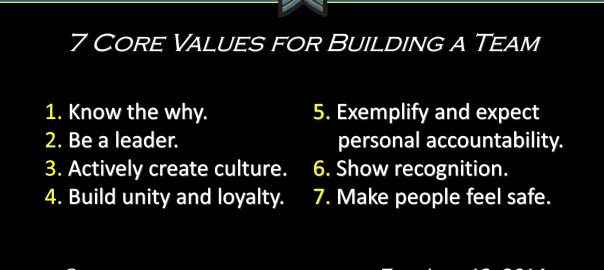
7 Core Values for Building a Team – Part 2

This blog is Part 2 of 7 Core Values for Building a Team. If you would like to read Part 1, click here.

  1. Build unity and loyalty.

Unity and loyalty . . . Aren’t those two of the greatest words to have around when it comes to being part of a team? When unity and loyalty are present, trust is flowing in all directions within the squad, precinct, district, or department – top down, bottom up, and laterally. But, there is a caveat to this and that is that there are just some people that won’t buy-in to the concepts that help build a good team. Regardless of the amount of effort expended on creating the right environment, they will just never get it. So, the leader has 2 options. They can decide that they are just not going to do anything to build a team and therefore they lose everyone. Or, they can work hard to build a team and get the buy-in of the vast majority of the people to create something really special within their department. There is no great secret to building unity and loyalty. It is one of the oldest concepts around. Treat people the way you want to be treated. That’s it. If you want to build unity and loyalty, then no matter how difficult the situation is, just ask, “How would I want someone to treat me under these circumstances?” The consistent practice of that concept will take a person a long way in their growth as a leader that creates positive cultures based upon unity and loyalty.

  1. Exemplify, then expect personal accountability.

Personal accountability is a tough one for many because it means stepping up and taking responsibility when the world is falling apart around them and/or their team. Personal accountability is easy when everything is going great, but not so much when things are turbulent. Leaders must be cautious about forcing personal accountability upon their teams because if it gets crammed down their throats, they will immediately reject it. To bring personal accountability to the team, the leader must first exemplify it to demonstrate how it is done and how it leads to positive growth both personally and for the team as a whole. They need to see it first because the greatest fear in applying personal accountability is that they are going to get themselves into some kind of trouble when they do it. The best thing about applying personal accountability is that it puts the leader in control of the situation. The leader is saying through their actions and attitude that “the buck stops here.” Once that control is accepted, the leader must begin asking questions that lead to solutions and not allow themselves to fall into a victim mentality. Here are some examples of personal accountability questions – What can I do? How can I learn from this mistake? What can I do to make a difference today? How can I be better? Because each of these questions is based on the concept of “I,” it puts the leader in control of developing a solution to whatever the problem is through their own actions, attitude, and effort. After the team sees personal accountability applied by the leader day in and day out, they will also begin applying it to their tough situations. Having a culture based upon personal accountability is one of the biggest differences between having a culture of mediocrity and a culture of excellence.

  1. Show recognition.

All of the above listed concepts are great, but they do not mean a thing if they are not ingrained into the culture of the team. A leader has the amazing opportunity to pick and choose what gets ingrained into a team’s culture by being selective of the actions and attitudes they recognize, reward, and promote. But, it all starts with the leader first having a vision of where they want the team to go and how they want them to get there. They must define the path and the goals to be achieved if the path is followed. Then, the leader must focus on finding behaviors that officers are doing that support that vision. When actions and attitudes are present that support the leader’s vision, it is imperative of the leader to recognize them and find ways to reward them for the behavior. One of the simplest rewards a leader has at their disposal is verbal praise. When giving verbal praise, do not just say, “Good job;” be specific about what the behavior was that made it good. If the leader says, “Good job, I really like the way you took the time to calm that victim down before doing the interview,” then not only has the leader praised the officer, but they have defined what exactly the behavior was they liked. After recognizing and rewarding something like that, what do you think that officer is going to do they next time they interview a really traumatized victim? That’s right, they are going to take the extra couple of minutes to talk to the victim on a human-level before getting down to the facts of the situation. After recognizing and rewarding the behavior, it must be promoted. One way to promote positive behaviors is to bring them up in briefing with the rest of the team around. This creates a second opportunity for the leader to recognize/reward the officer and then promotes it to the other member of the team. Obviously, the bigger and better the behavior, the more substantial the recognition, reward, and promotion should be. For example, if due to the heroic actions of an officer a person’s life is saved, then hopefully the department has some kind of official life saving award that can be given to the officer and thus the promotion of the behaviors goes to the highest ranks of the department. The key is to remember that what gets rewarded gets repeated.

  1. Make people feel safe.

To build a team, a leader must make the people on the team feel safe. Safe is not referring to the inherent dangers of the job. Safe, in these terms, means from the internal turmoil that can be present within an organization or the team itself. When there is turmoil within a group, like backstabbing, complaining, or general apathy, then no member of the team will ever feel safe within the group because they are always worried about what is going on when they aren’t around. It isn’t until they feel safe within their team that they can go out into the community and do their best work because they know that the team has their back. Creating that sense of safety is the job of the leader. When there is safety within the team, the natural reaction is the development of trust and cooperation. Trust and cooperation will lead people to do amazing things; things that are above and beyond the call of duty. When an officer stays late to help another officer impound a bunch of evidence, that shows that they have a level of trust and cooperation built. That trust and cooperation comes back in spaded when that other officer is wounded on a call and the team comes together to rescue him or her in the face of danger. In order for this level of trust and cooperation to exist, everyone must believe at their core that the other members of the team would be willing to do the same thing for them. Ultimately, people just want to feel like they belong. If there is a strong sense of belonging among the members of the team, then trust and cooperation will flourish among the group.

Instead of looking at culture, vision, mission, purpose, alignment, and value as 6 different items that a leader must work at getting across to their group, look at it as the single task of building a team. Think back to the best teams you were ever a part of and ask what it was that made those teams so special. What you’ll find is that the team had culture, vision, mission, purpose, alignment, and value in what they were doing. By building a team, the leader is creating a lens which each individual officer can look through as they go about doing their job each shift and see things in a similar manner instead of through just their own individual perspectives. Only then will officers be willing to drop their own personal agendas and give their blood, sweat, and tears for the good of the organization and the community.

If you would like to read further about these concepts, here are some good reading suggestions:

“Start With Why” by Simon Sinek

“Entreleadership” by Dave Ramsey

“QBQ! The Question Behind the Question” by John Miller

“The Energy Bus” or any other book by Jon Gordon

“Leaders Eat Last” by Simon Sinek

The mission at Thin Blue Line of Leadership is to inspire law enforcement supervisors to be the best leaders they can be by providing positive leadership tactics and ideas. Positive leadership and creating a positive squad culture are on-going commitments that must be nurtured and developed over time and Thin Blue Line of Leadership is here to help.

Please do not hesitate to contact us if you have ideas to share or suggestions for improvement. Share your thoughts or comments on this blog below or on our Facebook page. You can also follow us on Twitter at @tbl_leadership.

Continue saving the world one call at a time and as always, LEAD ON!

5 Steps to Develop Squad Culture

Whether you are a brand new law enforcement leader or one that has been around awhile, you must recognize the importance of developing a squad culture. If a squad culture is not developed intentionally, then the leader will be putting him or herself at the mercy of whatever fills that culture vacuum. So, the question becomes, how do you intentionally develop a squad culture?

Before getting into the nuts and bolts of developing a squad culture, there are two things that must be understood. The first thing to understand before developing a squad culture is the definition of culture. The culture of a group can be defined as the conglomeration of a group’s actions and attitudes over time; it’s atmosphere. The second thing to understand in developing a squad culture is that it doesn’t happen in a day, it has to happen every day. It must be taught, explained, reinforced, and made a priority in everything your squad does for it to take hold.

Here are 5 steps for developing a positive squad culture . . .

  1. Know what is already out there.

Before you can begin to establish your own culture, you have to have an idea of what is already out there within your organization. Study what is and what is not working. Then, seek out the leaders that are having success in developing their squad’s culture and talk to them about it. Save yourself some time and learn from their experience. Also, consider your own past experiences with law enforcement leaders. What did your previous sergeants do that made you feel like your work mattered and you were part of a team? Start isolating traits they had or things they did that helped to support the squad culture either positively or negatively. Sometimes your best learning experiences can come from the worst leaders by defining what you do not want to be or do.

  1. Identify what is important to you.

Now that you have seen what is out there and thought about past experiences, it is vital to identify what is important to you. What are the top 3 – 5 traits that you would want your squad to be known for – teamwork, officer safety, problem solving, being active, trust, positivity, treating people right, innovative, hardworking, caring about the community, responsive, rewarding, etc. Those are just a few of many words that could be used to describe a positive squad culture. The key is to settle on the ones that you want to make the focus of your squad.

  1. Visualize yourself in that environment.

After deciding on the 3 – 5 traits that you want your squad to be known for, you must now begin to visualize yourself being in and leading in that environment – see it, feel it, hear it. Start making your own personal actions match those traits you selected. If you chose teamwork, then it is imperative that you exemplify teamwork. Remember the definition of culture, it isn’t this ambiguous thing floating in the sky; it is the consistent actions and attitudes of your squad. Just as officers are told to play the “what if” game while thinking about calls they are responding to, the leader must play the “what if” game with the tough situations they may face as a leader and then look at them through the lens of the culture you desire to create. Ask yourself, how would having a strong, positive squad culture help deal with this? Walk through situations like an officer having a personal issue at home, handling an officer discipline situation, one of your officers involved in an officer-involved shooting, or dealing with a year without pay raises. Do the traits you chose to exemplify your squad’s culture support handling those types of scenarios? If not, refine them until they do.

  1. Put your culture into words.

Finally, it is time to take the traits you chose and put them into words that your officers can understand and relate to. Help them to understand why it is valuable to have a well-defined culture. As you create the wording to define your culture, keep the following questions in mind: Are they worded in a positive way? Avoid words like never, no, and don’t. Are they simple to understand? The less complicated the better; not because your officers aren’t smart, but because you want your culture to be easy to remember and adaptable to a multitude of situations. The more complicated you make them, the more restrictive they will become. Do they bring value to your officers? If they don’t, then what is the point in the first place? Do they have the potential to motivate and inspire? Ultimately, people decide if they want to be motivated or inspired, but that doesn’t mean your culture can’t be the fuel for motivation and inspiration. Does your culture provide opportunities for feedback? Feedback goes both directions; feedback for you and feedback for your officers. A solid culture is rich in trust which makes feedback able to be given and received without concern about negative ulterior motives.

  1. Develop a mechanism for reinforcing your culture.

As stated earlier, culture is not made in a day, it is made every day. You must teach your squad to look at every situation though the lens of the culture by talking them through incidents, scenarios, and calls for service with their relationship to the squad culture explained. Develop mechanisms to quickly reward officers when their actions and efforts support and build up the desired culture. (Also see blog: Law Enforcement Recognition: Idea #1) Vice versa, be willing to have the tough conversations when officers do things that do not support the culture. But, first and foremost, to support your desired culture, YOU must exemplify it in everything you do. Without that consistency from you, the leader, the squad will not take the culture seriously and you will run the risk of being labeled a hypocrite.

After going through the 5 steps listed above, you should have a good handle on the concepts you would want to base your own squad’s culture on. If you would like to see the results of me going through this same process, read the blog entitled Culture in Just 4 Words. I purposely chose to make my squad expectations the cornerstone for establishing my squad’s culture. Squad expectations should be about the culture; not policies and procedures. Cops know the policies and procedures through their General Orders. A strong, positive culture will support doing the job the right way without making officers feel like the rules are more important than they are as people.

The mission at Thin Blue Line of Leadership is to inspire law enforcement supervisors to be the best leaders they can be by providing positive leadership tactics and ideas. Positive leadership and creating a positive squad culture are on-going commitments that must be nurtured and developed over time and Thin Blue Line of Leadership is here to help.

Please do not hesitate to contact us if you have ideas to share or suggestions for improvement. Share your thoughts or comments on this blog below or on our Facebook page. You can also follow us on Twitter at @tbl_leadership.

Continue saving the world one call at a time and as always, LEAD ON!