This briefing video is the TBLL interpretation of the Pulse Nightclub after action report entitled Rescue, Response, and Resilience. This report was put out by COPS and the Police Foundation in 2017. This video tells the story of the Pulse Nightclub shooting and then reviews 10 of the top lessons learned.
To keep the video to an appropriate time frame for a briefing training, some minor details were omitted from the story and it focuses primarily on the initial response at the first responder level. There are multiple points during the video where questions are posed for the viewers to pause and have discussion about how they would respond.
The mission at Thin Blue Line of Leadership is to inspire law enforcement supervisors to be the best leaders they can be by providing positive leadership tactics and ideas. Positive leadership and creating a positive squad culture are on-going commitments that must be nurtured and developed over time. Thin Blue Line of Leadership is here to help.
Please do not hesitate to contact us if you have ideas to share or suggestions for improvement. Your thoughts or comments on this blog are always appreciated either below or on our Facebook page. You can also follow us on Twitter at @tbl_leadership.
Continue saving the world one call at a time and as always, LEAD ON!
This briefing video is the TBLL interpretation of the study Making It Safer: A Study of Law Enforcement Fatalities Between 2010 – 2016 that was put out in 2017 by COPS and the NLEOMF. There is also a clip on passenger-side approaches referenced from Gordon Graham and Lexipol. Overall, the suggestions provided are fundamentals of safe policing, but a reminder every now and then can be helpful to save a life.
The mission at Thin Blue Line of Leadership is to inspire law enforcement supervisors to be the best leaders they can be by providing positive leadership tactics and ideas. Positive leadership and creating a positive squad culture are on-going commitments that must be nurtured and developed over time. Thin Blue Line of Leadership is here to help.
Please do not hesitate to contact us if you have ideas to share or suggestions for improvement. Your thoughts or comments on this blog are always appreciated either below or on our Facebook page. You can also follow us on Twitter at @tbl_leadership.
Continue saving the world one call at a time and as always, LEAD ON!
There are two foundational principles of the Nextgen Field Training Model that are addressed by the way in which the phases are established:
Create a field training model with a clear distinction between training and evaluation.
Build both training and evaluation phases in a manner consistent with the crawl-walk-run experiential learning format.
PHASES OF THE NEXTGEN FIELD TRAINING MODEL:
Phase 1 – Foundational Training
Phase 2 – Exposure Training
Phase 3 – Cleanup Training
Phase 4 – Evaluation (Previous FTO)
Phase 5 – Evaluation (Independent FTO)
Solo Phase – Evaluation (Assigned Supervisor)
KEY CONCEPTS OF TRAINING PHASES 1, 2, and 3:
Primary goal is for FTOs to train the OIT as a TEAM in preparation for the evaluation phases and solo capability.
No scoring on Observation Reports (OR). This establishes the concept that learner effort and being willing to jump in, try something, and risk making mistakes is more valuable than learner correctness.
Integration, reinforcement, and debriefing of decision-making utilizing the PRIDE Adaptive Decision-Making Model and Policing Priorities. Focus on training deliberate action – Train OITs to know what they are doing and why they are doing it.
Phases 1, 2, and 3 are set up in the crawl, walk, run experiential learning format.
As exposure to tasks increases, the role of the OIT transitions.
Learning -> Trying -> Doing.
As exposure to tasks increases, the role of the FTO transitions.
FTO -> Coach -> Mentor.
As the OIT transitions through the learning phases, the reliance upon the FTO should lessen and the OIT will be expected to utilize other resources available to them to answer questions in preparation for the Evaluation Phases.
Proficiency Training Tasks are not assigned to specific training phases in order to stimulate interleaving, effortful retrieval, and spacing in OIT learning.
The Phase 1 Trainer is the Foundational Trainer. The goal of the Phase 1 FTO is to establish the OIT’s foundational knowledge/skills and then begin increasing their exposure to patrol experiences.
The Phase 2 Trainer is the Exposure Trainer. The goal of the Phase 2 FTO is to expose the OIT to as many patrol experiences as possible. Repeated exposure, especially to infrequent CFS, is encouraged and beneficial to the OIT’s learning. Take the experiential learning opportunities as they present themselves.
The Phase 3 Trainer is the Cleanup Trainer. The Phase 3 FTO focuses on getting exposure to CFS that Phase 1 and 2 were unable to get and/or provide additional repeated exposures.
All Proficiency Tasks must be signed off before the OIT can move to Evaluation Phase 4.
Phase 3 may be eliminated for lateral or waiver officers to accelerate their field training, but they will still be expected to demonstrate proficiency on all Proficiency Tasks during evaluation.
KEY CONCEPTS OF EVALUATION PHASES 4 and 5:
Primary goal is to EVALUATE the OIT’s ability to perform at a solo capable level.
Since this is an Evaluation Phase, observation reports are scored in comparison to the Standard Evaluation Guidelines definition of a solo capable officer.
All Proficiency Tasks are signed off and show OIT has had training and experience in these areas.
Scoring observation reports only in the Evaluation Phases helps to remove scoring inconsistencies since the FTOs are only scoring officers that have received ALL of the pre-requisite training and should be solo capable.
OIT is acting as a solo capable officer with the FTO there primarily as an evaluator. FTO evaluators will still provide training on infrequent tasks the OIT comes across during these phases. Scoring will reflect this appropriately.
Phase 4 Evaluator will be the same FTO, when available, the OIT had while on Phase 1. If the Phase 1 FTO is unavailable, then Phase 2 FTO will be the next choice for Phase 4.
This provides a bridge into the evaluation process for the OIT. (Crawl)
The OIT starts their evaluation process with a familiar FTO, squad, and district.
Phase 5 Evaluator will be an independent FTO that has not worked directly with the OIT.
This is to build the OIT’s self-reliance to assist in their success when they are solo.
The independent evaluator also limits potential biases in the OIT’s success or failure.
At the end of Phase 4 or 5, if an evaluator feels the OIT has not had enough exposures to be able to comfortably decide on the OIT moving forward, they may request an extension. This does not negatively impact the OIT and provides additional time for the OIT to demonstrate solo capability.
At the end of Phase 4 and 5, if an evaluator feels the OIT is not solo capable, they can initiate a Performance Training Plan to work on those specific issue(s).
If a Performance Training Plan is initiated, that Evaluation Phase will not count and the OIT will still need to pass 2 Evaluation Phases before moving on to the Solo Phase.
OITs will only be given one Performance Training Plan after they reach the Evaluation Phase.
Interpretation of Evaluation Phase Results
Both Evaluators Pass OIT. -> OIT moves to Solo Phase on assigned patrol squad.
Evaluator’s Disagree on Passing OIT. -> OIT receives a Performance Training Plan to address Evaluator’s specific concerns and then must pass another Evaluation Phase.
Both Evaluators Fail OIT. -> OIT is removed from the program.
KEY CONCEPTS OF SOLO PHASE:
Primary goal is to EVALUATE the OIT’s ability to perform at a solo capable level while operating on their assigned patrol squad under the supervision of their assigned sergeant.
To get to the Solo Phase, the OIT must have been passed by 2 Field Training Evaluators.
If the OIT is successful in the Solo Phase, they will be fully released from the Field Training Program by their assigned sergeant and will be considered a solo capable officer. The patrol sergeant receiving the new officer has final approval for releasing the OIT.
If the supervisor has significant and specific documented concerns about the OIT’s ability to perform at a solo capable level, a Performance Training Plan will be initiated. An FTO will work with the OIT on their assigned squad to complete the PTP. The OIT will then repeat a Solo Phase Evaluation with their assigned sergeant.
The mission at Thin Blue Line of Leadership is to inspire law enforcement supervisors to be the best leaders they can be by providing positive leadership tactics and ideas. Positive leadership and creating a positive squad culture are on-going commitments that must be nurtured and developed over time. Thin Blue Line of Leadership is here to help.
Please do not hesitate to contact us if you have ideas to share or suggestions for improvement. Your thoughts or comments on this blog are always appreciated either below or on our Facebook page. You can also follow us on Twitter at @tbl_leadership.
Continue saving the world one call at a time and as always, LEAD ON!
One of the responsibilities of my current position is to coordinate, organize, and instruct portions of our department’s Sergeant-In-Training (SIT) School. This school is designed to introduce prospective sergeants to the basic expectations, tasks, and responsibilities of the sergeant position before they head out for a five-week sergeant field training experience.
One of the most highly regarded portions of the school are the discussion panels that we have at the end of each day. Each discussion panel is a two-hour Q & A session with a specific group to get their thoughts on the position of being a sergeant. This is an opportunity for the prospective sergeants to hear each of the group’s viewpoints at the same time. The groups for this year’s discussion panels included the Chiefs, Patrol Lieutenants, and New Sergeants.
For this Thin Blue Line Leadership blog, I want to share the top 3 keys points that came up during each group’s discussion panel.
THE CHIEFS
You raised your hand for this. When putting in to be a sergeant or any leadership position, you are raising your hand volunteering to take on the tasks and responsibilities of that job. No one is forcing you. It will come with both good and bad. Attack the job with the personal accountability of a leader and set the example.
The most difficult transition. All of the chiefs agreed that the most difficult transition they went through was from that of officer to sergeant. One day they were working alongside their squad mates as peers and then after a few supervisor classes and riding with a couple of senior sergeants they were blessed off to be sergeants themselves. They now had to see things from a slightly more elevated organizational viewpoint and this can create some challenges, if new sergeants are not prepared for it.
You are a part of “they” now. This is a realization that relates to the second bullet point, but is one that prospective sergeants should come into with their eyes wide open. Even in excellent organizations, there is a degree of “us” versus “them,” management versus labor. Promoting to sergeant is the first step into the world of management and meeting the standards set forth by the department’s vision, mission, and values must be at the heart of a new sergeant’s communication and leadership.
PATROL LIEUTENANTS
Communication is key to clearly leading up and down the chain of command. In most law enforcement organizations, the lieutenant position is the definition of middle management. They have the unique position of observing the importance of clear communication throughout the chain of command on a daily basis. They rely on sergeants to clearly communication their officer’s needs up while also counting on the sergeants to relay their communication back down to the officers. It is only through this smooth flow of information that the chiefs hear the officers and the officers hear the chiefs.
Make decisions. Patrol lieutenants have one primary expectation for those selected to promote to the rank of sergeant – make decisions. Over the years, those that enter the sergeant process have done so with years of experience handling calls, working on specialty units, developing resources, and forming a network of connections. They have made numerous decisions for themselves, but typically not for an entire squad under the scrutiny of everyone listening to the radio. Forget all of those extraneous factors and focus on doing the right thing, at the right time, for the right reasons.
Handle issues when they are small. Sergeants have the unique opportunity to develop one-on-one relationships with their officers. If time and effort are put into establishing these relationships, sergeants will know when things are off or when an officer is having an issue. Issues will typically begin in the form of small mistakes; missed deadlines, short temperament, admin problems, mistakes on typical things they do not make mistakes on, etc. The best thing a sergeant can do is address these problems when they are small by finding the root cause. Find the root cause, help the officer through the issue, and keep it from becoming a larger problem that could affect the rest of their career. If the sergeant has established a rapport with their officers, they will understand that taking care of the small things is how they show they care.
NEW SERGEANTS
Humility is a must. Moving from officer to sergeant is a difficult transition for typical “Type A” personalities because no one wants to make mistakes; especially officers and detectives that have had successful careers up until promoting. The fact of the matter is that as a newly promoted sergeant, mistakes will be made. Have the humility to learn from those mistakes and get better every day; officers understand this and are willing to work with a humble sergeant.
There is a TON of admin to do for the benefit of your officers. The position of sergeant comes with a ton of new admin responsibilities that differ from those of being a solo officer. Primarily this admin is related to things that take care of the officers – vacation schedules, training requests, court conflicts, reading paper, etc. One of the keys to being a good, if not great sergeant, is handling all of these new admin responsibilities that primarily only benefit the officers without them ever knowing about the amount of time, effort, and energy put into doing what is right by them.
Actions show what you really care about. One of the key aspects of learning to be a good sergeant is understanding that a sergeant’s actions demonstrate what they really care about. Where a sergeant commits their time, effort, and energy is what officers will believe the sergeant cares about the most. Therefore, it is vital that sergeants take the time to build relationships, get to know their officers, and find ways to help their officers’ careers.
After going through each of these Discussion Panels, the observation that was consistent between the chiefs, lieutenants, and new sergeants was that being a patrol sergeant was and is by far one of the best assignments available in a police department.
The mission at Thin Blue Line of Leadership is to inspire law enforcement supervisors to be the best leaders they can be by providing positive leadership tactics and ideas. Positive leadership and creating a positive squad culture are on-going commitments that must be nurtured and developed over time. Thin Blue Line of Leadership is here to help.
Please do not hesitate to contact us if you have ideas to share or suggestions for improvement. Your thoughts or comments on this blog are always appreciated either below or on our Facebook page. You can also follow us on Twitter at @tbl_leadership.
Continue saving the world one call at a time and as always, LEAD ON!
In March 2019, I had the privilege of attending and instructing at the International Law Enforcement Educators and Trainers Association (ILEETA) Conference. I was able to attend multiple courses over the week, but the ones that had the most impact on me were a couple of classes on field training and applying stress appropriately during training. These classes got me thinking about my department’s field training program and the issues we were having training our next generation of police officers.
During one of the classes on field training, the instructor asked the following – How much has policing changed over just the last 5 years? How about the last 25 years? The last 50 years? Then he enlightened the class to the fact that the two most common models for field training used throughout the United States have been in use between 25 and 50 years. That information hit me like a ton of bricks because it was starting to make sense to me why we were having the issues we were having. Law enforcement field training, either for lack of a better option or due to tradition, had failed to keep up with new philosophies in policing, improved instructing/learning strategies, and generational differences by continuing to utilize these models.
Shortly after attending ILEETA, I had the opportunity to attend the Excellence in Training Class put on my Brian Willis. During that class, he asked us to think of a program that we were responsible for and answer the following questions:
What do you want to START doing that you aren’t already?
What do you want to STOP doing that isn’t working?
What do you want to CONTINUE doing that is working?
What are you willing and able to CHANGE?
With the ideas from ILEETA still fresh in my mind, I began writing out my answers to these questions. By the time I got done and reread my thoughts, the seed had been planted. If I could turn these thoughts into a legit field training program, then my agency would have an amazing field training program. So, with those notes, I began writing it out and six months later the Nextgen Field Training Model was developed.
The purpose of the Nextgen Field Training Model was to bring our field training better into alignment with 21st century policing ideals and train new officers in adaptive decision-making while utilizing improved instruction/learning strategies. To do this, the Nextgen Field Training Model was built on five foundational principles:
Establish a simple set of Standard Evaluation Guidelines that clearly define the expectations of a successful solo capable officer while emphasizing the Nextgen process for getting to this outcome.
Create a culture of rewarding learner effort and learner risk taking with a distinct separation between training and evaluating built upon a crawl-walk-run experiential learning format.
Emphasize the creation of adaptive decision-makers that can solve complex problems by basing training and debriefing around the P-R-I-D-E Adaptive Decision-Making Model.
Establish stronger connections between prior knowledge, skills, and experiences and the knowledge, skills, and experiences being taught during field training by implementing the most current instruction/learning strategies available.
Promote the officer safety concept of treating everyone with dignity and respect, but never compromising officer safety, good tactics, and appropriate use of force.
With these foundational elements in place, the Nextgen Field Training Model was taught to our cadre of current field trainers and implemented starting in September 2019. Over the last year and a half, we have seen excellent results with the 50+ officers-in-training that have gone through the program. Feedback from both field trainers and trainees has been extremely positive. In coming TBLL posts, I will share more details related to the Nextgen Field Training Model and what has made it so successful.
The mission at Thin Blue Line of Leadership is to inspire law enforcement supervisors to be the best leaders they can be by providing positive leadership tactics and ideas. Positive leadership and creating a positive squad culture are on-going commitments that must be nurtured and developed over time. Thin Blue Line of Leadership is here to help.
Please do not hesitate to contact us if you have ideas to share or suggestions for improvement. Your thoughts or comments on this blog are always appreciated either below or on our Facebook page. You can also follow us on Twitter at @tbl_leadership.
Continue saving the world one call at a time and as always, LEAD ON!
This TBLL Training Video is a decision by decision debriefing discussion based upon an officer involved shooting that occurred in Fort Collins, CO in 2016. Some minor details of this situation were changed to stimulate certain conversation points. TBLL does not try to provide the “correct answers” to this incident in the video. This video is meant to be played during a briefing or roll call to stimulate conversation among officers and supervisors in the room. Being on the same page regarding decision-making and tactics is critical to safe and professional responses to dynamic situations. Below is an outline for leading the training discussion…see the video HERE or click the title below. (https://www.youtube.com/watch?v=UYb-29rFp_E)
If you have any questions or thoughts on this training video, please do not hesitate to contact us. Your thoughts or comments on this blog are always appreciated either below or on our Facebook page. You can also follow us on Twitter at @tbl_leadership. Our email is tblleadership at gmail.com.
The mission at Thin Blue Line of Leadership is to inspire law enforcement supervisors to be the best leaders they can be by providing positive leadership tactics and ideas. Positive leadership and creating a positive squad culture are on-going commitments that must be nurtured and developed over time. Thin Blue Line of Leadership is here to help.
Continue saving the world one call at a time and as always, LEAD ON!
SETUP: At 1920 hours, you are dispatched to a family fight at 919 N. US Highway 287 in Fort Collins, Colorado. The reporting party called 911 stating that her husband, Jerry Jackson, is outside of her home threatening her with a knife. He is described as a white male in his 60s wearing a plaid shirt and blue jeans. Jackson is pounding on the windows of the home trying to get in. Dispatch advises that your call is being upgraded to a subject with a weapon call. (Hot Tone) Shortly thereafter, you and a second officer arrive together and approach the front driveway of a large property. You immediately see a subject matching Jackson’s description and make contact with him… (Fort Collins OBC Video 1 Starts)
Fort Collins OBC Video 1
Shows officers arrive and make first contact with the subject.
Debriefing Questions for the Squad (Pause Video)
Risk Assessment: What is the danger? How much danger? Who is in danger?
What do you predict the subject will do next?
What would you do in the next few seconds?
How much of a threat would you consider the subject right now?
Fort Collins OBC Video 2
Officers observe knife, begin giving commands, and start working a plan.
Debriefing Questions for the Squad (Pause Video)
What important observations have you made so far?
What would you do in the next few seconds?
How would you describe the subject’s behavior to this point?
How much of a threat would you consider the subject right now?
Fort Collins OBC Video 3
Officers attempt TASER deployments, subject keeps moving closer, and they give warnings they will shoot.
Debriefing Questions for the Squad (Pause Video)
Is there any information you would like to have, but don’t currently know about this situation?
What do you predict is going to happen next?
What would you do in the next few seconds?
How much of a threat would you consider the subject right now?
Fort Collins OBC Video 4
Officers shoot subject and begin post shooting process.
Debriefing Questions for the Squad (Pause Video)
Were there other options available to solve this problem? (Move a car between officers/subject? Hit with car? Pepper spray and charge with a shield? Get creative, but reasonable and acceptable within policy…)
How would you justify this decision?
What would you do in the next few seconds?
What concerns do you still have regarding this situation? (Securing subject safely, rounds that may have gone down range, status of victim, medical aid, etc.)
Fort Collins OBC Video 5
Officers work out a post-shooting plan and render emergency medical aid.
Debriefing Questions for the Squad (Pause Video)
What did you like best about their response after the shooting?
What could have made their response better?
What items still need to be addressed in this incident?
Fort Collins Shooting OBC Video played straight through. Final thoughts from squad?
The Rest of the Story
Larimer County District Attorney determined this was a justified shooting.
Key Findings in District Attorney’s Statement
Told multiple people he was going to make the police shoot him.
Officers took all reasonable steps to disarm and mitigate the situation.
Commanded 18 times to drop the knife.
Multiple warnings they would shoot.
Attempted use of the TASER.
Rendered Emergency Aid immediately.
NOTE: These “reasonable steps” applied to this set of circumstances specifically and will not necessarily apply to all shootings.
This is why understanding the Priority of Time is vital to good law enforcement decision-making. Understanding when you do and do not have time available to make decisions is critical.
Daniel Goleman wrote the book Emotional Intelligence back in 1995. The key concept behind emotional intelligence is that the better you understand and manage your emotions and the emotions of people around you, the greater your chances of success. In other words, make emotions work for and not against you. Whether it is during a call for service, traffic stop, conversation with a trainee, or an interview for a special assignment, your level of emotional intelligence is a key factor in how those situations play out.
The concept of emotional intelligence has a direct correlation to field training. The best field trainers are ones with high emotional intelligence because they not only control and utilize their own emotions effectively, but also those of their trainee and the other people involved in the calls for service they respond to. Emotionally intelligent officers can read people’s emotions and the atmosphere of a room as easily as other people read a book. This is an amazing asset to wield because it assists in their predictions about what will and will not work best in any given situation.
There are 4 domains to work on in order to improve your emotional intelligence and gain this edge for yourself…
1. Develop better self-awareness of your emotions.
Knowing what you feel, why you feel that way, and how those feelings are either helping or hindering you is the first step to developing better emotional intelligence. Take the time to slow down your thinking and explore why you feel the way you do whenever you have a strong emotional response to something. Why are you feeling anxious about a decision? What is causing you embarrassment, jealousy, or anger? Why do you love your significant other?
As you answer these questions, you start to realize that your brain is simply responding as it has been programmed to do for thousands of years. Emotions are an internal self-preservation system regulated by hormones and endorphins. They are meant to help us avoid danger and seek out things that help us survive. The problem is that we are responding to a 21st Century world with a “caveman” response system. Why do you think we get that feeling to punch a computer when it isn’t doing what we want it to? Or swear wildly at a car that just cut us off? When you develop the ability to pinpoint the root causes of your own emotions, then you’ll be ready to focus on improving the next domain.
2. Develop better self-management of your emotions.
Once you improve your ability to identify why you are feeling the way you do, now you begin to be able to better manage your emotional responses to stimuli. The ability to manage your own emotions gives you the following superpower – emotional adaptability. Emotional adaptability is the ability to adjust your emotions from the current state they are in and redirect them in another direction that is better suited for success. For example, simply take a sentence and replace the words “have to” with “get to.” Do you have to pick up the kids from school or do you get to pick up the kids from school? Do you have to be a field trainer or do you get to be a field trainer? Just a simple turn of phrase like this can completely change your emotional response to the situation or circumstances.
Scientific research has proven that when you have an overall positive outlook you have a greater chance of success at whatever you are doing. Want to improve your emotional self-management and adaptability? Here are 3 quick and easy ways to do it…
Write notes of appreciation. Whenever you show appreciation for something, not only does it make you feel better by recognizing it, but it also makes the person you are recognizing feel good. That starts a cycle of positive reinforcement. Even something as simple as a Post-It Note that says, “Great job interviewing that DV suspect yesterday” can go a long way towards motivation.
Take the time to reflect on things in your life that you are grateful for. Each night before bed or each morning before you start your day, take just 5 minutes to write down 3 things that you are grateful for in your life. I started doing this about 3 years ago and I cannot begin to tell you how much I have benefited from this practice.
Take the time to develop a strength. Whatever you are passionate about, be sure to give yourself opportunities to spend time doing what you love to do – hike, mountain bike, collect butterflies, shooting, wood work, fishing – whatever it is make time to do it.
3. Develop better social awareness.
Social awareness is the ability to understand how other people are feeling in the moment. It is empathy, paying attention to others, listening to their words, understanding why they feel the way they do, and finding a common ground. The ability to put yourself in another person’s shoes and understand their perspective, not necessarily agree with it, is what social awareness is all about. How does your OIT feel after a difficult call or after making a mistake? Understanding that can greatly improve your response and how the conversation goes afterwards. If you are reading this right now and thinking, “this is bullshit,” you have just proven that this could be an area for improvement for you. 🙂
This same concept also applies organizationally. Do you have the ability to see how organizational decisions effect the big picture or do you just look at how it affects you? Can you put yourself in the shoes of your sergeant or lieutenant and understand where they are coming from? It is this ability that often defines the great from the merely average leaders within an organization.
4. Develop better relationship management. (The key to being an awesome field trainer!)
The final step to improving your emotional intelligence comes in your ability to influence, mentor, coach, lead, and inspire others. It is about nurturing relationships through the 4 C’s of influence – Contact, Communication, Connection, and Commitment. Contact is the amount of time you have to spend around another person. As you spend time around them, communicate, interact, and learn about them. It is only through communication that you find ways to connect. What do you have in common? Once you build a connection, that is when you get a commitment from them to trust what you have to say and be accepting of your influence. It is this influence that makes an FTO memorable to an OIT. Everybody can remember fondly the FTO that you felt was truly invested in your success and wasn’t just going through the motions.
We, as law enforcement, spend hours and hours shooting, driving, and practicing defensive tactics. But, if you really want to develop a skill that will put you in the upper echelons of successful police officers, it is the skill of emotional intelligence that needs to be developed. When you think about it, policing is about 20% tactics and 80% communication, but we train in the exact opposite of that fact. The best part of this whole thing is that the domains of emotional intelligence are complimentary. Meaning that any improvement in one automatically helps to boost the others.
Stay safe and take care of each other. Thank you, as always, for everything you do to train the new officers of this department. It is greatly appreciated.
The mission at Thin Blue Line of Leadership is to inspire law enforcement supervisors to be the best leaders they can be by providing positive leadership and culture development tactics. Positive leadership and creating a positive squad culture are on-going commitments that must be nurtured and developed over time.
Thin Blue Line of Leadership is here to help. Continue reading our Twitter feed and check out our other blogs for tactics on creating positive culture. Share your thoughts or comments on this blog below or on our Facebook page. You can also follow us on Twitter at @tbl_leadership.
Continue saving the world one call at a time and as always, LEAD ON!
Almost 10 years ago, the Below 100 Program was brought to law enforcement agencies everywhere. That program emphasized that by following its 5 key tenants, US law enforcement agencies could reduce the total number of line of duty deaths in a year to less than 100.
The 5 Principles of Below 100 are…
Wear your seat belt.
Wear your vest.
Watch your speed.
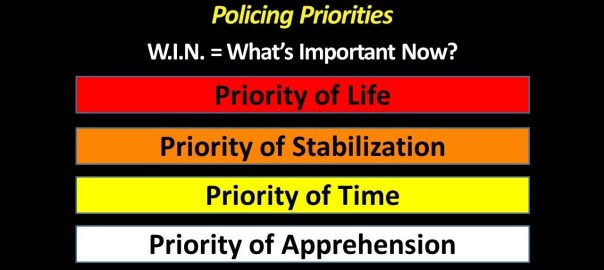
WIN – What’s Important Now?
Remember: Complacency kills.
All of those are crazy, simple ideas have had and continue to have a positive impact on reducing the overall number of law enforcement deaths each year. But, there was one thing that kept bugging me as a law enforcement trainer and it was the question, “What’s Important Now?” I love the concept of it and have even had the opportunity to discuss it in a training course taught by Brian Willis of Winning Mind Training who contributed that question. But there was just something about it…
To take that question to the next level, I believed that we could look at the common patterns used in answering it and develop a simple set of priorities that could be used to assist officers in their decision-making during high stress incidents. If these basic priorities could then be trained across an entire agency, we would have a force multiplier when it comes to decision-making all being on the same page. It was through studying and researching these patterns that the Policing Priorities were developed based off of ideas shared by other exceptional trainers, like Lou Hayes, and my own research regarding decision-making.
To assist in spreading this concept throughout my department, I created this briefing training video. These priorities are excellent for breaking down, discussing, and justifying decision-making at every level of the organization, during any call for service, and in every discipline of training.
The Policing Priorities are…
Priority of Life
Priority of Stabilization
Priority of Time
Priority of Apprehension
The link below will take you to the Policing Priorities Training video. Feel free to discuss it, try to break it, and test it out. We have found that they are applicable to every call for service we respond to. Whether it is an alarm call, traffic collision, burglary in-progress, pursuit, officer involved shooting, or an active killer, they apply.
To continue building these decision-making fundamentals into the foundation of my department, the Policing Priorities are taught during Post-Academy, reinforced throughout Field Training, utilized during training modules, and then additionally reinforced with video debriefs of our own on-body camera videos demonstrating positive uses of the Policing Priorities.
If you have any questions or thoughts on the Policing Priorities, please do not hesitate to contact us. Your thoughts or comments on this blog are always appreciated either below or on our Facebook page. You can also follow us on Twitter at @tbl_leadership. Our email is tblleadership at gmail.com.
The mission at Thin Blue Line of Leadership is to inspire law enforcement supervisors to be the best leaders they can be by providing positive leadership tactics and ideas. Positive leadership and creating a positive squad culture are on-going commitments that must be nurtured and developed over time. Thin Blue Line of Leadership is here to help.
Continue saving the world one call at a time and as always, LEAD ON!
What is more important when it comes to being a good field trainer – Performance or Trust?
Before you answer that, let’s explore why I’m asking the question. Author and speaker Simon Sinek works regularly with the Navy Seals. During one conversation he asked them how they select who gets to go to the elite Seal Team 6 or promoted since they are all considered to be the best of the best. To answer that question, they drew a graph like the one below. (Simon Sinek Performance vs. Trust Video)
On the vertical axis they wrote “performance” and on the horizontal axis they wrote “trust.” Performance was defined as their skills and knowledge on the battlefield – shooting, tactics, orienteering, planning, endurance, etc. Trust was defined as how they are off of the battlefield – teamwork, integrity, respect, humble, etc. The Seals explained that they take each candidate and rank them on both of these criteria to see how they compare. Over time, they discovered the following…
There were two candidates that were obvious. If the person was a Low Performer/Low Trust (LP/LT) they didn’t want them and if the person was a High Performer/High Trust (HP/HT) they absolutely wanted them. But, there were only so many candidates that were that clear and obvious.
It was the next choice were the Seals discovered they were initially making mistakes in their selection process. Their next choice initially was the High Performer/Low Trust (HP/LT). The person who was a “rock star” in training and on the battlefield, but outside of that they weren’t really liked or trusted. The quote the Seals used was, “I would trust them with my life, but NOT my money or my wife.” This caused many, many issues within the ranks of one of the most elite special forces units in the world.
What was their fix?
After analyzing where the mistakes were occurring, they reorganized the hierarchy of their entire selection process. Instead of taking the High Performer/Low Trust Seals, they prioritized taking the Moderate Performer/High Trust (MP/HP) individuals. They then would equally consider even a Low Performer/High Trust (LP/HT) candidate in comparison to a High Performer/Low Trust one. This was done because after years of various difficulties and failures, the Navy Seals discovered that Performance can be taught, learned, and improved. Trust can only be earned and is a much more valuable commodity when making such decisions of significance.
How does this relate to Field Training?
First, no one that works with you is going to care if you have the most tickets, most arrests, find the most drugs, take the most calls for service, or get the coolest assignment; if they don’t trust you. Do things often that build trust – back up other officers, help with impounds, take paper when you know they are down a lot . . . in other words, help other people out sometimes. That not only will help those around you, but will also make a huge difference when it comes to testing for special assignments or promotion.
Secondly, the same concept applies to the OITs (Officer-in-Training) you are training. It is great if they are a natural cop and are kicking butt through FTO (Field Training Officer), but if they are showing behaviors that make your level of trust in them diminish, then you should be cautious. Would you trust your money and spouse around them? If not, try to articulate why and document it. The FTO Program would rather remove a low trust OIT than have them make it through and be a pain for the next 25 years or until they cause a significant integrity issue of some kind.
Lastly, as a Field Training Officer, you will find that your ability to train and the success of your OITs is directly related to the level of trust you build with them during the short time you have them for training. Here are 3 tips for quickly building trust with OITs…
When you first meet them, introduce yourself and explain that everything you from here on out is for their benefit to make them a successful solo capable officer. If you say it with conviction, they will believe you and you will immediately be establishing a rapport built on trust; even if you have to get on them about something.
Be up front about the expectation for them to make mistakes. Explain that you would rather see them take initiative on a call for service and make a mistake; rather than, hang back waiting watching other officers do the work and not make a mistake. If you are going to be upset and/or frustrated with an OIT, be upset/frustrated at the lack of initiative, not the mistake. Training can fix the mistake. Initiative is built on trust.
Take the time to introduce yourself. Tell them about your family, life outside the PD, struggles you’ve experienced, and successes you’ve had. Then ask them about who they are. What is their family situation, what did they do before coming to SPD, why do they want to be a cop, what has been the hardest for them in FTO so far, how are they adjusting to shift work, etc. You never know where those conversation will go. OITs have to know you care about them before they will ever care about what you have to teach them. TRUST > PERFORMANCE
The mission at Thin Blue Line of Leadership is to inspire law enforcement supervisors to be the best leaders they can be by providing positive leadership tactics and ideas. Positive leadership and creating a positive squad culture are on-going commitments that must be nurtured and developed over time. Thin Blue Line of Leadership is here to help.
Please do not hesitate to contact us if you have ideas to share or suggestions for improvement. Your thoughts or comments on this blog are always appreciated either below or on our Facebook page. You can also follow us on Twitter at @tbl_leadership.
Continue saving the world one call at a time and as always, LEAD ON!
One of the greatest misconceptions about training is that it must be complex or difficult to have value. This is typically one of the largest hurdles for trainers to overcome because the training ideas they have don’t seem “cool” enough. This perceived lack of coolness then prevents them from doing any additional training outside of what they have been doing.
Simple training repeated regularly has the greatest positive impact on adult learning and performance success. It is the deep understanding of simple training basics that allow the learner to be creative and adaptive in their problem solving. Please do not confuse the word “simple” with being synonymous for “easy.” Easy implies that the task does not require effort to be done; simple means that it is merely not complex. Therefore, simple training ideas can have an extremely positive impact on learning.
If you have an OIT that is struggling with any concept like orientation, report writing, officer safety, handcuffing, interviewing, etc., then be sure to first be utilizing the 3 R’s to make the information you are trying to teach stickier…
REPEAT
It is silly to expect an OIT to learn something just because you said it once.
It is also silly to expect them to learn it if you only say it the same way every time.
The more important a concept is, the more times you should expect to say it and the more of a variety of ways you should have to teach it.
RECOGNIZE
When the OIT does what you have been teaching, recognize it.
Point it out to them so they realize they have done what you have been repeating.
This builds the importance of what you are teaching because now they know you are looking for it and pointing out their usage of the concept.
REINFORCE
Everybody loves a little positive reinforcement.
When you recognize the OIT has done what you have been training, always following it up with a statement like, “I saw how you did ___________. Great job! That is exactly what we have been talking about regarding your officer safety.”
The key is to make the reinforcement specific to the behavior you want. “Good job” by itself does NOT cut it because the OIT may have no idea what exactly was good.
It would be silly to assume that because you repeat, recognize, and reinforce once that the OIT has mastered the concept. Keep repeating the 3 R’s about the major concepts you want the OIT to learn throughout the time they are with you.
Here are 3 simple ideas for repeating concepts you want an OIT to learn. . .
NO COST QUIZ – Develop 3 to 5 questions to ask your OIT about key concepts/situations you have been discussing over the last couple of shifts. Write them down and give them to the OIT before briefing, just after briefing, during a break, or at the end of your shift to write out their answers. These questions can be about any concept you want to reinforce. This is a simple training idea that you could use each shift or a couple of times each week to reinforce your point(s). There is no cost to an incorrect answer, but it gives you the opportunity for a conversation.
OIT LEARNING JOURNAL – Ask your OIT to obtain a notebook specifically for the purpose of being their OIT Learning Journal. (I know . . . it is a stupid name, but the concept is sound.) Either just after briefing or at the end of the shift, ask the OIT to think back to what they did the previous shift. Have them write down the 3 to 5 most important things they learned during that shift from memory.
IMAGINE PERFECTION – FTO asks the OIT to imagine the perfect traffic stop, shoplifting call, domestic violence investigation, DUI investigation, etc. Then have the OIT write out the process for handling that situation perfectly in 10 to 15 steps. Limit the number of steps so that the OIT is focusing on only the most important aspects of handling the situation they are considering. Once complete, FTO debriefs OIT’s steps with them and draws comparisons to OIT’s performance on previous similar calls for service. FTO should also play the IF/WHEN/THEN Game with the OIT and ask if different variables change, how the OIT would respond. This technique is especially useful for OITs that are having difficulty remembering repeatable processes or forgetting key steps when under stress of real-world situations. This helps them to adjust from standard linear thinking to more adaptive thinking as they respond to your variables.
Each time you make the OIT remember back to something they did over 24 hours ago, you are repeating that information and utilizing the instructional concepts of spacing, interleaving, effortful retrieval, and desirable difficulties. Training effectively can sometimes be both simple and easy. Now, just be sure to recognize and reinforce each time the OIT exhibits the desired learning in the field.
The mission at Thin Blue Line of Leadership is to share positive leadership tactics with the field of law enforcement. Positive leadership and creating a positive squad culture are on-going commitments that must be nurtured and developed over time.
Share your thoughts or comments with us below or on our Facebook page. Continue saving the world one call at a time and as always, LEAD ON!









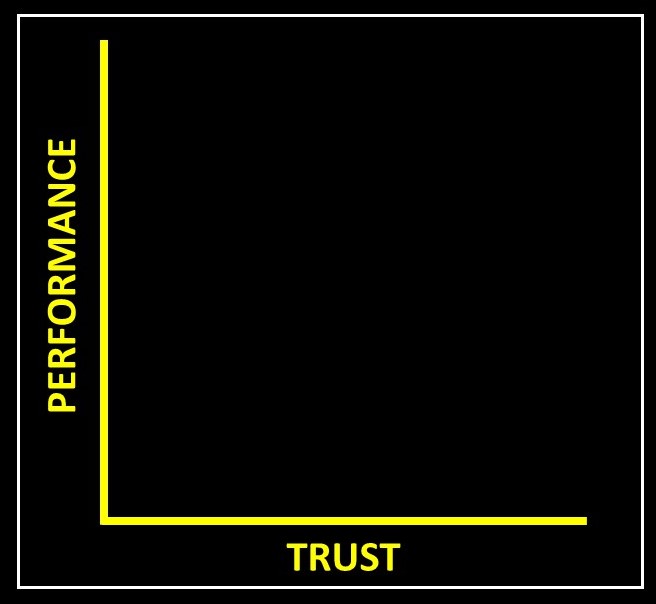 On the vertical axis they wrote “performance” and on the horizontal axis they wrote “trust.” Performance was defined as their skills and knowledge on the battlefield – shooting, tactics, orienteering, planning, endurance, etc. Trust was defined as how they are off of the battlefield – teamwork, integrity, respect, humble, etc. The Seals explained that they take each candidate and rank them on both of these criteria to see how they compare. Over time, they discovered the following…
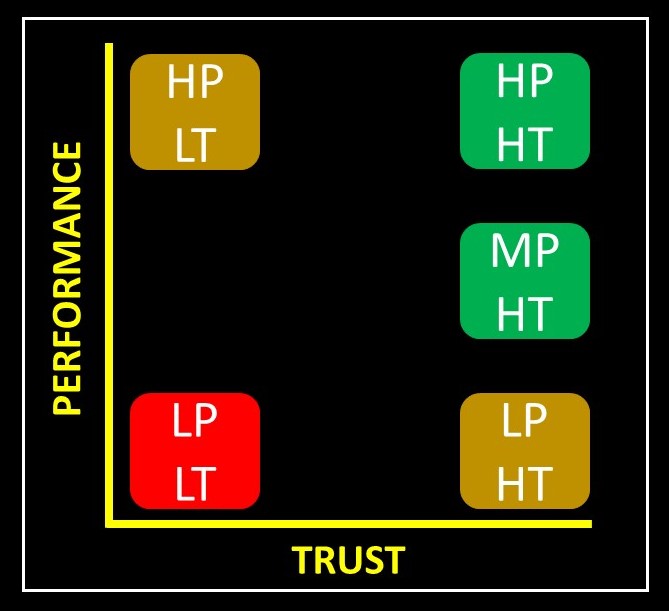 It was the next choice were the Seals discovered they were initially making mistakes in their selection process. Their next choice initially was the High Performer/Low Trust (HP/LT). The person who was a “rock star” in training and on the battlefield, but outside of that they weren’t really liked or trusted. The quote the Seals used was, “I would trust them with my life, but NOT my money or my wife.” This caused many, many issues within the ranks of one of the most elite special forces units in the world.
 Thin Blue Line of Leadership