Tag Archives: briefing

BRIEFING VIDEO: A Review of Making It Safer

This briefing video is the TBLL interpretation of the study Making It Safer: A Study of Law Enforcement Fatalities Between 2010 – 2016 that was put out in 2017 by COPS and the NLEOMF. There is also a clip on passenger-side approaches referenced from Gordon Graham and Lexipol. Overall, the suggestions provided are fundamentals of safe policing, but a reminder every now and then can be helpful to save a life.

The mission at Thin Blue Line of Leadership is to inspire law enforcement supervisors to be the best leaders they can be by providing positive leadership tactics and ideas. Positive leadership and creating a positive squad culture are on-going commitments that must be nurtured and developed over time. Thin Blue Line of Leadership is here to help.

Please do not hesitate to contact us if you have ideas to share or suggestions for improvement. Your thoughts or comments on this blog are always appreciated either below or on our Facebook page. You can also follow us on Twitter at @tbl_leadership.

Continue saving the world one call at a time and as always, LEAD ON!

3 Simple Field Training Ideas

One of the greatest misconceptions about training is that it must be complex or difficult to have value. This is typically one of the largest hurdles for trainers to overcome because the training ideas they have don’t seem “cool” enough. This perceived lack of coolness then prevents them from doing any additional training outside of what they have been doing.

Simple training repeated regularly has the greatest positive impact on adult learning and performance success. It is the deep understanding of simple training basics that allow the learner to be creative and adaptive in their problem solving. Please do not confuse the word “simple” with being synonymous for “easy.” Easy implies that the task does not require effort to be done; simple means that it is merely not complex. Therefore, simple training ideas can have an extremely positive impact on learning.

If you have an OIT that is struggling with any concept like orientation, report writing, officer safety, handcuffing, interviewing, etc., then be sure to first be utilizing the 3 R’s to make the information you are trying to teach stickier…

 REPEAT

  • It is silly to expect an OIT to learn something just because you said it once.
  • It is also silly to expect them to learn it if you only say it the same way every time.
  • The more important a concept is, the more times you should expect to say it and the more of a variety of ways you should have to teach it.

RECOGNIZE

  • When the OIT does what you have been teaching, recognize it.
  • Point it out to them so they realize they have done what you have been repeating.
  • This builds the importance of what you are teaching because now they know you are looking for it and pointing out their usage of the concept.

 REINFORCE

  • Everybody loves a little positive reinforcement.
  • When you recognize the OIT has done what you have been training, always following it up with a statement like, “I saw how you did ___________. Great job! That is exactly what we have been talking about regarding your officer safety.”
  • The key is to make the reinforcement specific to the behavior you want. “Good job” by itself does NOT cut it because the OIT may have no idea what exactly was good.
  • It would be silly to assume that because you repeat, recognize, and reinforce once that the OIT has mastered the concept. Keep repeating the 3 R’s about the major concepts you want the OIT to learn throughout the time they are with you.


Here are 3 simple ideas for repeating concepts you want an OIT to learn. . .

NO COST QUIZ – Develop 3 to 5 questions to ask your OIT about key concepts/situations you have been discussing over the last couple of shifts. Write them down and give them to the OIT before briefing, just after briefing, during a break, or at the end of your shift to write out their answers. These questions can be about any concept you want to reinforce. This is a simple training idea that you could use each shift or a couple of times each week to reinforce your point(s). There is no cost to an incorrect answer, but it gives you the opportunity for a conversation.

OIT LEARNING JOURNAL – Ask your OIT to obtain a notebook specifically for the purpose of being their OIT Learning Journal. (I know . . . it is a stupid name, but the concept is sound.) Either just after briefing or at the end of the shift, ask the OIT to think back to what they did the previous shift. Have them write down the 3 to 5 most important things they learned during that shift from memory.

IMAGINE PERFECTION – FTO asks the OIT to imagine the perfect traffic stop, shoplifting call, domestic violence investigation, DUI investigation, etc. Then have the OIT write out the process for handling that situation perfectly in 10 to 15 steps. Limit the number of steps so that the OIT is focusing on only the most important aspects of handling the situation they are considering. Once complete, FTO debriefs OIT’s steps with them and draws comparisons to OIT’s performance on previous similar calls for service. FTO should also play the IF/WHEN/THEN Game with the OIT and ask if different variables change, how the OIT would respond. This technique is especially useful for OITs that are having difficulty remembering repeatable processes or forgetting key steps when under stress of real-world situations. This helps them to adjust from standard linear thinking to more adaptive thinking as they respond to your variables.

Each time you make the OIT remember back to something they did over 24 hours ago, you are repeating that information and utilizing the instructional concepts of spacing, interleaving, effortful retrieval, and desirable difficulties. Training effectively can sometimes be both simple and easy. Now, just be sure to recognize and reinforce each time the OIT exhibits the desired learning in the field.

The mission at Thin Blue Line of Leadership is to share positive leadership tactics with the field of law enforcement. Positive leadership and creating a positive squad culture are on-going commitments that must be nurtured and developed over time.

Share your thoughts or comments with us below or on our Facebook page. Continue saving the world one call at a time and as always, LEAD ON!

10 Tips for New Sergeants

For the last 8 years, I have been a Field Training Sergeant. It is truly a pleasure knowing that I am having an impact on the future of my police department by training these new leaders. I see this responsibility as a vital one. If I do not do a good job, I am not just affecting that new sergeant, but every officer that serves on his or her squad.

Just so we are on the same page, here is how my department handles sergeant training. Sergeant field training is a 5 week process – 2 weeks with one training sergeant, 2 weeks with a different training sergeant, and then one final week back with the first training sergeant. At the end of each shift, the Field Training Sergeant completes a daily observation report (similar to FTO) that summarizes and scores everything the prospective new sergeant did throughout that shift. While writing these daily observation reports, I have noticed that there are certain bits of advice that I seem to be repeatedly writing for every sergeant I help train.

So, here are my 10 tips for new sergeants . . .

  1. Successful sergeants spend 80% of their time working with people and 20% doing everything else. Sergeants that fail to inspire, have a poor squad culture, and breed negative officers focus more on everything else rather than people and building relationships.
  2. Successful sergeants find ways to teach their officers to be adaptive decision-makers; not robots that only understand how to solve problems with checklists. When opportunities present themselves, sergeants explain their process for making difficult decisions and everything they took into account. Then, when their officers face similar situations they have been taught to apply their own similar process.
  3. Successful sergeants never waste briefing time. There is always something that could be discussed, debated, trained, or learned in briefing. This is one of the few opportunities when sergeants have their entire squad’s attention at the same time; make the most of it.
  4. Successful sergeants understand that policing is a complicated profession. Both sergeants and their officers are going to make mistakes at some point. Do not hide mistakes, share them openly and turn them into learning opportunities focused on improvement. Mistakes are fine, just don’t make the same one twice.
  5. Successful sergeants recognize, reward, and promote good police work by their officers. They use whatever methods are available at their department to make this happen anytime an officer goes above and beyond. Not only does this create a more positive culture, but it also spurs on more officers to look for opportunities to go above and beyond. What a sergeant rewards will be repeated.
  6. Successful sergeants have a vision of the culture they want to have on their squad. Squad culture is defined as the conglomeration of your officers’ actions, attitude, and effort. If you asked another sergeant to describe your squad in 4 words, what words would they use? That is your culture. If you don’t like those words, do something about it.
  7. Successful sergeants do not lead from their desks. They get out on the road with their officers and find ways to serve them throughout each shift. They never believe themselves to be too good for the “grunt” work of being a patrol officer; they get in there and get their hands dirty occasionally.
  8. Successful sergeants recognize that their actions, attitude, and effort tell their officers what is important to them. If a sergeant speaks negatively about their schedule, some situation at the department, or some aspect of the job, then don’t be surprised when the officers have that same opinion or are representing that opinion openly. Negativity breeds negativity.
  9. Successful sergeants know what they do not know, then they find ways to compensate for those areas. If they are not good at tactical situations, they talk to the department’s SWAT officers about various scenarios and how they would handle them. If they are not good at traffic or investigations, they build relationships with motors or detectives that are respected. The most important aspect of this tip is that a sergeant never fakes knowledge and gives bad advice to an officer. This will kill their credibility. If an officer has a question that the sergeant does not know the answer to, the best thing they can do is say, “That is a great question, I don’t know, but I know someone who will. Standby and I’ll call you right back.”
  10. Successful sergeants never allow themselves or their officers to stop learning. The minute a sergeant thinks they know it all is the moment they begin sliding towards mediocrity. A sergeant values training and realizes that the more training they can get for their officers, the better their officers will be on the road.

Got a tip you would give to a new sergeant?

The mission at Thin Blue Line of Leadership is to inspire law enforcement supervisors to be the best leaders they can be by providing positive leadership tactics and ideas. Positive leadership and creating a positive squad culture are on-going commitments that must be nurtured and developed over time. Thin Blue Line of Leadership is here to help.

Please do not hesitate to contact us if you have ideas to share or suggestions for improvement. Your thoughts or comments on this blog are always appreciated either below or on our Facebook page. You can also follow us on Twitter at @tbl_leadership.

Continue saving the world one call at a time and as always, LEAD ON!

Culture in Just 4 Words

THE SETUP: Another sergeant asked how my squad of mostly brand new police officers was having such great success on the road and in the community. I attributed it to the culture that we had created as a squad in the briefing room and then worked hard to exemplify each shift on the road. When he asked what my squad’s culture was, I quickly rattled off just 4 words – Positivity, Activity, Teamwork, and Humility. As I said these 4 words aloud, the other sergeant looked at me like I was holding out on him and I replied, “No really . . . that is our culture in just 4 words and it works.”

THEN IT HITS ME: The realization that came to me as we continued this conversation was that a strong, sustainable culture should be just that easy to define, explain, understand, and apply. Culture has to be tangible and not just something that is said or posted on a wall. It also has to be easily articulated and reproducible by all involved with it.

THE HOW: I pulled out a piece of paper and divided it into 4 boxes. At the top of each box I wrote one of the words that I had told the other sergeant about – Positivity, Activity, Teamwork, and Humility. Knowing that culture is defined by our actions and attitudes, I made sure that I could define each of the words in terms of both; specifically actions and attitudes that I had seen these officers previously demonstrate. This would give me an easy way to talk about the culture with specific examples. Here is what I came up with . . .

POSITIVITY

  • Know your “why.”
  • Community service – treat everyone with dignity and respect.
  • Do the right thing, at the right time, for the right reasons.
  • Recognize each other for good police work.

ACTIVITY

  • Strive to be the most active squad in the city.
  • Calls for service are our priority, but initiative fills the gaps.
  • Take pride in your beat, know your beat, and work it as such.
  • Be a leader on calls – step up when others hesitate.

TEAMWORK

  • We before I.
  • Many hands make light work – have a “how can I help” mentality.
  • Back each other up – stay safe.
  • No gossip, no complaining – develop solutions.

HUMILITY

  • Get involved – policing is experiential learning.
  • Don’t fear mistakes, learn from them.
  • Remain humble and continue learning.
  • Take training seriously; continue growing throughout your career.

The above 4 words and defining bullet points are what best describe the actions and attitudes of our squad and what we want to project to everyone we interact with in the department and the community. The next step was presenting it to the squad.

THE PRESENTATION: On the presentation day, I explained to my 7 officers the conversation I had with that other sergeant and how this all got started. As I spoke about each of the 4 words and the corresponding bullet points, I used specific examples of times when I had seen these actions and attitudes displayed previously by them. I wrote each of the words on the outside of a box that I had drawn on the whiteboard. The conversation was amazing. Based on their comments the bullet points were altered to reflect their input.

When everything was said and done, I explained that if everything they said or did on this job could fall into the confines of this box then they would know they were doing policing the right way. It is only when actions and/or attitudes don’t fit into that box that problems occur and build distrust between the squad, police department, and their community.

REINFORCEMENT: Whenever a new officer comes to the squad, I go over these same 4 words in the same way as described above. The only thing that changes are newer, better examples. This serves two purposes. First, it reinforces the importance of our culture to the officers that have heard it before and keeps it fresh in their memory. Secondly, by going over this on the new officer’s very first day of joining the squad it solidifies how important we take our culture and begins to quickly assimilate them into the fold. If there are no new officers coming to the squad, then I make sure it gets repeated and discussed at least once every couple of months.

Between squad expectation presentations, it is vital to positively reinforce the desired culture. Whenever a member of the squad handles a difficult call, solves a problem, or demonstrates a great attitude about a tough situation; I make sure to mention it in briefing the next day and thank them for their outstanding service and commitment to our squad expectations. I make sure to specifically attribute whatever they did to the word(s) it best corresponds to. Culture in 4 words has gone over even better than I expected. In fact, they now recognize each other in briefing when they see something on a call that I was not able to get to. This reinforcement creates a positive cycle that just continues building and building and building.

THE CHALLENGE: Obviously, if you are still reading this far into the blog I have peaked your interest. Answer the following questions to get you started . . .

  1. If your squad was running exactly the way you wanted it to, what 4 words would you chose to describe your squad’s culture?
  2. Once you know your 4 words, list 3 – 5 specific actions or attitudes for each word that exemplify specifically how you would like to see that word expressed by your officers.
  3. Present your 4 words to your squad and have a discussion.
  4. Take the time and make opportunities to positively reinforce the 4 words of your culture.

Squad expectations need to be about establishing culture; not rules. Police departments have plenty of rules, laws, and policies to follow; that’s what those big books of general orders and revised statutes are for. If you get the culture right; the rules will take care of themselves. So, I challenge you to discover your 4 words and get them out there to your squad.

The mission at Thin Blue Line of Leadership is to inspire law enforcement supervisors to be the best leaders they can be by providing positive leadership tactics and ideas. Positive leadership and creating a positive squad culture are on-going commitments that must be nurtured and developed over time and Thin Blue Line of Leadership is here to help.

Please do not hesitate to contact us if you have ideas to share or suggestions for improvement. Your thoughts or comments on this blog are always appreciated either below or on our Facebook page. You can also follow us on Twitter at @tbl_leadership.

Continue saving the world one call at a time and as always, LEAD ON!

A Simple Gesture

I am a police officer that just happens to have the rank of sergeant. I have 8 police officers that work with me to keep the community we serve safe on one of the toughest work schedules and largest districts in the department.

One week a few months ago, due to scheduling issues out of my control, my squad of 8 officers was reduced to just 4. I knew that we were going to be slammed handling the same amount of calls for service that usually come in, but with half the number of officers.

At the beginning of each shift that week, I walked into the briefing room and extended my hand to my 4 officers for a handshake. I told them that I appreciated them being there and for all of the hard work that we knew was ahead of us.

What I found was that the simple action of shaking their hands in advance of what was before us served two purposes:

  1. The handshakes demonstrated respect for them by showing appreciation for their presence in the face of a tough situation.
  2. The handshakes also negated the negative of the situation and turned it into a positive to be fought through as a team, not to be put out by.

In recognizing the power of this simple action, I felt compelled to find a way to continue building the same connection with my officers that started with these simple gestures. With the busy week over, I had the weekend to consider how I was going to use it going forward.

I walked into our squad briefing the next Wednesday and looked around at my 8 young officers ready to hit the road. Without thinking about it for a second, I extended my hand and began walking around the room shaking each of their hands and saying, “Thanks for being here.”

To this day, I start every Wednesday briefing just like that. Do not underestimate the power of a simple gesture and the positive effect it can have on your officers.

The mission at Thin Blue Line of Leadership is to inspire law enforcement supervisors to be the best leaders they can be by providing positive leadership tactics and ideas. Positive leadership and creating a positive squad culture are on-going commitments that must be nurtured and developed over time and Thin Blue Line of Leadership is here to help.

Please do not hesitate to contact us if you have ideas to share or suggestions for improvement. Your thoughts or comments on this blog are always appreciated either below or on our Facebook page. You can also follow us on Twitter at @tbl_leadership.

Continue saving the world one call at a time and as always, LEAD ON!

A Law Enforcement Leadership Reward

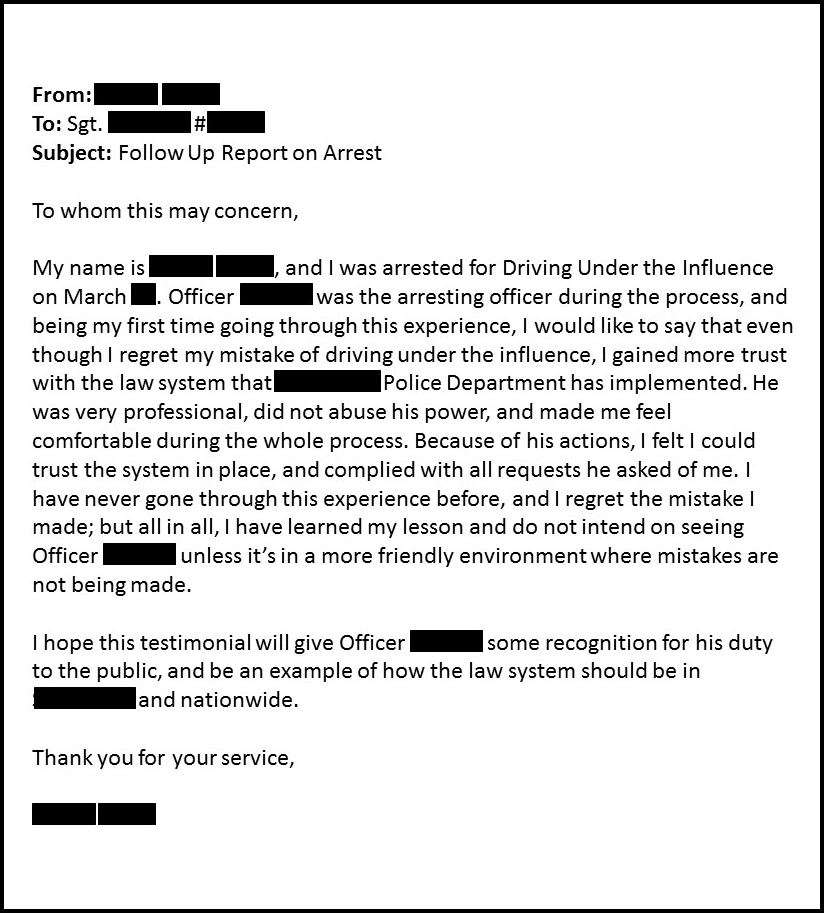
“Leadership is not a license to do less. Leadership is a responsibility to do more.” (Simon Sinek) The results of your leadership, no matter how hard you work, cannot be easily measured. But every now and then you receive something like the letter below and know that all of the effort that has been put into leading your officers is worth it. These are the rewards of positive law enforcement leadership.

The names of the subject, officer, and police department have been removed for privacy.

Letter

One final note regarding a leadership reward of this nature. Always be sure to appropriately recognize, reward, and promote the officer that earned this kind of respect from a subject they arrested. Recognize them by reading the letter in front of their squad mates and reward them with whatever means your department provides or you have developed within the squad. Promote the officer by forwarding the letter up the chain of command so their name gets attributed appropriately to this type of excellence.

The mission at Thin Blue Line of Leadership is to inspire law enforcement leaders to be better than they were yesterday. Positive leadership and creating a positive squad culture are on-going commitments that must be nurtured and developed over time by anyone in a law enforcement leadership position.

Share your thoughts or comments with us below or on our Facebook page. Continue saving the world one call at a time and as always, LEAD ON!

A Law Enforcement Recognition Idea

The mission at Thin Blue Line of Leadership is to share positive leadership tactics with the field of law enforcement. Positive leadership and creating a positive squad culture are on-going commitments that must be nurtured and developed over time. One way to do this is by recognizing and rewarding great police work on a routine basis. Here is an idea that came to me the other day.

I found myself watching a college football game last weekend and was noticing the band, the cheerleaders, the crazy student section, the mascot, and of course the players. A thought struck me at that time regarding the strength of culture at these collegiate institutions. Then I began to pay particular attention to the helmets of the Florida State Seminoles and noticed that there were little tomahawk stickers on the player’s helmets. This was not something new as I have seen them on many other college team helmets, but today I guess it just struck me at the right time.

helmet

A Wikipedia search of “helmet stickers” revealed that recognition or pride stickers have been rewarded to players since the mid-1950’s for making excellent plays, selfless plays, and even for hard work at practices. The idea stemmed from fighter pilots that marked their planes to signify the number of kills or successful missions they had flown. Then I started to make a connection to police work.

Most police departments have awards that are given out on an annual basis, but if you really want to positively reinforce behavior then it needs to be done on a much more consistent basis than that. So, I created some law enforcement recognition stickers using the Thin Blue Line of Leadership logo and had them printed at evermine.com.

sticker

For a very small cost ($15+shipping), I received over 100 custom recognition stickers (1″ diameter) to give out in briefings to reward the great things that officers do on a daily basis. I am not selling anything or being paid by evermine.com to tell you any of this; I am simply sharing an idea and evermine happened to be the website that popped up first.

Walking into briefing with a couple of recognition stickers immediately makes everyone wonder who is being recognized and for what. It provides the perfect opportunity to reinforce more of the “smaller” things that do not rise to the level of an official ribbon or annual award.

If you catch an officer changing a flat tire, give them a sticker. Have an officer that routinely volunteers to hold over a couple of hours to accommodate staffing needs, give them a sticker. If an officer does an amazing investigation or writes a great report, give them a sticker after they talk about it with the squad so everyone has a chance to learn from that officers great moment. Any action that supports what the squad is all about, the desired culture, should be recognized. This sticker is only given out when I, the sergeant, want to personally thank them or recognize them for some good work or a sacrifice they made for the squad. What gets recognized and rewarded gets repeated.

After the success of the above recognition sticker,  I created a second sticker for our squad. These stickers can only be received by officers that are being recognized by a person outside of the squad or directly from another officer on the squad.

r1lion

The second sticker is a squad logo created of a lion (think LE Memorial) and stars to represent the people on our squad. These stickers are used for two purposes. First, when someone from outside the squad wants to recognize a member of the squad for something. These commendations could come from citizens, other supervisors, upper staff, etc. Secondly, the most interesting use for these stickers was for officers to internally thank each other when someone sacrificed to help them out personally. For example, when an officer found a good arrest and had a ton of items to impound and their squad mates stayed late to help them get done quicker. The next shift, they would come ask me for however many stickers they needed and in briefing would thank the officers that helped them out. The coolest part of the stickers is that they ended up perpetuating officers going above and beyond for their fellow officers to a whole new level than I had ever seen in policing.

Officers decide where to collect their stickers, but my suggestion would be their ticket clipboards to display their accomplishments proudly. Some put them on their locker or other place they see on a daily basis. This serves as a consistent reminder of their many accomplishments and makes a statement about the positive squad culture that is being nurtured.

clipboard

Do you have a similar way of rewarding officers in your department?

Share your thoughts or comments with us below or on our Facebook page. Continue saving the world one call at a time and as always, LEAD ON!

Briefing with Purpose

“There are no secrets to success. It is the result of preparation, hard work, and learning from failure.” ~ Colin Powell
Success is absolutely about preparation, hard work, and learning from failure. As a leader of people, you have taken on the challenge of doing everything within your power to make your people successful. One of the best places to start doing that with your officers is in the briefing room. In law enforcement, the time that you get to spend with your entire squad together is extremely limited; therefore, it is up to you to make the most of it.

In my department, each patrol shift starts with a 30 minute briefing conducted by the squad sergeant. This is the only time that the squad has the opportunity to be together in same place at the same time without the next call for service pulling us away. (Most of the time.) There are many purposeful activities that can fill this time, but unfortunately they often just turn into “bull sessions” with no real purpose and become a waste of everyone’s time. Don’t get me wrong, there is a time and a place to have unplanned, open discussions in briefing so long as there is a purpose to it and it is not just a default due to a lack of planning on the part of the supervisor.

Prior to being a police officer, I was a math teacher for just shy of 7 years. I was educated on the importance of lesson planning, building themes, identifying “teachable” moments, and organizing curriculum. When you walk into a classroom of 30+ teenagers every day, you quickly come to understand how important organization is to facilitating effective learning. When I promoted to sergeant, these same lessons came flooding back to me and I found ways to modify the concepts to work within the given 30 minute briefing times I had.

As a patrol sergeant, I work four 10 hour shifts a week. I try to stay at least one week ahead with whatever I am planning for briefing training so I have some idea of where I am going and have time to gather resources or create them. With that being said, it is vital to not be overly invested in the briefing plan because things occasionally come up that may take precedent; such as a major call for service that needs to be discussed that offers some “teachable” moments. Below is an example of the form I used to plan my briefings . . .

lesson

Here was the thinking behind how my weekly planning was organized. DAY 1 was typically reserved for administrative topics. All of the emails, criminal info bulletins, policy updates, and more that needed to be to be shared with the whole squad were saved over the weekend for this day. The last thing I ever wanted was for administrative stuff to take over all of my briefings. I also found that the first day back to work for the week was usually not the best day for conducting briefing training. Once the admin stuff was out of the way, then I would end the briefing by recognizing some of the good work from the week before to start us off positively. This recognition was with the express intent of wanting to see those specific actions, attitudes, or efforts repeated by the squad.

DAY 2 and DAY 3 were reserved for Briefing Training. These could include any number of topics and may involve bringing in a guest speaker from another part of the department, using a short PowerPoint, leading a discussion on our successes/failures from a call, conducting a demonstration, putting together a scenario, watching a police-related video then discussing how it relates to our policies/practices/state laws, etc. There are so many great topics and activities related to our profession that can fit into a 30 minute time period to instigate learning and/or create culture. Ultimately, when planning briefing training, we are not trying to certify officers in anything, just share information so we are all on the same page.

DAY 4 was usually more relaxed. I would lead a discussion called “What did you learn?” in which each member of the squad would talk about one thing they learned or did differently this week on a call and if it was or was not successful. Finally, I would always end the last briefing of the week by recognizing some more of the fine work that had been done by my officers that supported our positive squad culture. There would also be an opportunity for them to recognize each other for things I may not have seen.

At the bottom of the weekly plan was a list of all of my officers. This gave me the ability to know who was or was not in briefing on a given day so either myself or an informal leader on the squad could follow up with them later regarding what we covered. As mentioned above, the power of having briefings with purpose comes from everyone being on the same page. Without this follow-up, you fall short on one of the best parts of having organized briefing plans.

With purpose, there is power. Time with the entire squad together allows a leader to communicate specific messages that puts everyone on the same page. This creates opportunities to share the mission, build squad culture, recognize good work, educate on policy/legal updates, discuss success/failures, and much more. Having these types of purposeful briefings are especially beneficial for newer officers, but also serve the purpose of being a reminder to the more senior officers about what is important.

I challenge you to find the time and make the effort to plan briefings with purpose and see the many positive benefits that come from it.

The mission at Thin Blue Line of Leadership is to inspire law enforcement supervisors to be the best leaders they can be by providing positive leadership tactics and ideas. Positive leadership and creating a positive squad culture are on-going commitments that must be nurtured and developed over time. Thin Blue Line of Leadership is here to help.

Please do not hesitate to contact us if you have ideas to share or suggestions for improvement. Your thoughts or comments on this blog are always appreciated either below or on our Facebook page. You can also follow us on Twitter at @tbl_leadership.

Continue saving the world one call at a time and as always, LEAD ON!

10 Tips for New Sergeants

For the last 2 years, I have been a Field Training Sergeant. It is a pleasure knowing that I am having an impact on the future of my police department by training these new leaders. I see this responsibility as a vital one because if I do not do a good job, I am not just affecting that new sergeant, but every officer that serves on his or her squad.

Just so we are on the same page, here is how my department handles sergeant training. Sergeant field training is a 5 week process – 2 weeks with one training sergeant, 2 weeks with a different training sergeant, and then one final week back with the first training sergeant. At the end of each shift, the Field Training Sergeant completes a daily activity report that summarizes and scores everything the prospective new sergeant did throughout that shift. While writing these daily activity reports, I have noticed that there are certain bits of advice that I seem to be repeatedly writing for every sergeant I help train.

So, here are my 10 tips for new sergeants . . .

  1. Successful sergeants spend 80% of their time working with people and 20% doing everything else. Sergeants that fail to inspire, have a poor squad culture, and breed negative officers focus more on everything else rather than people and building relationships.
  2. Successful sergeants find ways to teach their officers to be adaptive decision-makers; not robots that only understand “if – then” statements. When opportunities present themselves, sergeants explain their process for making difficult decisions and everything they took into account. Then, when their officers face similar situations they will apply their own similar process.
  3. Successful sergeants never waste briefing time. There is always something that could be discussed, debated, trained, or learned in briefing. This is one of the few opportunities when sergeants have their entire squad’s attention at one time; make the most of it.
  4. Successful sergeants understand that policing is a complicated profession. Both sergeants and their officers are going to make mistakes at some point. Do not hide mistakes, share them openly and turn them into learning opportunities focused on improvement. Mistakes are fine, just don’t make the same one twice.
  5. Successful sergeants recognize, reward, and promote good police work by their officers. They use whatever methods are available at their department to make this happen anytime an officer goes above and beyond. Not only does this create a more positive culture, but it also spurs on more officers to look for opportunities to go above and beyond. What a sergeant rewards will be repeated.
  6. Successful sergeants have a vision of the culture they want to have on their squad. Squad culture is defined as the conglomeration of your officers’ actions, attitude, and effort. If you asked another sergeant to describe your squad in 4 words, what words would they use? That is your culture. If you don’t like those words, do something about it.
  7. Successful sergeants do not lead from their desks. They get out on the road with their officers and find ways to serve them throughout each shift. They never believe themselves to be too good for the “grunt” work of being an officers; they get in there and get their hands dirty occasionally.
  8. Successful sergeants recognize that their actions, attitude, and effort tell their officers what is important to them. If a sergeant speaks negatively about their schedule, some situation at the department, or some aspect of the job, then don’t be surprised when the officers have that same opinion or are representing that opinion openly. Negativity breeds negativity.
  9. Successful sergeants know what they do not know, then they find ways to compensate for those areas. If they are not good at tactical situations, they talk to the department’s SWAT officers about various scenarios and how they would handle them. If they are not good at traffic or investigations, they build relationships with motors or detectives that are respected. The most important aspect of this tip is that a sergeant never fakes knowledge and gives bad advice to an officer. This will kill their credibility. If an officer has a question that the sergeant does not know the answer to, the best thing they can do is say, “That is a great question, I don’t know, but I know someone who will. Standby and I’ll call you right back.”
  10. Successful sergeants never allow themselves or their officers to stop learning. The minute a sergeant thinks they know it all is the moment they begin sliding towards mediocrity. A sergeant values training and realizes that the more training they can get for their officers, the better their officers will be on the road.

Got a tip you would give to a new sergeant?

The mission at Thin Blue Line of Leadership is to inspire law enforcement supervisors to be the best leaders they can be by providing positive leadership tactics and ideas. Positive leadership and creating a positive squad culture are on-going commitments that must be nurtured and developed over time. Thin Blue Line of Leadership is here to help.

Please do not hesitate to contact us if you have ideas to share or suggestions for improvement. Your thoughts or comments on this blog are always appreciated either below or on our Facebook page. You can also follow us on Twitter at @tbl_leadership.

Continue saving the world one call at a time and as always, LEAD ON!

Shifting Gears in Policing

Recently Harvard Law Review published an article by Seth Stoughton entitled “Law Enforcement’s ‘Warrior’ Problem.” It discussed the need for law enforcement to move beyond the idea of being “warriors” and accept the concept of becoming “guardians.” Stoughton wrote that the concept of being warriors started with the best of intentions, but has “created substantial obstacles to improving police/community relations.” Whichever side of the discussion you fall on, warrior or guardian, it is a huge over simplification to think that a single mentality can define the role patrol officers must play each shift to remain safe and protect the community. Law enforcement cannot be one or the other; we must have the ability to fill many different roles dependent upon the circumstances presented by the situation.

As a patrol sergeant with one of the youngest squads in the department, I knew that it would be vital to define the mentality I expected my officers to have while on the road. I could not support a singular mentality whose sole purpose was to either keep them safe or allow them to more easily interact with the public. Through this internal debate, I concluded that one of the biggest challenges facing law enforcement is getting away from any concept that takes a “one size fits all” approach. Patrol officers should not be asked or expected to be just warriors or just guardians. They should be expected to be and trained to be warriors, guardians, caretakers, counsellors, educators, enforcers, and community representatives with the ability to shift gears from one role into another seamlessly based upon the circumstances of the call.

Officers must possess the intelligence to quickly assess a situation, decide on the role they must play, and then execute it successfully while continuing to assess their ever changing environment. As law enforcement supervisors, we have to assist our officers in rectifying the conflict between showing compassion, empathy, and understanding while at the same time being ready to maintain control of the situation and possibly use force. Training the ability to show compassion, empathy, and understanding while also maintaining officer safety is the challenge law enforcement faces and the primary reason why a “one size fits all” mentality so easily took hold in the first place. One requires constant thinking, adapting, and assessing; while the other allows for simplicity.

Department training must adapt to this more complicated and effective style of policing. Just as it is critical for officers to have on-going training in firearms, legal updates, emergency driving, and defensive tactics; it is equally as important to find training techniques that emphasize problem-solving, de-escalation, and proper “gear selection” based upon a call’s circumstances. There must be an emphasis on finding solutions to problems and not just being a Band-Aid.

I understand that making training changes within a police department can be like turning around the Titanic; so here are 10 ways patrol supervisors can reinforce “gear shift” thinking within their squad.

  1. When officers call you with a question, walk them through your decision-making process by asking these 3 questions: 1) What do you know? 2) What do you want to do? 3) What is your intent with the chosen solution? Then affirm their answer or provide other options, but ultimately leave the decision up to the officer unless it endangers or violates rights.
  2. Take the time to train officers in all of the department’s available resources and referral services such as crisis lines, shelters, etc. Knowing the options available to them increases the number of possible solutions to a call for service.
  3. Debrief calls in detail and discuss alternative options at critical decision points.
  4. Send officers to outside trainings that build their knowledge base in other roles such as Crisis Intervention Training (CIT), negotiating, and de-escalation techniques.
  5. Be on the road as a resource to your officers, but refrain from taking over calls unless necessary. Help them to recognize opportunities to use the department’s available resources and referral services when making an arrest is not the best “gear” to be in. Remember, solutions not Band-Aids.
  6. Tabletop training scenarios in briefing with multiple acceptable endings: arrest, warning/discretion, use a resource, or make a referral. Just like reality, there is rarely a single correct answer.
  7. Discuss de-escalation techniques and how to tone down “command presence” without sacrificing officer safety. Have officers that have attended training on topics like this share what they learned upon returning to the squad.
  8. Recognize and reward thoughtful, creative problem solving in briefing. What you reward will be repeated.
  9. Bring experts into briefing to discuss department resources and all the ways they are available to help officers when they are on calls. Do not assume that your officers know all of the resources available to them.
  10. Train your officers to be leaders on calls. When officers from other squads are hesitant to make a decision, your officers can take them over and set the example of finding solutions.

So, how does law enforcement need to be training for the future? Not just as warriors and not just as guardians, but as thoughtful officers that respond to situations in the most appropriate gear for finding solutions to the problems they are presented with.

The mission at Thin Blue Line of Leadership is to inspire law enforcement leaders to be better than they were yesterday. Positive leadership and creating a positive squad culture are on-going commitments that must be nurtured and developed over time. To lead your officers in this direction, you have to make the most out of the precious time you have available in briefing to establish the culture you wish for them to demonstrate on your road.

Share your thoughts or comments with us below or on our Facebook page. Continue saving the world one call at a time and as always, LEAD ON!