Tag Archives: Decision-Making

BRIEFING VIDEO: A Review of the Pulse Nightclub Shooting

This briefing video is the TBLL interpretation of the Pulse Nightclub after action report entitled Rescue, Response, and Resilience. This report was put out by COPS and the Police Foundation in 2017. This video tells the story of the Pulse Nightclub shooting and then reviews 10 of the top lessons learned.

To keep the video to an appropriate time frame for a briefing training, some minor details were omitted from the story and it focuses primarily on the initial response at the first responder level. There are multiple points during the video where questions are posed for the viewers to pause and have discussion about how they would respond.

The mission at Thin Blue Line of Leadership is to inspire law enforcement supervisors to be the best leaders they can be by providing positive leadership tactics and ideas. Positive leadership and creating a positive squad culture are on-going commitments that must be nurtured and developed over time. Thin Blue Line of Leadership is here to help.

Please do not hesitate to contact us if you have ideas to share or suggestions for improvement. Your thoughts or comments on this blog are always appreciated either below or on our Facebook page. You can also follow us on Twitter at @tbl_leadership.

Continue saving the world one call at a time and as always, LEAD ON!

BRIEFING VIDEO: A Review of Making It Safer

This briefing video is the TBLL interpretation of the study Making It Safer: A Study of Law Enforcement Fatalities Between 2010 – 2016 that was put out in 2017 by COPS and the NLEOMF. There is also a clip on passenger-side approaches referenced from Gordon Graham and Lexipol. Overall, the suggestions provided are fundamentals of safe policing, but a reminder every now and then can be helpful to save a life.

The mission at Thin Blue Line of Leadership is to inspire law enforcement supervisors to be the best leaders they can be by providing positive leadership tactics and ideas. Positive leadership and creating a positive squad culture are on-going commitments that must be nurtured and developed over time. Thin Blue Line of Leadership is here to help.

Please do not hesitate to contact us if you have ideas to share or suggestions for improvement. Your thoughts or comments on this blog are always appreciated either below or on our Facebook page. You can also follow us on Twitter at @tbl_leadership.

Continue saving the world one call at a time and as always, LEAD ON!

Nextgen Field Training

In March 2019, I had the privilege of attending and instructing at the International Law Enforcement Educators and Trainers Association (ILEETA) Conference. I was able to attend multiple courses over the week, but the ones that had the most impact on me were a couple of classes on field training and applying stress appropriately during training. These classes got me thinking about my department’s field training program and the issues we were having training our next generation of police officers.

During one of the classes on field training, the instructor asked the following – How much has policing changed over just the last 5 years? How about the last 25 years? The last 50 years? Then he enlightened the class to the fact that the two most common models for field training used throughout the United States have been in use between 25 and 50 years. That information hit me like a ton of bricks because it was starting to make sense to me why we were having the issues we were having. Law enforcement field training, either for lack of a better option or due to tradition, had failed to keep up with new philosophies in policing, improved instructing/learning strategies, and generational differences by continuing to utilize these models.

37

Shortly after attending ILEETA, I had the opportunity to attend the Excellence in Training Class put on my Brian Willis. During that class, he asked us to think of a program that we were responsible for and answer the following questions:

  • What do you want to START doing that you aren’t already?
  • What do you want to STOP doing that isn’t working?
  • What do you want to CONTINUE doing that is working?
  • What are you willing and able to CHANGE?

With the ideas from ILEETA still fresh in my mind, I began writing out my answers to these questions. By the time I got done and reread my thoughts, the seed had been planted. If I could turn these thoughts into a legit field training program, then my agency would have an amazing field training program. So, with those notes, I began writing it out and six months later the Nextgen Field Training Model was developed.

NG2

The purpose of the Nextgen Field Training Model was to bring our field training better into alignment with 21st century policing ideals and train new officers in adaptive decision-making while utilizing improved instruction/learning strategies. To do this, the Nextgen Field Training Model was built on five foundational principles:

  • Establish a simple set of Standard Evaluation Guidelines that clearly define the expectations of a successful solo capable officer while emphasizing the Nextgen process for getting to this outcome.
  • Create a culture of rewarding learner effort and learner risk taking with a distinct separation between training and evaluating built upon a crawl-walk-run experiential learning format.
  • Establish stronger connections between prior knowledge, skills, and experiences and the knowledge, skills, and experiences being taught during field training by implementing the most current instruction/learning strategies available.
  • Promote the officer safety concept of treating everyone with dignity and respect, but never compromising officer safety, good tactics, and appropriate use of force.

With these foundational elements in place, the Nextgen Field Training Model was taught to our cadre of current field trainers and implemented starting in September 2019. Over the last year and a half, we have seen excellent results with the 50+ officers-in-training that have gone through the program. Feedback from both field trainers and trainees has been extremely positive.  In coming TBLL posts, I will share more details related to the Nextgen Field Training Model and what has made it so successful.

The mission at Thin Blue Line of Leadership is to inspire law enforcement supervisors to be the best leaders they can be by providing positive leadership tactics and ideas. Positive leadership and creating a positive squad culture are on-going commitments that must be nurtured and developed over time. Thin Blue Line of Leadership is here to help.

Please do not hesitate to contact us if you have ideas to share or suggestions for improvement. Your thoughts or comments on this blog are always appreciated either below or on our Facebook page. You can also follow us on Twitter at @tbl_leadership.

Continue saving the world one call at a time and as always, LEAD ON!

TBLL TRAINING: Debriefing Decision-Making

This TBLL Training Video is a decision by decision debriefing discussion based upon an officer involved shooting that occurred in Fort Collins, CO in 2016. Some minor details of this situation were changed to stimulate certain conversation points. TBLL does not try to provide the “correct answers” to this incident in the video. This video is meant to be played during a briefing or roll call to stimulate conversation among officers and supervisors in the room. Being on the same page regarding decision-making and tactics is critical to safe and professional responses to dynamic situations. Below is an outline for leading the training discussion…see the video HERE or click the title below. (https://www.youtube.com/watch?v=UYb-29rFp_E)

If you have any questions or thoughts on this training video, please do not hesitate to contact us. Your thoughts or comments on this blog are always appreciated either below or on our Facebook page. You can also follow us on Twitter at @tbl_leadership. Our email is tblleadership at gmail.com.

The mission at Thin Blue Line of Leadership is to inspire law enforcement supervisors to be the best leaders they can be by providing positive leadership tactics and ideas. Positive leadership and creating a positive squad culture are on-going commitments that must be nurtured and developed over time. Thin Blue Line of Leadership is here to help.

Continue saving the world one call at a time and as always, LEAD ON!

DEBRIEFING DECISION-MAKING

Fort Collins Briefing Outline

SETUP: At 1920 hours, you are dispatched to a family fight at 919 N. US Highway 287 in Fort Collins, Colorado. The reporting party called 911 stating that her husband, Jerry Jackson, is outside of her home threatening her with a knife. He is described as a white male in his 60s wearing a plaid shirt and blue jeans. Jackson is pounding on the windows of the home trying to get in. Dispatch advises that your call is being upgraded to a subject with a weapon call. (Hot Tone) Shortly thereafter, you and a second officer arrive together and approach the front driveway of a large property. You immediately see a subject matching Jackson’s description and make contact with him… (Fort Collins OBC Video 1 Starts)

  • Fort Collins OBC Video 1
    • Shows officers arrive and make first contact with the subject.
    • Debriefing Questions for the Squad (Pause Video)
      • Risk Assessment: What is the danger? How much danger? Who is in danger?
      • What do you predict the subject will do next?
      • What would you do in the next few seconds?
      • How much of a threat would you consider the subject right now?
  • Fort Collins OBC Video 2
    • Officers observe knife, begin giving commands, and start working a plan.
    • Debriefing Questions for the Squad (Pause Video)
      • What important observations have you made so far?
      • What would you do in the next few seconds?
      • How would you describe the subject’s behavior to this point?
      • How much of a threat would you consider the subject right now?
  • Fort Collins OBC Video 3
    • Officers attempt TASER deployments, subject keeps moving closer, and they give warnings they will shoot.
    • Debriefing Questions for the Squad (Pause Video)
      • Is there any information you would like to have, but don’t currently know about this situation?
      • What do you predict is going to happen next?
      • What would you do in the next few seconds?
      • How much of a threat would you consider the subject right now?
  •  Fort Collins OBC Video 4
    • Officers shoot subject and begin post shooting process.
    • Debriefing Questions for the Squad (Pause Video)
      • Were there other options available to solve this problem? (Move a car between officers/subject? Hit with car? Pepper spray and charge with a shield? Get creative, but reasonable and acceptable within policy…)
      • How would you justify this decision?
      • What would you do in the next few seconds?
      • What concerns do you still have regarding this situation? (Securing subject safely, rounds that may have gone down range, status of victim, medical aid, etc.)
  • Fort Collins OBC Video 5
    • Officers work out a post-shooting plan and render emergency medical aid.
    • Debriefing Questions for the Squad (Pause Video)
      • What did you like best about their response after the shooting?
      • What could have made their response better?
      • What items still need to be addressed in this incident?
  • Fort Collins Shooting OBC Video played straight through. Final thoughts from squad?
  • The Rest of the Story
    • Larimer County District Attorney determined this was a justified shooting.
    • Key Findings in District Attorney’s Statement
      • Told multiple people he was going to make the police shoot him.
      • Officers took all reasonable steps to disarm and mitigate the situation.
        • Commanded 18 times to drop the knife.
        • Multiple warnings they would shoot.
        • Attempted use of the TASER.
        • Rendered Emergency Aid immediately.
      • NOTE: These “reasonable steps” applied to this set of circumstances specifically and will not necessarily apply to all shootings.
      • This is why understanding the Priority of Time is vital to good law enforcement decision-making. Understanding when you do and do not have time available to make decisions is critical.

TBLL TRAINING: Utilizing Policing Priorities

TBLL TRAINING: UTILIZING POLICING PRIORITIES (VIDEO)

Almost 10 years ago, the Below 100 Program was brought to law enforcement agencies everywhere. That program emphasized that by following its 5 key tenants, US law enforcement agencies could reduce the total number of line of duty deaths in a year to less than 100.

The 5 Principles of Below 100 are…

  • Wear your seat belt.
  • Wear your vest.
  • Watch your speed.
  • WIN – What’s Important Now?
  • Remember: Complacency kills.

All of those are crazy, simple ideas have had and continue to have a positive impact on reducing the overall number of law enforcement deaths each year. But, there was one thing that kept bugging me as a law enforcement trainer and it was the question, “What’s Important Now?” I love the concept of it and have even had the opportunity to discuss it in a training course taught by Brian Willis of Winning Mind Training who contributed that question. But there was just something about it…

To take that question to the next level, I believed that we could look at the common patterns used in answering it and develop a simple set of priorities that could be used to assist officers in their decision-making during high stress incidents. If these basic priorities could then be trained across an entire agency, we would have a force multiplier when it comes to decision-making all being on the same page. It was through studying and researching these patterns that the Policing Priorities were developed based off of ideas shared by other exceptional trainers, like Lou Hayes, and my own research regarding decision-making.

To assist in spreading this concept throughout my department, I created this briefing training video. These priorities are excellent for breaking down, discussing, and justifying decision-making at every level of the organization, during any call for service, and in every discipline of training.

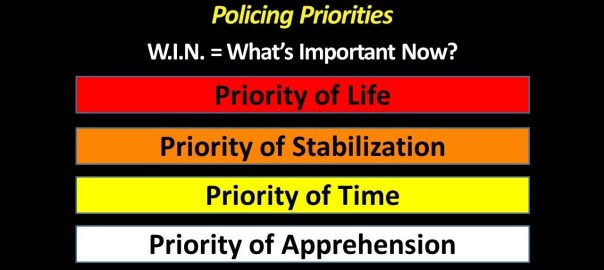
The Policing Priorities are…Slide3

  • Priority of Life
  • Priority of Stabilization
  • Priority of Time
  • Priority of Apprehension

The link below will take you to the Policing Priorities Training video. Feel free to discuss it, try to break it, and test it out. We have found that they are applicable to every call for service we respond to. Whether it is an alarm call, traffic collision, burglary in-progress, pursuit, officer involved shooting, or an active killer, they apply.

TBLL TRAINING: UTILIZING POLICING PRIORITIES (VIDEO)

Here are some related blogs that may help for deeper understanding of the Policing Priorities…

To continue building these decision-making fundamentals into the foundation of my department, the Policing Priorities are taught during Post-Academy, reinforced throughout Field Training, utilized during training modules, and then additionally reinforced with video debriefs of our own on-body camera videos demonstrating positive uses of the Policing Priorities.

If you have any questions or thoughts on the Policing Priorities, please do not hesitate to contact us. Your thoughts or comments on this blog are always appreciated either below or on our Facebook page. You can also follow us on Twitter at @tbl_leadership. Our email is tblleadership at gmail.com.

The mission at Thin Blue Line of Leadership is to inspire law enforcement supervisors to be the best leaders they can be by providing positive leadership tactics and ideas. Positive leadership and creating a positive squad culture are on-going commitments that must be nurtured and developed over time. Thin Blue Line of Leadership is here to help.

Continue saving the world one call at a time and as always, LEAD ON!