Tag Archives: leader

BRIEFING VIDEO: A Review of the Pulse Nightclub Shooting

This briefing video is the TBLL interpretation of the Pulse Nightclub after action report entitled Rescue, Response, and Resilience. This report was put out by COPS and the Police Foundation in 2017. This video tells the story of the Pulse Nightclub shooting and then reviews 10 of the top lessons learned.

To keep the video to an appropriate time frame for a briefing training, some minor details were omitted from the story and it focuses primarily on the initial response at the first responder level. There are multiple points during the video where questions are posed for the viewers to pause and have discussion about how they would respond.

The mission at Thin Blue Line of Leadership is to inspire law enforcement supervisors to be the best leaders they can be by providing positive leadership tactics and ideas. Positive leadership and creating a positive squad culture are on-going commitments that must be nurtured and developed over time. Thin Blue Line of Leadership is here to help.

Please do not hesitate to contact us if you have ideas to share or suggestions for improvement. Your thoughts or comments on this blog are always appreciated either below or on our Facebook page. You can also follow us on Twitter at @tbl_leadership.

Continue saving the world one call at a time and as always, LEAD ON!

Sergeant School Discussion Panel Key Points

One of the responsibilities of my current position is to coordinate, organize, and instruct portions of our department’s Sergeant-In-Training (SIT) School. This school is designed to introduce prospective sergeants to the basic expectations, tasks, and responsibilities of the sergeant position before they head out for a five-week sergeant field training experience.

One of the most highly regarded portions of the school are the discussion panels that we have at the end of each day. Each discussion panel is a two-hour Q & A session with a specific group to get their thoughts on the position of being a sergeant. This is an opportunity for the prospective sergeants to hear each of the group’s viewpoints at the same time. The groups for this year’s discussion panels included the Chiefs, Patrol Lieutenants, and New Sergeants.

For this Thin Blue Line Leadership blog, I want to share the top 3 keys points that came up during each group’s discussion panel.

THE CHIEFS

  • You raised your hand for this. When putting in to be a sergeant or any leadership position, you are raising your hand volunteering to take on the tasks and responsibilities of that job. No one is forcing you. It will come with both good and bad. Attack the job with the personal accountability of a leader and set the example.
  • The most difficult transition. All of the chiefs agreed that the most difficult transition they went through was from that of officer to sergeant. One day they were working alongside their squad mates as peers and then after a few supervisor classes and riding with a couple of senior sergeants they were blessed off to be sergeants themselves. They now had to see things from a slightly more elevated organizational viewpoint and this can create some challenges, if new sergeants are not prepared for it.
  • You are a part of “they” now. This is a realization that relates to the second bullet point, but is one that prospective sergeants should come into with their eyes wide open. Even in excellent organizations, there is a degree of “us” versus “them,” management versus labor. Promoting to sergeant is the first step into the world of management and meeting the standards set forth by the department’s vision, mission, and values must be at the heart of a new sergeant’s communication and leadership.

PATROL LIEUTENANTS

  • Communication is key to clearly leading up and down the chain of command. In most law enforcement organizations, the lieutenant position is the definition of middle management. They have the unique position of observing the importance of clear communication throughout the chain of command on a daily basis. They rely on sergeants to clearly communication their officer’s needs up while also counting on the sergeants to relay their communication back down to the officers. It is only through this smooth flow of information that the chiefs hear the officers and the officers hear the chiefs.
  • Make decisions. Patrol lieutenants have one primary expectation for those selected to promote to the rank of sergeant – make decisions. Over the years, those that enter the sergeant process have done so with years of experience handling calls, working on specialty units, developing resources, and forming a network of connections. They have made numerous decisions for themselves, but typically not for an entire squad under the scrutiny of everyone listening to the radio. Forget all of those extraneous factors and focus on doing the right thing, at the right time, for the right reasons.
  • Handle issues when they are small. Sergeants have the unique opportunity to develop one-on-one relationships with their officers. If time and effort are put into establishing these relationships, sergeants will know when things are off or when an officer is having an issue. Issues will typically begin in the form of small mistakes; missed deadlines, short temperament, admin problems, mistakes on typical things they do not make mistakes on, etc.  The best thing a sergeant can do is address these problems when they are small by finding the root cause. Find the root cause, help the officer through the issue, and keep it from becoming a larger problem that could affect the rest of their career. If the sergeant has established a rapport with their officers, they will understand that taking care of the small things is how they show they care.

NEW SERGEANTS

  • Humility is a must. Moving from officer to sergeant is a difficult transition for typical “Type A” personalities because no one wants to make mistakes; especially officers and detectives that have had successful careers up until promoting. The fact of the matter is that as a newly promoted sergeant, mistakes will be made. Have the humility to learn from those mistakes and get better every day; officers understand this and are willing to work with a humble sergeant.
  • There is a TON of admin to do for the benefit of your officers. The position of sergeant comes with a ton of new admin responsibilities that differ from those of being a solo officer. Primarily this admin is related to things that take care of the officers – vacation schedules, training requests, court conflicts, reading paper, etc. One of the keys to being a good, if not great sergeant, is handling all of these new admin responsibilities that primarily only benefit the officers without them ever knowing about the amount of time, effort, and energy put into doing what is right by them.
  • Actions show what you really care about. One of the key aspects of learning to be a good sergeant is understanding that a sergeant’s actions demonstrate what they really care about. Where a sergeant commits their time, effort, and energy is what officers will believe the sergeant cares about the most. Therefore, it is vital that sergeants take the time to build relationships, get to know their officers, and find ways to help their officers’ careers.

After going through each of these Discussion Panels, the observation that was consistent between the chiefs, lieutenants, and new sergeants was that being a patrol sergeant was and is by far one of the best assignments available in a police department.

The mission at Thin Blue Line of Leadership is to inspire law enforcement supervisors to be the best leaders they can be by providing positive leadership tactics and ideas. Positive leadership and creating a positive squad culture are on-going commitments that must be nurtured and developed over time. Thin Blue Line of Leadership is here to help.

Please do not hesitate to contact us if you have ideas to share or suggestions for improvement. Your thoughts or comments on this blog are always appreciated either below or on our Facebook page. You can also follow us on Twitter at @tbl_leadership.

Continue saving the world one call at a time and as always, LEAD ON!

Performance vs. Trust in Field Training

What is more important when it comes to being a good field trainer – Performance or Trust?

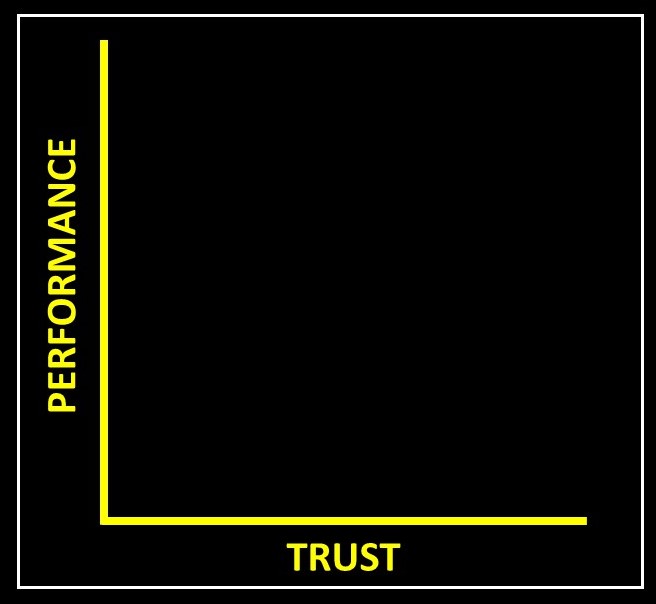
Before you answer that, let’s explore why I’m asking the question. Author and speaker Simon Sinek works regularly with the Navy Seals. During one conversation he asked them how they select who gets to go to the elite Seal Team 6 or promoted since they are all considered to be the best of the best. To answer that question, they drew a graph like the one below. (Simon Sinek Performance vs. Trust Video)

Slide1On the vertical axis they wrote “performance” and on the horizontal axis they wrote “trust.” Performance was defined as their skills and knowledge on the battlefield – shooting, tactics, orienteering, planning, endurance, etc. Trust was defined as how they are off of the battlefield – teamwork, integrity, respect, humble, etc. The Seals explained that they take each candidate and rank them on both of these criteria to see how they compare. Over time, they discovered the following…

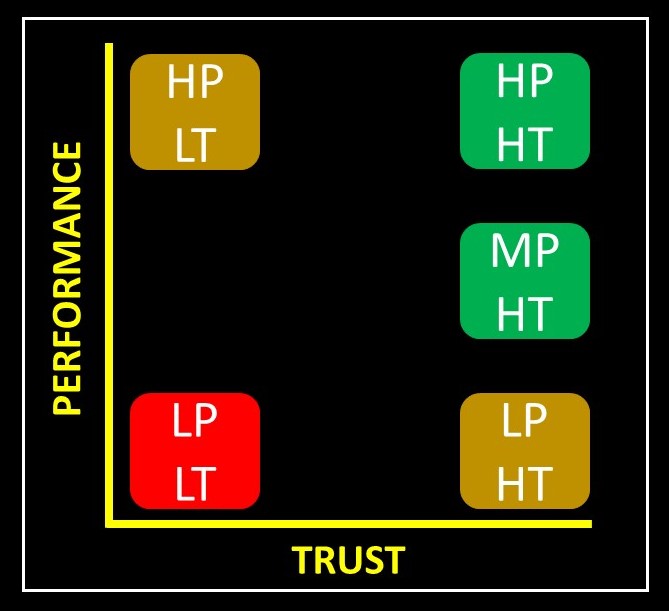
There were two candidates that were obvious. If the person was a Low Performer/Low Trust (LP/LT) they didn’t want them and if the person was a High Performer/High Trust (HP/HT) they absolutely wanted them. But, there were only so many candidates that were that clear and obvious.

Slide2It was the next choice were the Seals discovered they were initially making mistakes in their selection process. Their next choice initially was the High Performer/Low Trust (HP/LT). The person who was a “rock star” in training and on the battlefield, but outside of that they weren’t really liked or trusted. The quote the Seals used was, “I would trust them with my life, but NOT my money or my wife.” This caused many, many issues within the ranks of one of the most elite special forces units in the world.

What was their fix?

After analyzing where the mistakes were occurring, they reorganized the hierarchy of their entire selection process. Instead of taking the High Performer/Low Trust Seals, they prioritized taking the Moderate Performer/High Trust (MP/HP) individuals. They then would equally consider even a Low Performer/High Trust (LP/HT) candidate in comparison to a High Performer/Low Trust one. This was done because after years of various difficulties and failures, the Navy Seals discovered that Performance can be taught, learned, and improved. Trust can only be earned and is a much more valuable commodity when making such decisions of significance.

How does this relate to Field Training?

First, no one that works with you is going to care if you have the most tickets, most arrests, find the most drugs, take the most calls for service, or get the coolest assignment; if they don’t trust you. Do things often that build trust – back up other officers, help with impounds, take paper when you know they are down a lot . . . in other words, help other people out sometimes. That not only will help those around you, but will also make a huge difference when it comes to testing for special assignments or promotion.

Secondly, the same concept applies to the OITs (Officer-in-Training) you are training. It is great if they are a natural cop and are kicking butt through FTO (Field Training Officer), but if they are showing behaviors that make your level of trust in them diminish, then you should be cautious. Would you trust your money and spouse around them? If not, try to articulate why and document it. The FTO Program would rather remove a low trust OIT than have them make it through and be a pain for the next 25 years or until they cause a significant integrity issue of some kind.

Lastly, as a Field Training Officer, you will find that your ability to train and the success of your OITs is directly related to the level of trust you build with them during the short time you have them for training. Here are 3 tips for quickly building trust with OITs…

  1. When you first meet them, introduce yourself and explain that everything you from here on out is for their benefit to make them a successful solo capable officer. If you say it with conviction, they will believe you and you will immediately be establishing a rapport built on trust; even if you have to get on them about something.
  2. Be up front about the expectation for them to make mistakes. Explain that you would rather see them take initiative on a call for service and make a mistake; rather than, hang back waiting watching other officers do the work and not make a mistake. If you are going to be upset and/or frustrated with an OIT, be upset/frustrated at the lack of initiative, not the mistake. Training can fix the mistake. Initiative is built on trust.
  3. Take the time to introduce yourself. Tell them about your family, life outside the PD, struggles you’ve experienced, and successes you’ve had. Then ask them about who they are. What is their family situation, what did they do before coming to SPD, why do they want to be a cop, what has been the hardest for them in FTO so far, how are they adjusting to shift work, etc. You never know where those conversation will go. OITs have to know you care about them before they will ever care about what you have to teach them. TRUST > PERFORMANCE

The mission at Thin Blue Line of Leadership is to inspire law enforcement supervisors to be the best leaders they can be by providing positive leadership tactics and ideas. Positive leadership and creating a positive squad culture are on-going commitments that must be nurtured and developed over time. Thin Blue Line of Leadership is here to help.

Please do not hesitate to contact us if you have ideas to share or suggestions for improvement. Your thoughts or comments on this blog are always appreciated either below or on our Facebook page. You can also follow us on Twitter at @tbl_leadership.

Continue saving the world one call at a time and as always, LEAD ON!


What Will Your Verse Be?

My police department has had its ups and downs. At this time, we happen to be in a down. Below is a note I sent to Field Training Officers because my gut told me it was needed…


“The powerful play goes on and you can contribute a verse…

What will your verse be?”   ~Dead Poets Society

THE POWERFUL PLAY GOES ON: The powerful play called life goes on and on and on. Regardless of all the “stuff” that happens within an organization, things always continue moving forward. You know the “stuff” I’m referring to, it gets talked about in-between calls, while writing paper in a beat office, or shows up on the 10 o’clock news. We have zero control over those things. What I do know is that we have an incredible team of people that have taken on the responsibility of being Field Training Officers and that team is actively creating our next generation law enforcement officers.

YOU CAN CONTRIBUTE A VERSE: With every trainee you are assigned, you have the opportunity to contribute a verse which may last over the next 5, 10, 15, or 25 years. The value of that verse cannot be overstated. Look around you and decide right now what kind of officers you want to work with on your squad. Do you want to work with mopey, victims of circumstance that HAVE TO be here or do you want to work with positive, solution-focused officers that WANT TO be here? That is the verse that you, more than anyone else in this department, gets to contribute. If not for the organization, then for your squad, your team, your family.

WHAT WILL YOUR VERSE BE?: In this entire world there are only three things you truly control. Your actions. Your attitude. Your effort. Every challenge we face at work, at home, or in life can be made simpler by attacking it head-on with those three things. What are the actions I need to take? What is the attitude I need to have? How much effort am I willing to expend to be successful? I challenge you to consider these aspects as you decide what your verse will be. What are you willing to contribute to the success of another person? What are you willing to contribute to the success of your next backup officer?

As Field Training Officers, you have a tremendous amount of influence by contributing a verse to the organization one trainee at a time. They look up to you, they envy you, they want to be just like you because you make this very complex profession look easy.

Thank you for everything you do and everything you are going to do!


As leaders, I encourage you to follow your leadership instincts. When you feel that things are off and something encouraging needs to be said, follow that instinct. You never know who you may inspire during that tough time…

The mission at Thin Blue Line of Leadership is to inspire law enforcement supervisors to be the best leaders they can be by providing positive leadership tactics and ideas. Positive leadership and creating a positive squad culture are on-going commitments that must be nurtured and developed over time. Thin Blue Line of Leadership is here to help.

Please do not hesitate to contact us if you have ideas to share or suggestions for improvement. Your thoughts or comments on this blog are always appreciated either below or on our Facebook page. You can also follow us on Twitter at @tbl_leadership.

Continue saving the world one call at a time and as always, LEAD ON!


Defining the TBL Leader

The mission at Thin Blue Line of Leadership is to share positive leadership tactics with the field of law enforcement. It is undeniable that law enforcement is a unique working environment and one in which the word positive is not always easily associated. Law enforcement is not just about laws and policies. It is about the community – victims, civilians, officers, and even the criminals. So, bringing the word “positive” more frequently into law enforcement is a necessity because policing is about people. This belief must be a core value of any Thin Blue Line Leader before delving into a deeper list of qualities.

Leadership comes in many different styles. When it comes to developing one’s own style of leadership, it is most common to emulate leaders that had a significant influence on you either personally or professionally. These role-models of leadership won your heart and then were able to influence your mind.

Here are 10 qualities that define a Thin Blue Line Leader . . .

WINNING RESPECT  – Getting people to listen.

1. Competence – Being competent should be a given. Knowing basic and advanced techniques along with any specialty knowledge/skills you possess starts building your officers’ views of your competency. Do not assume that reputation alone will carry you. Accurately recognizing your own strengths and weaknesses will assist you in developing your competency across the board. A TBL Leader proves their competency from call to call and shift to shift.

2. Integrity and Honesty – Most people would say that integrity and honesty are the same thing, but let’s define it more specifically. Integrity is when your actions match your words. Honesty is when your words match your actions.  Law enforcement officers are constantly in situations and circumstances that test their integrity and honesty. A TBL Leader exemplifies this by holding themselves and their officers to a standard that is above reproach.

3. Initiative – Do not stand still. Leaders with initiative constantly ask why something is the way it is, can it be improved, and what can I do to help. Just assuming that things are fine because “that’s how we’ve always done it” leads to stagnation and mediocrity. Regardless of the time and effort required, the TBL Leader is always looking for innovative ways to improve themselves, their officers, their department, and their community.

WINNING HEARTS – Getting people to believe.

4. Servant – This is not to be confused with subservient. A servant leader recognizes that as a leader they have taken on the responsibility of being selfless for the good of their officers. It is no longer just about your career, but lifting up your officers in their careers. TBL Leaders find ways to make their officers’ jobs easier by providing them with resources, training, and guidance.

5. Authentic – Be yourself. Arrogance and false bravado will build a wall between you and your officers that will make leading effectively much more difficult. Share your experience openly from both law enforcement and your personal life. Talking about things like your marriage, children, hobbies, or pets allows those you lead to gain insight into your belief structure. If you make a mistake, own up to it and set the example by seeking to improve. You are still human and no one, regardless of your rank, expects you to be perfect at all times. TBL Leaders recognize that when it comes to being authentic, you get what you give.

6. Supportive – Being supportive starts by opening your ears. As a leader, you have to listen, recognize, validate, and only then act. Clear communication with your officers will give you all the information you need to proceed with a course of action. Standing up for your officers, when in the right, is a must because TBL Leaders are the glue that holds a team together.

7. Passionate – Passion should be encourage and never discouraged as long as it is appropriately directed. By setting a clear vision and mission for your squad, the leader creates focus and defines what winning looks like. Police officers like to win and the more they win, the more passion that is generated. TBL Leaders do not fear passion; they work tirelessly to create an environment that generates and feeds off of it.

8. Rewarding – Catching your officers doing something right should be an on-going goal of a leader. Too often, excessive amounts of time and energy are wasted searching for things that are done wrong and rewarding what gets done right gets overlooked. Obviously, serious malfunctions in officer safety or investigations need to be addressed, but there is always a way to address this so it does not destroy the officer’s morale or belief in the mission. TBL Leaders realize that rewarding officers positively reinforces and defines the behaviors that you, the leader, want to promote.

WINNING MINDS – Getting people to change.

9. Learner/Educator – Learner and educator go hand in hand. A leader must be a life-long learner. Personal experience will only hold out so long before you are just repeating yourself over and over. Taking the initiative to seek out new information and experiences will allow you to continue growing. Then, as the leader, you must be willing to share and teach what you have learned so the development of those you are responsible for can continue. No one is an expert in everything. Use your network of resources within the department to find experts in areas where you are weak. The TBL Leader recognizes the great value of learning, but realizes that it is most valuable only when it is disseminated.

10. Translator – As a leader, being a good communicator is vital, but more important than communication is the ability to receive information and translate it into support for the vision and mission of your team. As a first-line supervisor, you are the translation conduit between information coming from upper staff and those on your team. The way in which you respond to and present the information you are given will dictate your officers’ response to it. TBL Leaders recognize the power of translation and are clear and direct in their messages.

These 10 qualities define a Thin Blue Line Leader. Thin Blue Line of Leadership can be reached at tblleadership@gmail.com for any questions, comments, or suggestions. You can Like us on Facebook now, as well.

LEAD ON!

Leading with P-R-I-D-E

“Leadership is influence; nothing more, nothing less.”  ~ John Maxwell

The most fundamental building block of policing is decision-making.

  • Make contact or leave the person alone?
  • Ask or command?
  • Search or don’t search?
  • Arrest or don’t arrest?
  • Shoot or don’t shoot?

These are just a few examples of major decisions made by officers every day regarding issues of communication, search/seizure, legal authority, and use of force. These decisions, along with a multitude of lesser ones, get them through each shift – most of the time good, sometimes not so good dependent upon their decision-making. Law enforcement leaders must understand how they influence officer decision-making because safety, public trust, and lives are on the line. To put it bluntly, law enforcement leaders must learn to lead with P-R-I-D-E.

Policing is a very complicated profession and inevitably mistakes are going to happen. Therefore, law enforcement leaders must proactively discuss decision-making with their officers in terms of the process, not just in terms of right or wrong after the fact. While officers makes their own individual decisions, it is the leader that creates the environment they work in. That environment can either nurture or devastate good decision-making.

pride

Part of the P-R-I-D-E Adaptive Decision-Making Model is a large blue circle with the following words written around it: Culture, Mission, Goals, and Why. This is the Leadership Circle. All decisions are influenced by this circle because culture, mission, goals, and why create the lens through which officers view their policing world. This is how law enforcement leaders influence and manage officer decision-making in advance of them having to make those critical decisions in the moment.

If there is a squad of lazy, negative officers that are constantly having issues, it is absolutely related to the environment allowed to exist by their “leader.” If there is a squad of hard working, positive officers that are constantly being recognized for their excellent work, it is related to the environment created by their leader.

CULTURE: Culture is simply defined as the prevailing actions and attitudes of a group over time. The leader of a group must play a significant role in setting the culture. The key to setting a culture is that the leader knows what they want their culture to be. Once the desired culture is defined, then the leader must identify ways to repeat, recognize, and then reinforce actions and attitudes that promote that culture. If a leader fails to define and implement their desired culture, then another one will form and the leader is no longer leading. For more on culture development, see our blog “Culture in Just 4 Words.”

MISSION: Mission starts with the department’s mission statement which is usually posted on a wall somewhere. Leaders must find ways to take the words off of the poster and make them part of the culture as defined above. On a smaller scale, each call for service officers respond to has its own more specific mission. Identifying the purpose of a mission is a must for operational success. Many times, the mission can be defined by the role(s) that must be played by the officer in order to achieve a successful outcome. Does this call need a guardian, a warrior, a caretaker, a social worker, or an enforcer? Understanding large scale and small scale missions is important to good decision-making because mission sets the vision. For more on mission, see our blog “Shifting Gears in Policing.”

GOALS: Goals can exist on multiple levels; for example, department goals and personal goals. Many departments set goals for their officers with the intention of creating a method for tracking their officers’ activity or productivity. Where many departments fail with goal setting is that they set arbitrary goals that are not tied to their mission. In other words, there is no understanding as to why the goals exist or the purpose they serve. Department goals must be tightly correlated to the department mission to give them meaning to the officers and to provide meaningful information to upper staff. Personal goals should be set by the officers and related to their desired career path. Their career path sets a long-term vision which enables the officer, hopefully with the assistance of their leader, to determine specific goals that can be worked on each shift. Meeting incremental personal goals are the building blocks to an officer getting where they eventually want to go within the department. Leaders should put this into perspective for their officers so they understand that each shift is essentially part of the interview for their job of the future.

WHY: No one goes into law enforcement because they are going to get rich or be famous. Deep down there is something special in each person that decides to pin on a badge that drives them to run towards conflict, put their lives on the line, and serve a community. Whatever the reason, that is their personal why. The why fuels the fire to continue working when times get hard and empowers officers to go above and beyond when those opportunities exist. Law enforcement leaders must help officers identify their why, be able to articulate it, and help them hold tight to it for the entirety of their career.  For more on why, see our blog “HELP WANTED: Police Officers.”

When a person chooses to promote within a law enforcement organization, they essentially have raised their hand and said, “I’m willing to lead.” It is not permission to do less, but a mandate to do more. Leading takes effort. Leading takes skill. Leading takes caring. Leading takes passion. To build influence in officer decision-making, those that promote must stand up and lead. They must create environments that focus on culture, mission, goals, and why. The leaders that take the time and make the effort to create these positive environments will be rewarded by the outcomes seen in their officers’ decision-making and they will spend less time running around putting out fires created by a bad environment.

The mission at Thin Blue Line of Leadership is to inspire law enforcement supervisors to be the best leaders they can be by providing positive leadership tactics and ideas. Positive leadership and creating a positive squad culture are on-going commitments that must be nurtured and developed over time. Thin Blue Line of Leadership is here to help.

Please do not hesitate to contact us if you have ideas to share or suggestions for improvement. Your thoughts or comments on this blog are always appreciated either below or on our Facebook page. You can also follow us on Twitter at @tbl_leadership.

Continue saving the world one call at a time and as always, LEAD ON!

Small Words, BIG MESSAGE

Yesterday morning, I went out for my typical run before the blazing Arizona sun made it unbearable. After a year or so of consistent running, I have finally gotten to the point that I can actually think while I’m running hard. So, when I veered off my regular route to break routine, I ran by a church that I normally would never see and noticed a sign similar to the one pictured above. That sign definitely got me thinking throughout the rest of my run and even into the next morning which is why I am writing this.

The sign is placed directly in front of the main doors of the sanctuary. It is at the head of the closest parking stall in a rather large parking lot. This parking spot was even closer to the church entrance than 5 handicapped stalls. By the way, the pastor lives in the house directly behind the sanctuary…

Please do not think this blog is a bash on religion, any specific religious organization, or religious leaders. This could have been in front of any number of organizations, including a police department. The one I saw just happened to be in front of a church.

For the rest of my run, I could not help but to ponder all of the small words and/or actions that have big messages. We, as law enforcement leaders, must be cautious of even the smallest words and actions we say or do. In the moment, we may not recognize the perception and meaning granted to them by others.

  • Do we take the newest car in the fleet or do we have the oldest?
  • Do we hold doors open for people or expect them to open them for us?
  • Do we go to others to interact or expect them to come to us?
  • Do we train with our officers or do we have our own “special” training?
  • Do we expect others to put their phones down when we speak, but don’t do the same for them?
  • Do we park in the closest spot to the front doors or leave it open for others?

I challenge every leader that reads this blog to slow down their thinking and explore what small words or actions may be sending big messages to those around you. As easy as it is to assume these messages are all negative, understand that doing the opposite of the things listed above are small things that can have a significant positive impact on those around you.

The mission at Thin Blue Line of Leadership is to inspire law enforcement supervisors to be the best leaders they can be by providing positive leadership and culture development tactics. Positive leadership and creating a positive squad culture are on-going commitments that must be nurtured and developed over time.

Thin Blue Line of Leadership is here to help. Continue reading our Twitter feed and check out our other blogs for tactics on creating positive culture. Share your thoughts or comments on this blog below or on our Facebook page. You can also follow us on Twitter at @tbl_leadership.

Continue saving the world one call at a time and as always, LEAD ON!

10 Tips for New Sergeants

For the last 8 years, I have been a Field Training Sergeant. It is truly a pleasure knowing that I am having an impact on the future of my police department by training these new leaders. I see this responsibility as a vital one. If I do not do a good job, I am not just affecting that new sergeant, but every officer that serves on his or her squad.

Just so we are on the same page, here is how my department handles sergeant training. Sergeant field training is a 5 week process – 2 weeks with one training sergeant, 2 weeks with a different training sergeant, and then one final week back with the first training sergeant. At the end of each shift, the Field Training Sergeant completes a daily observation report (similar to FTO) that summarizes and scores everything the prospective new sergeant did throughout that shift. While writing these daily observation reports, I have noticed that there are certain bits of advice that I seem to be repeatedly writing for every sergeant I help train.

So, here are my 10 tips for new sergeants . . .

  1. Successful sergeants spend 80% of their time working with people and 20% doing everything else. Sergeants that fail to inspire, have a poor squad culture, and breed negative officers focus more on everything else rather than people and building relationships.
  2. Successful sergeants find ways to teach their officers to be adaptive decision-makers; not robots that only understand how to solve problems with checklists. When opportunities present themselves, sergeants explain their process for making difficult decisions and everything they took into account. Then, when their officers face similar situations they have been taught to apply their own similar process.
  3. Successful sergeants never waste briefing time. There is always something that could be discussed, debated, trained, or learned in briefing. This is one of the few opportunities when sergeants have their entire squad’s attention at the same time; make the most of it.
  4. Successful sergeants understand that policing is a complicated profession. Both sergeants and their officers are going to make mistakes at some point. Do not hide mistakes, share them openly and turn them into learning opportunities focused on improvement. Mistakes are fine, just don’t make the same one twice.
  5. Successful sergeants recognize, reward, and promote good police work by their officers. They use whatever methods are available at their department to make this happen anytime an officer goes above and beyond. Not only does this create a more positive culture, but it also spurs on more officers to look for opportunities to go above and beyond. What a sergeant rewards will be repeated.
  6. Successful sergeants have a vision of the culture they want to have on their squad. Squad culture is defined as the conglomeration of your officers’ actions, attitude, and effort. If you asked another sergeant to describe your squad in 4 words, what words would they use? That is your culture. If you don’t like those words, do something about it.
  7. Successful sergeants do not lead from their desks. They get out on the road with their officers and find ways to serve them throughout each shift. They never believe themselves to be too good for the “grunt” work of being a patrol officer; they get in there and get their hands dirty occasionally.
  8. Successful sergeants recognize that their actions, attitude, and effort tell their officers what is important to them. If a sergeant speaks negatively about their schedule, some situation at the department, or some aspect of the job, then don’t be surprised when the officers have that same opinion or are representing that opinion openly. Negativity breeds negativity.
  9. Successful sergeants know what they do not know, then they find ways to compensate for those areas. If they are not good at tactical situations, they talk to the department’s SWAT officers about various scenarios and how they would handle them. If they are not good at traffic or investigations, they build relationships with motors or detectives that are respected. The most important aspect of this tip is that a sergeant never fakes knowledge and gives bad advice to an officer. This will kill their credibility. If an officer has a question that the sergeant does not know the answer to, the best thing they can do is say, “That is a great question, I don’t know, but I know someone who will. Standby and I’ll call you right back.”
  10. Successful sergeants never allow themselves or their officers to stop learning. The minute a sergeant thinks they know it all is the moment they begin sliding towards mediocrity. A sergeant values training and realizes that the more training they can get for their officers, the better their officers will be on the road.

Got a tip you would give to a new sergeant?

The mission at Thin Blue Line of Leadership is to inspire law enforcement supervisors to be the best leaders they can be by providing positive leadership tactics and ideas. Positive leadership and creating a positive squad culture are on-going commitments that must be nurtured and developed over time. Thin Blue Line of Leadership is here to help.

Please do not hesitate to contact us if you have ideas to share or suggestions for improvement. Your thoughts or comments on this blog are always appreciated either below or on our Facebook page. You can also follow us on Twitter at @tbl_leadership.

Continue saving the world one call at a time and as always, LEAD ON!

3 Signs of a Miserable Law Enforcement Job

“High school kids at In-N-Out Burger and Chick-fil-A are doing largely the same job that kids at any other fast-food restaurant are doing, and yet there are a lot fewer miserable jobs at In-N-Out and Chick-fil-A. The difference is not the job itself. It is the management. And one of the most important things that managers must do is help employees see why their work matters to someone. Even if this sounds touchy-feely to some, it is a fundamental part of human nature.”     – Patrick Lencioni

3signs

The premise of the book “Three Signs of a Miserable Job” by Patrick Lencioni is simply this – staying in a miserable job can have severely negative consequences on a person mentally, physically, and emotionally. These consequences can affect a person’s life both personally and professionally and it does not have to be that way. The good news is that, as supervisors, we have the ability to combat the 3 signs of a miserable job and it really is not that complicated.

Here are the 3 signs of a miserable job . . .

  1. ANONYMITY

“People cannot be fulfilled in their work if they are not known. All human beings need to be understood and appreciated for their unique qualities by someone in a position of authority. . . . People who see themselves as invisible, generic, or anonymous cannot love their jobs, no matter what they are doing.”

  1. IRRELEVANCE

“Everyone needs to know that their job matters, to someone. Anyone. Without seeing a connection between the work and the satisfaction of another person or group of people, an employee simply will not find lasting fulfillment. Even the most cynical employees need to know that their work matters to someone, even if it’s just the boss.”

  1. IMMEASUREABILITY

“Employees need to be able to gauge their progress and level of contribution for themselves. They cannot be fulfilled in their work if their success depends on the opinions or whims of another person, no matter how benevolent that person may be. Without a tangible means for assessing success or failure, motivation eventually deteriorates as people see themselves as unable to control their own fate.”

In relation to law enforcement, if an officer is miserable in their job due to the factors of anonymity, irrelevance, and immeasurability, then what is the cost to them personally, their squad, their department, and the community they are supposed to be serving? Personally, they carry their misery home which adversely affects their family life. They become the salty grump in the back of the briefing room that complains about everything and sucks the energy out of all around them. To the department they are a liability because of the negative impact on the culture and the unpredictability of their actions on the road. The community suffers because the miserable officer represents the worst of the police department which erodes public trust and makes the job that much more difficult for the officers that are not miserable. How many officers are you picturing in your head right now that match this description of a miserable officer?

Here are 25 ways law enforcement supervisors can combat anonymity, irrelevance, and immeasurability . . .

ANONYMITY

  1. Create a team atmosphere within the squad where it is believed that we is greater than I.
  2. When you get a new officer, meet with them individually and get them on board with the squad culture from day one.
  3. Recognize good police work in briefing. What you reward will be repeated.
  4. Have officers debrief good calls for service and share their expertise and successes with others.
  5. Get out of the office and on the road with your officers. Try to get on a call for service or backup each of your officers during each shift, if time allows.
  6. Rotating having officers conduct briefing training based upon their policing strengths and interests.
  7. Meet with officers regularly to discuss their career goals and seek out opportunities to help them fulfill those goals.
  8. Get to know your officers’ families. Create opportunities for them to all get together with the other families of the squad.
  9. Send handwritten thank you notes to your officers’ spouses or significant others to let them know that you appreciate the commitment that the families make to law enforcement, too.

IRRELEVANCE

  1. Making policing relevant is about getting back to the “why.” Know why you chose to become a police officer. Know why you chose to be a supervisor. Share your why with your officers. Get to know their why, find opportunities to relate their why to calls for service, and discuss the relationship in briefing.
  2. As a supervisor, you set the tone and create value in community service. If it is important to you, it will be important to them.
  3. Promote public commendations in briefing by reading them aloud for all your officers to hear.
  4. Teach your officers to be good beat cops and take pride in their assigned part of the city.
  5. Get away from the term customer service and focus on community service. The term customer service cheapen what we do as police officers and builds irrelevance.
  6. Have discussions in briefing regarding who your officers serve. Point out that they serve not only the community, but they also serve each other. Discuss that you, the supervisor, are there to serve them.
  7. Teach your squad to have a focus on finding solutions while on calls for serve; not on producing statistics, being a band aid, or handling them as quickly as possible.
  8. Exemplify and promote a culture of positivity on your squad through your actions, attitude, and effort.
  9. Provide good feedback and evaluations to your officers. In return, ask for them to do the same for you.

IMMEASUREABILITY

Of the 3 signs of a miserable job, immeasureability is the most difficult for law enforcement supervisors to deal with directly. There is no limit to the number of statistics that can be measured for each officer: calls for service responded to, self-initiated activities, arrests made, tickets written, response times, amount of time spent on each call, number of community policing activities, etc. The question becomes, are we measuring the right things?

  1. Clearly define what the “rock star” police officer would do on a “perfect” shift based upon the mission, vision, and operational goals of the department.
  2. Determine what statistics officers and/or the department have the ability to capture that correspond to the “perfect” shift. If part of the “perfect” shift includes community policing and/or positive interactions with the community, then a way to count those interactions must be determined, as well.
  3. Set specific goals based upon what the “perfect” shift would look like that clearly define what success looks like for officers and provide them with a way to track those numbers.
  4. Ultimately, whatever is chosen to be measured must be supported by the officers’ direct supervisors because the direct supervisors will give the statistics being measure their value.
  5. Supervisors must assist officers in seeing the positive perspective to their seemingly negative activities like making arrests or writing tickets.
  6. The question to be answered is how do you measure community policing activity effectiveness? Do you count the number of positive citizen commendations, the number of people that say “thank you” after being arrested/written a ticket, or the amount of time dedicated to solving beat problems? This is where the difficulty in the measurability of policing comes into play and must be answered by departments everywhere.

There are many more ways to combat anonymity, irrelevance, and immeasurability in policing. If these 3 signs of a miserable job are not addressed by law enforcement supervisors, then they will have to deal with the miserable officers they are allowing to be created.

“If you’re still not convinced that this makes sense or that it applied to you, this would be a good time to consider resigning your position as a manager and finding a role as an individual contributor.”  – Patrick Lencioni

The mission at Thin Blue Line of Leadership is to inspire law enforcement supervisors to be the best leaders they can be by providing positive leadership tactics and ideas. Positive leadership and creating a positive squad culture are on-going commitments that must be nurtured and developed over time. Thin Blue Line of Leadership is here to help.

Please do not hesitate to contact us if you have ideas to share or suggestions for improvement. Your thoughts or comments on this blog are always appreciated either below or on our Facebook page. You can also follow us on Twitter at @tbl_leadership.

Continue saving the world one call at a time and as always, LEAD ON!

10 Steps for Teaching Leadership in Law Enforcement – Part 2

10 Steps

This is Part 2 of 10 Steps for Teaching Leadership in Law Enforcement. To read Part 1, click here.

  1. Leadership-Based Promotional Processes

When it comes to promoting higher in rank, every department seems to have their own unique process; usually some combination of written tests, assessment centers, oral boards, etc. Most of these evaluation tools focus more on the managerial qualities of rank rather than leadership qualities. In order to promote the continual learning of leadership, promotional processes must be based upon leadership demonstrated in the past, present, and most likely into the future. That is what a leadership-based promotional process must be based upon; the prediction of continued leadership into the future. I will not attempt to give a generic process that a law enforcement agency should duplicate, but I will try to make a few points that any agency could focus their process upon in their own way.

(1) How has the promotional candidate represented the definition of leadership as described in Step #2 in their current and past assignments?

(2) Has the promotional candidate contributed to the future of the agency as a Field Training Officer and how have their Officers-In-Training turned out?

(3) Is the promotional candidate an instructor of anything; do they share their knowledge and expertise with others to make those around them stronger?

(4) How has the promotional candidate responded to failure and/or correction in the past?

(5) How does the promotional candidate make others feel around them?

(6) Does the promotional candidate lean more towards being an optimist or a pessimist?

(7) Has the promotional candidate shown an ability to bring a team or squad together?

If an agency creates a process that focuses on these 7 questions, they will identify the future leaders that should be promoting and those who should not.

  1. Leadership-Based Sergeant Training Program

First-line supervisors have the most direct influence on their officers and sworn officers make up the largest percentage of any law enforcement agency. Even though sergeant is typically the lowest rank of official promotion, this influence gives them a great deal of power within the organization and in the development of the department’s culture. Therefore, it is imperative that law enforcement agencies have a well thought out leadership-based sergeant training program. The word sergeant comes from the Latin term “serviens” which means “one who serves” and it is important that a sergeant training program emphasizes this belief for the good of the department and the continuous teaching of leadership. Creating a Sergeant-In-Training (SIT) Program for officers that are seeking promotion which occurs prior to promotion and mimics a Field Training Officer Program, provides the agency with consistency in training among their leadership ranks. A good Sergeant-In-Training Program should be built upon the department’s definition of leadership. As the sergeant-in-training progresses through the phases of the SIT Program, the experienced training sergeant must ensure that the SIT adheres to the department’s definition of leadership in their decision-making, interactions with officers, running of critical incidents, and in all other duties of a sergeant. In these actions they will be evaluated and only upon successful completion of the Sergeant-In-Training Program will they officially promote.

  1. Experience on Rookie Schedules

The most easily influenced officers within an agency are the rookies. They come out of the academy full of piss and vinegar ready to save the world only to realize once they step foot on the streets that they really do not know nearly as much as they thought they did. Upon making this humbling realization, they become the most malleable officers with the entire department. Therefore, if there are schedules (ie. nights and weekends) within the agency where rookie officers conglomerate due to their lack of seniority, then there must be a mechanism in place to exemplify the application of the department’s definition of leadership as they learn to work within their new world as police officers. It is vital to have sergeants and hopefully a couple of experienced officers, possibly FTOs, they can work alongside that represent the highest standards of leadership within the agency. Having these models for rookies to watch and emulate at the early stages of their careers perpetuates both the desired culture and leadership style of the department. If change is sought within an agency, start by influencing the rookies. Over the long run, the rookies will work their way through the years of their careers and possible promotion to eventually complete the cycle of teaching leadership throughout the various schedules and ranks of the department.

  1. Mentorship at All Levels of Command

In order to support the department’s definition of leadership at all levels, there must be a trickle-down effect of mentorship. With a single, consistent message being passed through the ranks, the cycle of leadership will be further disseminated. Experienced officers should mentor newer officers. Sergeants should mentor their experienced officers. Lieutenants should mentor their sergeants and so on throughout the agency’s ranks. The key is that the agency’s definition of leadership must be the one consistent message throughout. (Example “Trickle-Down Leadership”)

  1. 360 Evaluations & Feedback

The final step for teaching leadership in law enforcement creates the guidelines for making sure all involved in the teaching of leadership remain true to the message. Having an evaluation system established that takes into account the perspectives of those above, at, and below each rank in the chain of command will provide the feedback necessary to motivate leaders to stay true to the department’s definition of leadership. True leaders should not fear what they may hear from those they work with and around in their evaluations, if they have been true leaders directed by the definition of leadership put forward by the department. They welcome the feedback and opportunity to learn and improve as leaders. If evaluations of a leader are negative, then that should serve as an arrow pointing out the direction in which additional leadership training and mentorship should take place. If negative feedback continues after additional training and mentorship have been given, then consideration should be made into whether or not the department wants that leader to remain in a leadership position because it will be at the expense of those they are supposed to be leading. These evaluations need to be active and on-going. Receiving feedback once a year is not nearly enough to provide an accurate guide for leadership. Once a quarter would provide a more regular supply of information, but the key is that the evaluation process must be quick and simple. A time consuming evaluation process done 4 times a year would do nothing but add more paperwork to an already administratively burdened profession. The key to having success with this type of process is that the definition of leadership is clear, trust in the process is developed, and an environment of education and learning is supported.

By implementing these 10 steps to teach leadership in law enforcement, the department gains a clear and concise message of leadership throughout the organization. Once all ranks within the department share the same message, the effort needed to sustain this culture of leadership will lessen. Inspired leaders will inspire officers which will improve policing and thus improve the community they serve.

The mission at Thin Blue Line of Leadership is to inspire law enforcement supervisors to be the best leaders they can be by providing positive leadership tactics and ideas. Positive leadership and creating a positive squad culture are on-going commitments that must be nurtured and developed over time. Thin Blue Line of Leadership is here to help.

Please do not hesitate to contact us if you have ideas to share or suggestions for improvement. Your thoughts or comments on this blog are always appreciated either below or on our Facebook page. You can also follow us on Twitter at @tbl_leadership.

Continue saving the world one call at a time and as always, LEAD ON!